

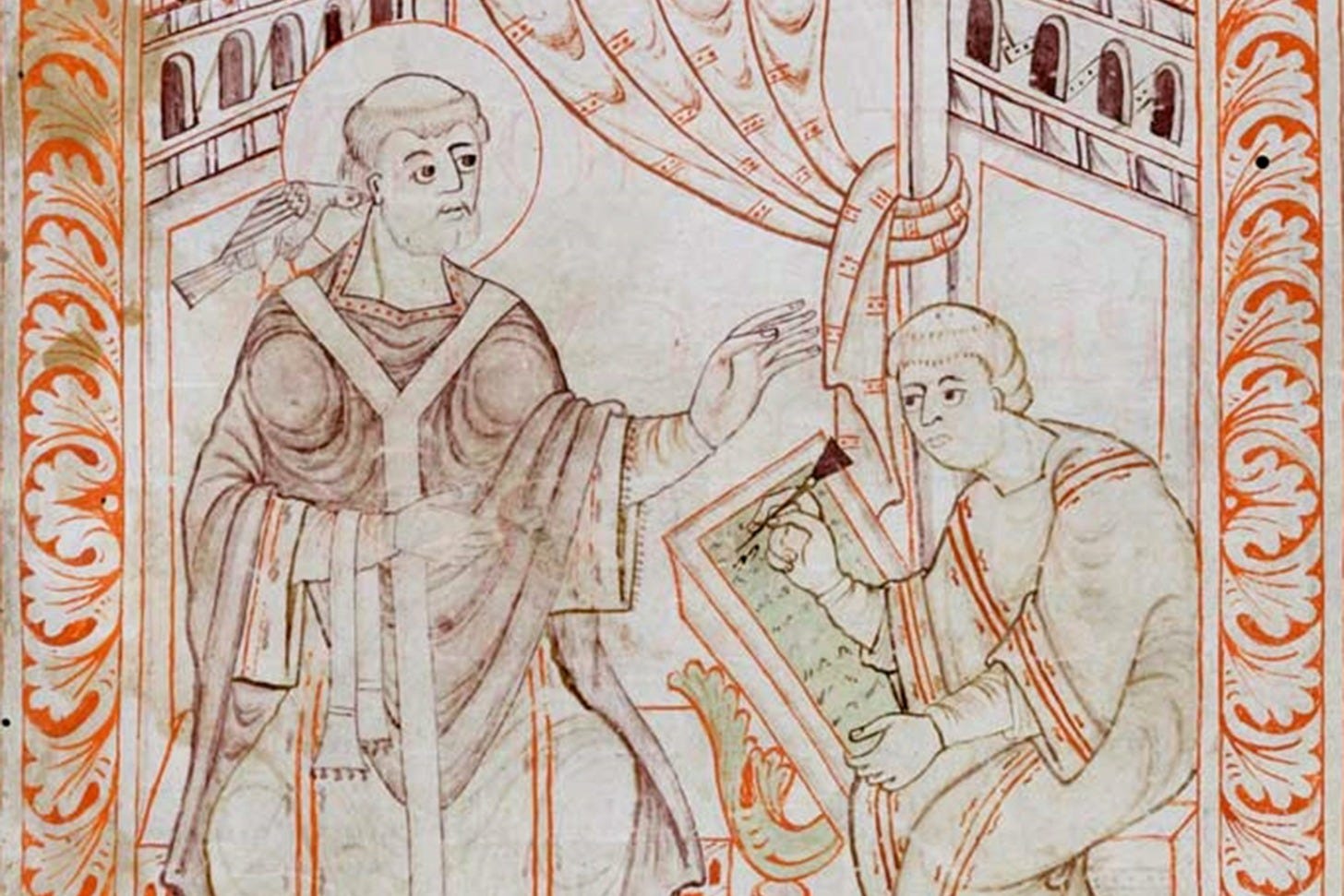
Gregory the Great Dictating Chant | Hartker Antiphonary, St. Gall, ca. 1000 CE (detail)
Why did Charlemagne want every church to sing the same way?
Key Terms for this Lesson
Gregorian Chant · Monophony · Neumes
The Roman Chant Comes North | 754–850 CE
The development of music at this time is closely tied to the Church. Since the apostles, Christians had sung the Psalms, led by a cantor and answered by the congregation (cf. Sec. 10.4). But every region sang its own way. Rome had one body of chant, and the Franks had another.
In 754 CE, Pope Stephen II crossed the Alps to ask Pepin the Short for protection (cf. Sec. 12.1). The Franks heard the Roman singers in the pope’s company, and Pepin set out to make Frankish churches sing as Rome did. His son finished the work. In 789 CE, Charlemagne ordered his clergy to learn the Roman chant fully (Admonitio Generalis 80), as his father had done “for the sake of unanimity with the apostolic see and the peaceful concord of God’s holy Church” (my translation). Einhard adds that the king “carefully reformed the manner of reading and singing,” though he “never read publicly himself, nor sang except in a low voice, and with the rest of the congregation” (Life of Charlemagne 26, trans. A. J. Grant).
Why? One empire, one Church, one song. Charlemagne’s reign saw many aspects of religious life standardized: the Rule for monks (made binding under his son, cf. Sec. 12.3), the Bible’s text, the script it was copied in (cf. Sec. 12.4), and the music of worship. A monk at Aachen and a monk in Lombardy were meant to sing the same Psalm to the same melody on the same day.
The repertory that grew from this Frankish-Roman meeting is Gregorian chant, the unaccompanied Latin song of the Western Church’s worship. It is named for Gregory the Great (d. 604 CE) (cf. Sec. 12.3). Later legend held that the Holy Spirit, in the form of a dove, sang the melodies into his ear while a scribe wrote them down, the scene in this lesson’s header. Historians date the chant as it was sung in the Middle Ages to two centuries after Gregory, in the Carolingian churches.
The Sound of Chant | Monophony & the Modes
Of the three elements of most Western music (melody, harmony, and rhythm), only melody is fully present in chant. There is no harmony, and there is no steady beat: the rhythm follows the Latin words. Gregorian chant is sung in monophony, a single melodic line, whether one voice sings it or a hundred voices sing it together. And it is sung a cappella (It. in the manner of the chapel), with no instruments, only voices (cf. Sec. 10.4).
The words come first. A syllabic chant gives each syllable one note, so the text stays clear. A melismatic chant stretches one syllable over many notes: the last a of an Alleluia can run for thirty notes or more. Medieval theorists sorted the melodies into eight church modes, named for the Greek modes (cf. Sec. 6.4), though the scales themselves were not the same. Like the Qur’an’s tajwid (cf. Sec. 11.5) and the Vedas chanted on fixed pitches (cf. Sec. 4.2), chant is sacred text carried on a voice.
Chant filled the monastery’s day. Benedict’s monks sang all 150 Psalms each week (cf. Sec. 12.3), often in two choirs facing each other across the church and trading verses in antiphony (cf. Sec. 10.4).
Neumes | ca. 850–1030 CE
A problem remained. How do you teach the same melodies to an entire empire when no one can write music down? A century and a half before Charlemagne, Isidore of Seville (d. 636 CE) had said plainly that it could not be done:
For unless sounds are held in memory by a person, they perish, because they cannot be written. Etymologies (3.15.2, my translation)
A singer learned the chant by ear, from a teacher, over years. In the 800s, Frankish singers began writing neumes above the words, small marks that show the melody’s rise and fall (Gr. neuma, a gesture or sign). The earliest neumes did not give exact pitches. They reminded a singer how a melody he already knew should move. One of the finest early books of them, the Cantatorium of St. Gall, was copied around 920 CE.
Around 1030, an Italian monk, Guido of Arezzo (d. after 1033), placed the neumes on lines a third apart, so each note had a fixed pitch. He taught his choirboys to remember the steps of the scale from a hymn whose lines began ut, re, mi, fa, sol, la. Students still sing those syllables today as do-re-mi (with do for ut). Guido boasted that what once took a singer ten years to learn could now be learned in one or two.
Charlemagne’s wish for one song had produced something he never saw: a way to write music down.
Sec 12 • The Holy Roman Empire
12.1 History & Politics • Charlemagne & Feudal Europe
12.2 Literature & Drama • Beowulf & the Heroic Code
12.3 Religion • Monks, Popes, & Canon Law
12.4 Philosophy • The Trivium & the Carolingians
12.5 Art & Architecture • Romanesque & the Book of Kells
12.6 Music • Gregorian Chant
Course Page: Humanities I & II
Next Section: The High Middle Ages