

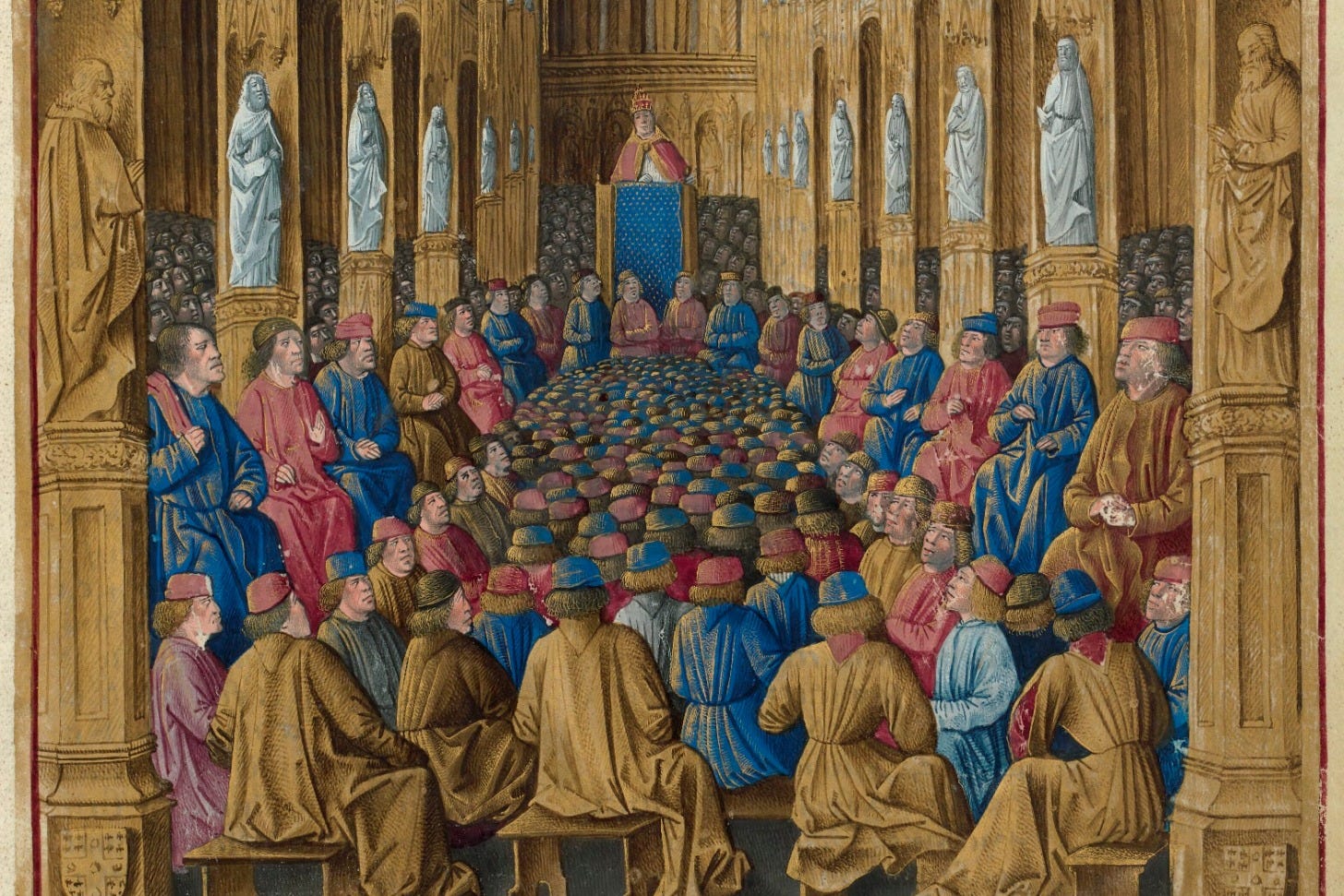
Urban II at the Council of Clermont | Jean Colombe, ca. 1474 (cropped)
Why did Constantinople ask Rome for knights?
Key Terms for this Lesson
Great Schism · Excommunication · Crusades
The Great Schism | 1054
By 1050, Christendom had two capitals. Rome spoke Latin and looked to its pope. Constantinople spoke Greek and looked to its patriarch and its emperor (cf. Sec. 10.1). The fundamental debate rested in one question: who is the most important living leader in Christianity? Leo the Great had argued from Jesus’ words to Peter (Matthew 16:18) that the bishop of Rome held authority over every bishop. The East answered that Rome was first in honor among equals (cf. Sec. 12.3).
A second quarrel ran through the creed itself. The Nicene Creed (cf. Sec. 10.3) says that the Holy Spirit proceeds “from the Father.” The West had added one Latin word, filioque (“and the Son”). The Greeks would not accept a change no council of the whole Church had made, and the two quarrels wore at East and West until the tension finally snapped.
On July 16, 1054, three envoys from Rome, led by Cardinal Humbert (d. 1061), walked up to the altar of the Hagia Sophia (cf. Sec. 10.6) during the afternoon liturgy and laid down a document against the patriarch Michael Cerularius (d. 1059). It was a sentence of excommunication, a church’s formal act of cutting a member off from its fellowship and its sacraments. Within days, the patriarch excommunicated the envoys in turn.
This split is called the Great Schism (Gr. schisma, a tear), the division of Christendom into the Catholic West and the Orthodox East. The East took its name from “correct belief” (Gr. orthos doxa). The excommunications were lifted in 1965, but the division continues to the present day.
Clermont & the First Crusade | 1095–1099
In 1071, the Seljuk Turks crushed a Byzantine army at Manzikert and soon held most of Anatolia (today, Türkiye). In 1095, the emperor Alexios I (d. 1118) sent envoys to the pope to ask for soldiers. Forty-one years after the schism, Constantinople asked Rome for knights.
Pope Urban II (d. 1099) answered at the Council of Clermont, in France, on November 27, 1095. In the account of the chronicler Fulcher of Chartres (d. ca. 1127), Urban began with the East:
For your brethren who live in the east are in urgent need of your help, and you must hasten to give them the aid which has often been promised them. Speech at Clermont (Fulcher of Chartres, trans. Oliver J. Thatcher)
Urban asked for more than the emperor had. He called on the knights of the West to march to Jerusalem and free the Church of the Holy Sepulchre, built over the place Christians honor as the tomb of Jesus. For anyone who went out of devotion alone, not for honor or money, the council counted the journey in place of all penance. It was a pilgrimage under arms, and for many it stirred sincere piety (lords sold their lands to go). Those who vowed to go sewed a cloth cross to their clothes and were said to have “taken the cross.” Later centuries would name their journeys from that cross: the Crusades, from the Latin crux.
Jerusalem had been under Muslim rule since 637 or 638 CE (cf. Sec. 11.1), and Muslims honor it as the city of Muhammad’s Night Journey, where the Dome of the Rock stands (cf. Sec. 11.6). After a siege of some forty days, the crusaders took the city on July 15, 1099, and killed much of its Muslim and Jewish population.
Saladin & the Cities | 1187–1291
The crusaders set up four small states along the eastern Mediterranean. Less than a century later, the Kurdish sultan of Egypt and Syria, Saladin (d. 1193), took Jerusalem back. Saladin took the city by siege and terms, not by storm. He ransomed its Christians and freed some who could not pay, though thousands of others were sold into slavery, and he kept the Holy Sepulchre open to pilgrims. His name survives, in the West as well as the East, as the model of the chivalrous adversary.
Then a crusade turned on the city that had asked for help. In 1204, the Fourth Crusade sacked Constantinople, and the bitterness between Catholic and Orthodox deepened for centuries. The emperor Frederick II (d. 1250) won Jerusalem back by a ten-year treaty in 1229, but it was lost for good in 1244. In 1291, Acre, the last great crusader stronghold, fell to the Mamluks of Egypt.
Meanwhile, trade enriched Venice and Genoa, and towns filled with merchants and craftsmen. They were the beginnings of the middle class, an entirely new group of citizens between the poor and those who owned their own land. The most significant city of the time, Paris, was becoming the center of Western civilization between 1150 and 1300: the city of the king of France, the Gothic cathedral (cf. Sec. 13.5), and the university (cf. Sec. 13.6).
Sec 13 • The High Middle Ages
13.1 History & Politics • The Great Schism & Crusades
13.2 Literature & Drama • Song of Roland & Troubadours
13.3 Religion • Monastic Reform & St. Francis
13.4 Music • Hildegard & Notre Dame
13.5 Art & Architecture • The Gothic Cathedral
13.6 Philosophy • Aquinas, Maimonides, & Scholasticism
Course Page: Humanities I & II