

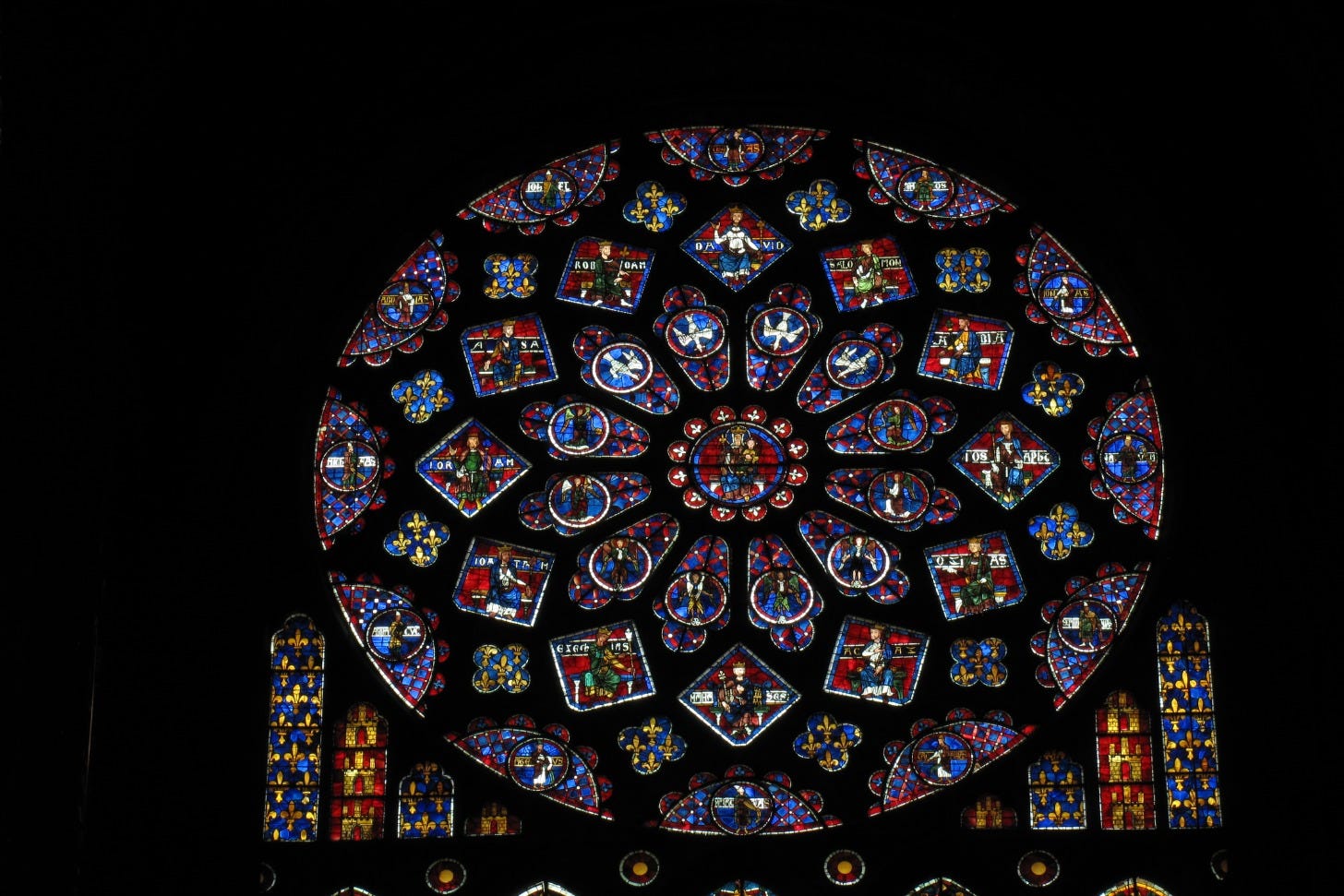
North Rose Window | Chartres Cathedral, ca. 1230
Photo Credit: Rama via Wikimedia Commons
Why did a town spend a hundred years building one church?
Key Terms for this Lesson
Gothic · Flying Buttress · Stained Glass
Suger & Saint-Denis | 1137–1144
The Romanesque church was built of stone to last, but its thick walls allowed only small windows (cf. Sec. 12.5). In the 1140s, builders in France found a way to raise the walls higher and open them to light. It began with an abbot. Suger (d. 1151) ruled the royal abbey of Saint-Denis, just north of Paris, where the kings of France were buried and where pilgrims came to honor the relics of Saint Denis. Crowds packed the old church so tightly on feast days, he wrote, that people could hardly move.
Suger rebuilt it. He asked travelers who had seen the Hagia Sophia in Constantinople (cf. Sec. 10.6) whether his treasures could compare, and he measured his work against the Temple of Solomon described in the Bible (cf. Sec. 9.3). His new choir, consecrated before the king in 1144, ringed the altar with chapels whose walls were almost all window. This was the beginning of the Gothic, the style of the High Middle Ages, built with pointed arches, ribbed vaults, and walls of glass. The name was an insult. Renaissance critics called the style “Gothic,” as if the barbarian Goths had built it (cf. Sec. 15.3).
Abbot Suger had a “theology of beauty.” He drew it from the writings of Pseudo-Dionysius, a Neoplatonist (cf. Sec. 10.5) whom his age believed to be Saint Denis himself. In Suger’s view, the closer you get to light, the closer you get to God. He had verses cast on his gilded bronze doors:
The noble work shines bright; but let the work that nobly shines brighten minds, so that they may pass through true lights to the True Light, where Christ is the true door. Inscription on the Doors of Saint-Denis (Suger, my translation)
The Cathedral & the Town | 1163–1260
Within a generation, every bishop wanted one. Paris began Notre-Dame in 1163, and work on it went on for about a century. The pointed arch carried the weight of the stone vault down more steeply than the round Roman arch (cf. Sec. 8.4), and stone ribs gathered that weight onto a few points. But a high vault still pushes outward, and thin walls cannot hold it alone. The flying buttress is an arched brace outside the building that carries the outward push of the vault down to a pier of stone. The flying buttress is like the cane holding up the structure. Notre-Dame’s, built around 1180, are among the first, and they let the walls rise and open.
A town built a cathedral over generations because the cathedral was the center of its whole life. It had an area similar to a town square, where the community gathered. It was a center of education, with schools and later universities attached. It held church courts, which were sometimes more trusted than civil courts. It cared for the sick, orphans, and the poor. And the bells, ringing the hours of prayer (cf. Sec. 12.3), also set the time for the town. Pilgrims came to honor relics and bought badges and little flasks to carry home (an ancestor of the souvenir), and their gifts helped pay for the building. So did the guilds, the town’s associations of craftsmen and merchants.
Windows of Light | ca. 1145–1250
At Chartres, a fire in 1194 destroyed most of the old cathedral. The townspeople rebuilt it in about twenty-five years, and it still holds most of its medieval glass. Stained glass is colored glass set in lead strips to make pictures in a window, so that light itself carries the image. To see a window properly, you stand inside the church with the sun behind it. The viewer is literally bathed in light, looking at a scene from scripture or the life of a saint.
The purpose of the windows was to teach and edify. Back in 600 CE, Gregory the Great (cf. Sec. 12.3) had written that pictures do for those who cannot read what books do for those who can. At Chartres, along the bottom of dozens of windows, the donors appear at work: bakers, butchers, shoemakers, and money-changers. The heart of its most beloved window, Our Lady of the Beautiful Window, survived the fire of 1194. Outside, on the cathedral’s west front, the seven liberal arts are carved around the doorway (cf. Sec. 12.4), each with a famous ancient teacher beneath it.
Gothic decoration often served two purposes at once. The gargoyles that jut from the walls are, functionally, spouts for rain water, carrying it away from the foundation. Some read their monstrous faces as a sign that evil flees from the sacred. A cathedral was a building, a book, and a town square in one, and it was worth a hundred years.
Sec 13 • The High Middle Ages
13.1 History & Politics • The Great Schism & Crusades
13.2 Literature & Drama • Song of Roland & Troubadours
13.3 Religion • Monastic Reform & St. Francis
13.4 Music • Hildegard & Notre Dame
13.5 Art & Architecture • The Gothic Cathedral
13.6 Philosophy • Aquinas, Maimonides, & Scholasticism
Course Page: Humanities I & II