

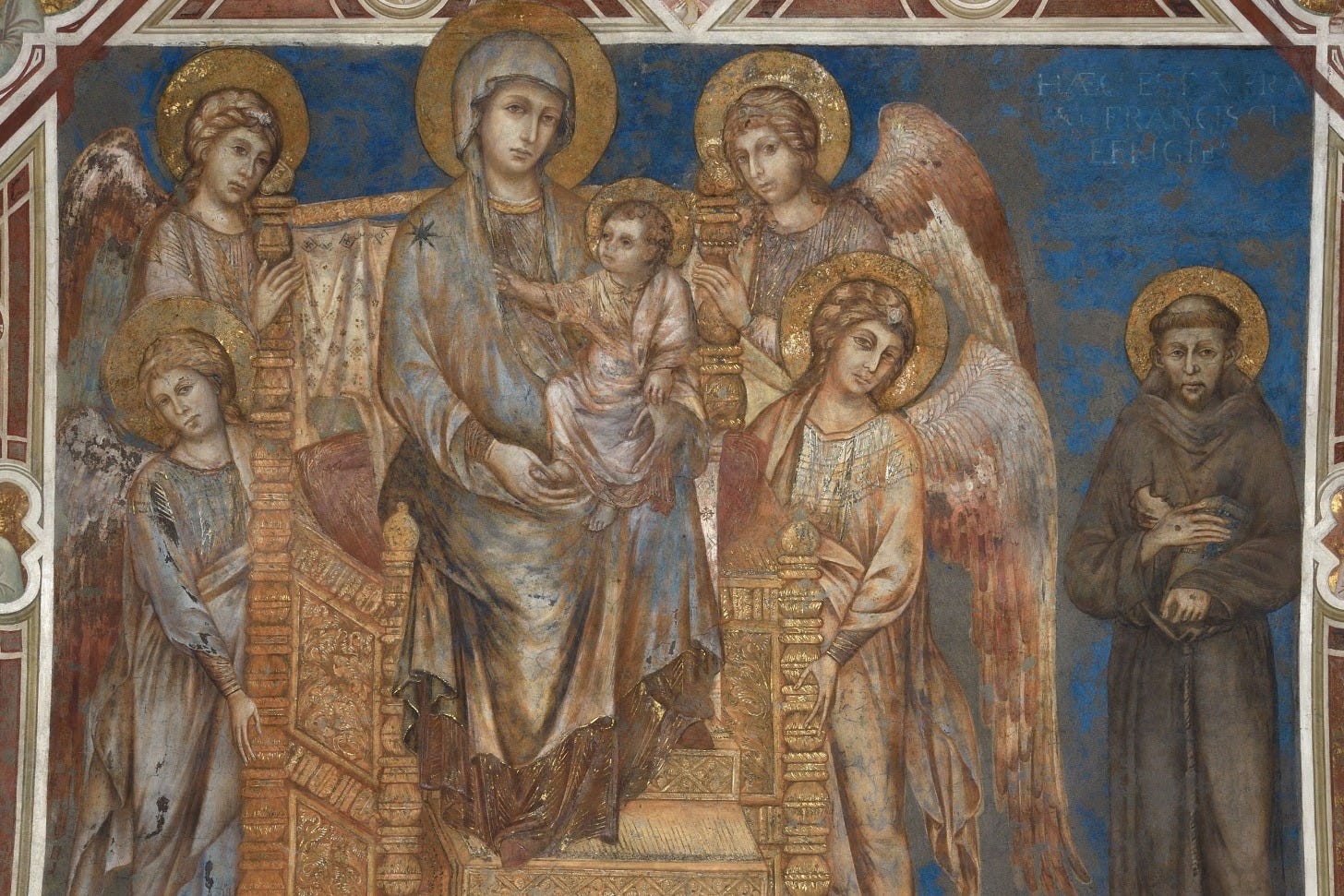
Maestà with Saint Francis | Cimabue, Assisi, ca. 1280 (cropped)
Why did Francis’ friars refuse to stay in one place?
Key Terms for this Lesson
Cistercians · Friars · Mendicant Orders
Cluny & Cîteaux | 910–1153
The Benedictine monastery had become the great institution of the countryside (cf. Sec. 12.3). Lords gave it land, and with land came lords’ interference. In 910, William the Pious, duke of Aquitaine, founded a new abbey at Cluny, in Burgundy, and placed it under the protection of the pope alone, out of reach of any lord, and in time of the local bishop too. Cluny led a reform of monastic life that spread across Europe. At its height, more than a thousand houses looked to its abbot, and its third church, begun in 1088, was the largest in Western Christendom (cf. Sec. 12.5). Its monks spent most of the day at prayer in ever longer services.
Some thought reform had grown too rich. In 1098, a small band of monks left their abbey for a marsh at Cîteaux to keep the Rule of St. Benedict to the letter. The Cistercians were a reforming order of monks who returned to the Rule’s poverty, silence, and manual labor. Called the White Monks for their undyed wool, they built plain churches without sculpture and settled in wild places they drained and farmed. Their great voice was Bernard of Clairvaux (d. 1153), who preached the Second Crusade in 1146. When he died, some 340 Cistercian abbeys stood across Europe.
Cluny and Cîteaux differed on much, but they agreed with Benedict about one thing. A monk stayed home. His vow of stability bound him to one house for life, and the world came to his gate (cf. Sec. 12.3).
Francis of Assisi | ca. 1181–1226
Francis of Assisi (d. 1226) was born Giovanni di Pietro di Bernardone, the son of a rich cloth merchant in the Italian town of Assisi. As a young man he wanted to be a knight. He went to war, spent a year as a prisoner, and came home ill and changed. He began to care for lepers, and when his father took him before the bishop to demand his money back, Francis gave up his inheritance on the spot.
In 1208, at Mass, he heard the Gospel in which Jesus sends out his disciples: “Provide neither gold, nor silver, nor brass in your purses, Nor scrip for your journey, neither two coats, neither shoes, nor yet staves” (Matthew 10:9–10). From it Francis developed the idea of the mendicant brotherhood, a life of total poverty, mobility, and preaching. Followers gathered, and around 1209 Pope Innocent III approved their way of life by word of mouth. They called themselves the Friars Minor, the little brothers. A friar (Lt. frater, brother) was a member of a religious order who lived and worked among the people rather than in a cloister. A friar’s house was a base, not a home.
That was the answer to the monks’ vow. Benedict had warned against wandering monks (cf. Sec. 12.3). Francis sent his brothers out on purpose, into the crowded towns (cf. Sec. 13.1) where the monasteries had never reached. A noblewoman of Assisi, Clare (d. 1253), founded the women’s branch, the Poor Clares. By 1221, thousands of friars were gathering for the order’s meetings. In 1219, during the Fifth Crusade, Francis crossed the lines in Egypt to preach before the sultan al-Kamil, who, his early biographers report, received him with courtesy and let him go. His followers also reported that two years before his death he received the wounds of Christ in his hands and feet, the stigmata.
The Mendicants | 1216–1226
Francis was not alone. A Spanish priest, Dominic (d. 1221), founded the Order of Preachers in 1216 to teach and to preach, with study at its heart. The Franciscans and Dominicans were mendicant orders (Lt. mendicare, to beg), religious orders that owned no property and lived from work and the gifts of those they served. Within a generation, friars taught at the new universities, and the greatest of them, Thomas Aquinas, was a Dominican (cf. Sec. 13.6).
Francis believed in the goodness of God’s creation and had a deep concern for all creatures. Illustrations of Saint Francis often depict him among animals, preaching to the birds. Near the end of his life, nearly blind, he wrote the Canticle of the Creatures, one of the earliest poems in Italian:
Praised be my Lord God with all his creatures; and specially our brother the sun, who brings us the day, and who brings us the light; fair is he, and shining with a very great splendor: O Lord, he signifies to us thee! Canticle of the Creatures (trans. Matthew Arnold)
Sun, moon, wind, water, fire, and earth all appear as his brothers and sisters. Francis promoted the emotional, caring side of religion in the same way that Aquinas promoted its rational side. He died in 1226 and was declared a saint two years later.
Sec 13 • The High Middle Ages
13.1 History & Politics • The Great Schism & Crusades
13.2 Literature & Drama • Song of Roland & Troubadours
13.3 Religion • Monastic Reform & St. Francis
13.4 Music • Hildegard & Notre Dame
13.5 Art & Architecture • The Gothic Cathedral
13.6 Philosophy • Aquinas, Maimonides, & Scholasticism
Course Page: Humanities I & II