

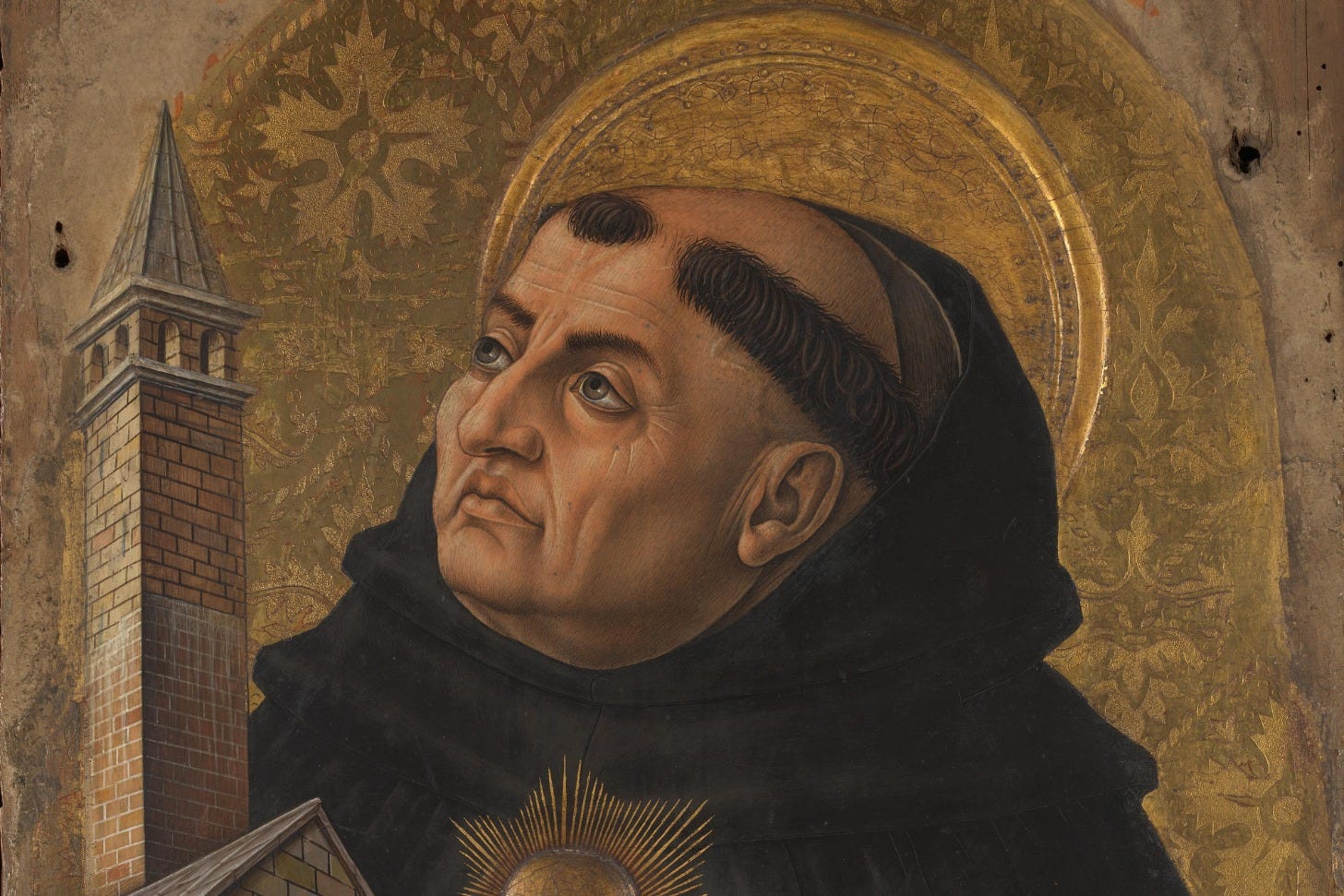
Saint Thomas Aquinas | Carlo Crivelli, 1476 (detail)
Why did a Christian friar call a pagan “the Philosopher”?
Key Terms for this Lesson
Scholasticism · Guide for the Perplexed · Natural Law
Aristotle Returns | 1120–1270
For six centuries, Western Europe knew Aristotle mostly through a few books of logic that Boethius had translated (cf. Sec. 12.4). Then, in the 1100s, the rest arrived. In Toledo, taken by Castile in 1085, Gerard of Cremona (d. 1187) translated more than seventy works from Arabic, with Jewish and Christian scholars at his side. In Venice, Sicily, and Constantinople, others translated from the Greek manuscripts kept in Byzantium. Aristotle came back to the Latin West partly from the Greek and partly through the Arabic, with the commentaries of Muslim philosophers attached (cf. Sec. 11.3). Chief among them was Averroes (d. 1198), the judge of Córdoba, whose line-by-line commentaries taught Europe how to read Aristotle.
The books arrived just as a new institution was taking shape. Teachers and students in Paris, Bologna, and Oxford formed guilds of learning, and by 1200 the university (Lt. universitas, a whole body or guild) had been born. There was a new demand for an educated class of lawyers and officials to manage the growing towns and kingdoms. University students began with the liberal arts (cf. Sec. 12.4) and went on to law, medicine, or theology. Women were not admitted, and were educated instead by private tutors or in convents.
Scholasticism was the method of the medieval schools: the systematic integration of theology and philosophy through the logical analysis of questions. In Paris, the teacher Peter Abelard (d. 1142) had shown the way with Sic et Non (Yes and No), which set the conflicting answers of the Church Fathers side by side, unresolved, so that students would learn to reason their way through them. Scholasticism treats faith and reason as separate but complementary paths to truth.
Maimonides | 1138–1204
The same Aristotle reached Jewish thinkers. Maimonides (d. 1204), Moses ben Maimon, was born in Córdoba, fled with his family when a new dynasty threatened Jews and Christians with forced conversion, and settled at last in Cairo, where he served as a physician at the court of Saladin’s Egypt (cf. Sec. 13.1). His Mishneh Torah (1180) set the whole of Jewish law in order, drawing on the Talmud (cf. Sec. 9.5).
Inspired in part by al-Farabi and Avicenna (cf. Sec. 11.3), Maimonides aimed to show the coherence of philosophy with religion from a Jewish perspective. His Guide for the Perplexed (ca. 1190) is a work of philosophy written in Arabic for a student torn between the Torah and Aristotle. Maimonides held that the Torah, rightly read, never contradicts what reason can prove, and that reason is a gift from God. He also taught that God’s nature is beyond human comprehension, so that one speaks most truly of God by saying what God is not. Within a generation the Guide was translated into Hebrew, and then into Latin, and Christian schoolmen in Paris read “Rabbi Moses” with care.
Aquinas & the Summa | 1225–1274
If the most important early medieval thinker was Augustine (cf. Sec. 10.5), the most consequential late medieval thinker was Thomas Aquinas (d. 1274). Thomas was a Dominican friar (cf. Sec. 13.3) and a master at the University of Paris. Like the other schoolmen, Aquinas called Aristotle simply “the Philosopher,” and Averroes “the Commentator.” He could honor a pagan philosopher because he held that truth reached by reason and truth received by faith cannot contradict each other. His central claim was that reason is a gift from God given to us to deepen our faith, and he promoted the idea that reason could be applied in all areas, including religion. From Avicenna he took the distinction between essence (what something is) and existence (that something is).
His Summa Theologica (lit. the sum of theology) represents one of the most ambitious philosophical efforts of the Middle Ages. Every article follows the same form. It asks a question. It lists the strongest objections against Thomas’ own answer. It cites an authority “on the contrary.” Then he gives his answer and replies to each objection in turn. The scholastic method begins by taking the other side seriously.
Cicero had called true law “right reason conformable to nature” (cf. Sec. 8.6). One of the Summa’s best-known answers builds on that idea:
Hence this is the first precept of law, that ‘good is to be done and pursued, and evil is to be avoided.’ All other precepts of the natural law are based upon this… Summa Theologica (I-II, q. 94, a. 2, trans. Fathers of the English Dominican Province)
Natural law, for Aquinas, is the moral law written into human nature, which every person can know by reason. He never finished the Summa. In December 1273, after an experience at Mass, his companions reported, he stopped writing and said that all he had written seemed to him like straw. He died the next spring, on his way to a council of the Church.
Sec 13 • The High Middle Ages
13.1 History & Politics • The Great Schism & Crusades
13.2 Literature & Drama • Song of Roland & Troubadours
13.3 Religion • Monastic Reform & St. Francis
13.4 Music • Hildegard & Notre Dame
13.5 Art & Architecture • The Gothic Cathedral
13.6 Philosophy • Aquinas, Maimonides, & Scholasticism
Course Page: Humanities I & II
Next Section: The Late Middle Ages