

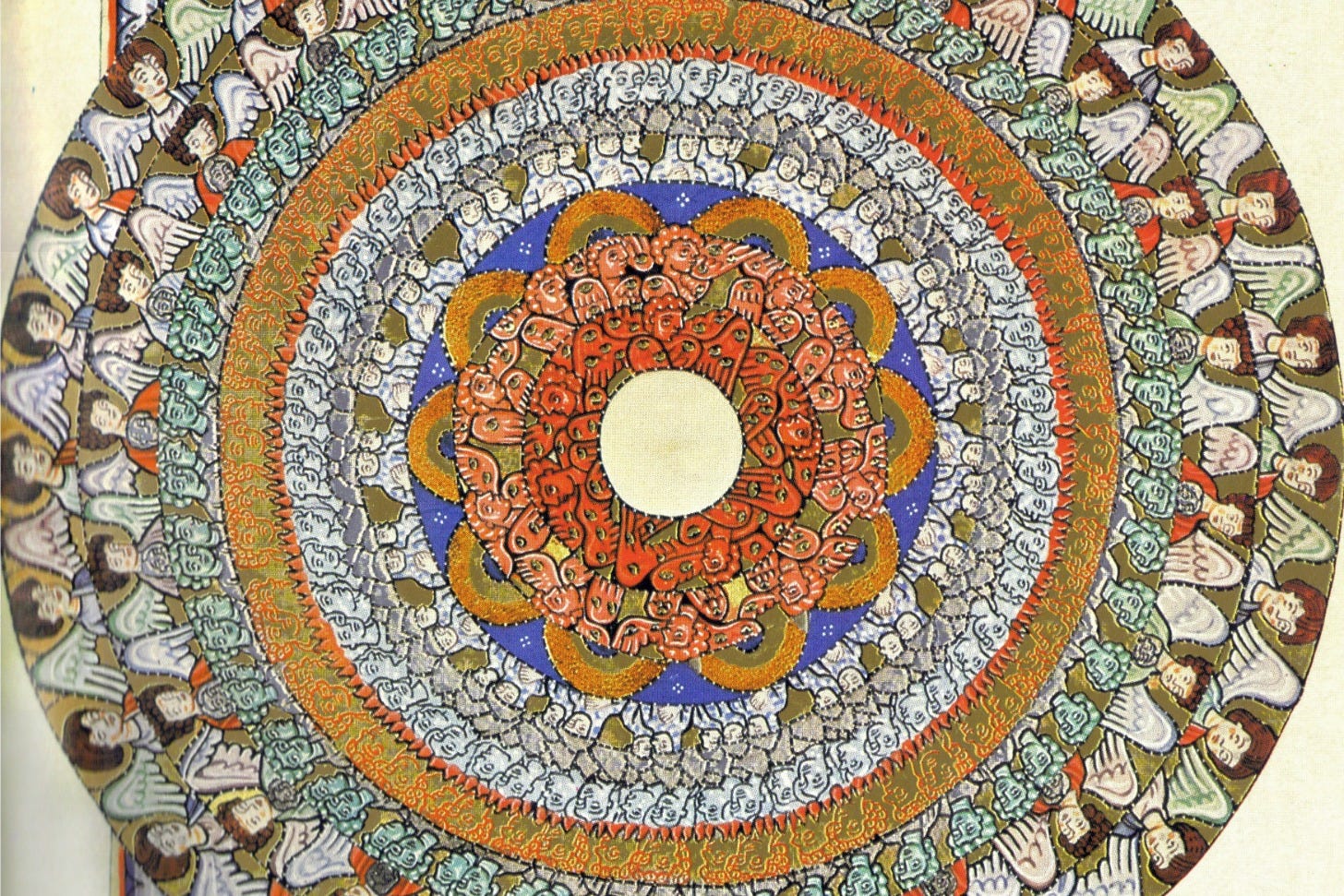
The Choirs of Angels | Hildegard of Bingen, Rupertsberg, ca. 1175 (detail)
Why did the singers of Notre Dame add voices to the chant?
Key Terms for this Lesson
Ordo Virtutum · Organum · Notre Dame School
Hildegard of Bingen | 1098–1179
In the 1100s, one of the most famous women in the Latin Church was a Benedictine nun in the Rhineland. Hildegard of Bingen (d. 1179) was the tenth child of a noble family, given as a child to the religious life at the monastery of Disibodenberg. In 1136, her sisters chose her to lead them, and around 1150 she founded her own convent on the Rupertsberg, near Bingen. Hildegard was a nun, abbess, writer, and composer whose works made her one of the most celebrated voices of her age.
She reported visions from childhood, but she kept them to herself for decades. Then, in her forties, she began to write them down:
It happened in the year 1141 of the incarnation of Jesus Christ, the Son of God, when I was forty-two years and seven months old, that a fiery light of great brilliance came from the open heavens and poured through my whole mind. Scivias (Declaration, my translation)
The book became the Scivias (Lt. Sci vias, Know the Ways). Pope Eugenius III read from it at a council in Trier in 1147–1148 and encouraged her to go on. She wrote to popes, emperors, and Bernard of Clairvaux (cf. Sec. 13.3), and she wrote books on medicine and the natural world.
Hildegard also wrote her own songs, some seventy chants for the worship of her community, one of the largest bodies of music by any medieval composer whose name we know. Her melodies soar across a wider range than ordinary chant (cf. Sec. 12.6), with long runs of notes on a single syllable. Around 1151 she wrote the Ordo Virtutum (Lt. Order of the Virtues), a sung drama in which sixteen Virtues help a human soul resist the Devil. Her nuns sang the Virtues. In Hildegard’s design, only the Devil has no melody: he can only shout. For Hildegard, music was the sound of a soul in harmony with heaven, and the one who refuses that harmony cannot sing.
Organum | ca. 900–1150
Hildegard’s songs, like the chant of Charlemagne’s churches, were monophony: one melodic line (cf. Sec. 12.6). But music in this period was changing. Music textbooks of the time began to describe adding a new musical element: additional voices or lines. When two or more independent melodic lines sound at once, the music is polyphony (Gr. many voices). Polyphony would become the great art of the Renaissance (cf. Sec. 15.4). It began here, inside the chant.
Organum is the earliest kind of Western polyphony, in which one or more voices are added to a Gregorian chant. A teaching book of about 900 CE, the Musica enchiriadis (Handbook of Music), shows a second voice singing the chant at a fixed distance below it, parallel to it note for note. By around 1100, in the abbeys of southern France, the added voice had broken free. It soared above the chant in long, flowing lines while the chant held each of its notes below. Guido’s staff (cf. Sec. 12.6) made it possible to write both parts down, so singers could learn them from the page.
The Notre Dame School | 1163–1250
In 1163, Paris began its great new cathedral, Notre-Dame (cf. Sec. 13.5). Its singers became the most important composers of the age. The Notre Dame School was the circle of composers at the cathedral of Notre-Dame in Paris, ca. 1160–1250, who developed organum into a large and rhythmic art.
We know their names from an English student who wrote about them around 1275. He calls Léonin “the best composer of organum” (my translation) and credits him with the Magnus Liber Organi, the Great Book of Organum, two-voice settings of the chants for the great feasts of the church year. His successor, Pérotin, wrote for three and even four voices. In 1198 and 1199, the bishop of Paris allowed organum for three and four voices to be sung at feasts of the Christmas season, including the New Year.
Why add voices? To make the greatest feasts sound as splendid as the new cathedral looked. In Notre Dame organum, the lowest voice is the tenor (Lt. tenere, to hold): it holds the chant in long notes, while the upper voices move above it in quick, repeating rhythms. The old chant is still there, the foundation under everything, stretched so long that a single syllable can last for minutes. Later composers gave the upper voices words of their own, and the result was the motet, the most sophisticated music of the age, typically for three voices (cf. Sec. 14.4).
Sec 13 • The High Middle Ages
13.1 History & Politics • The Great Schism & Crusades
13.2 Literature & Drama • Song of Roland & Troubadours
13.3 Religion • Monastic Reform & St. Francis
13.4 Music • Hildegard & Notre Dame
13.5 Art & Architecture • The Gothic Cathedral
13.6 Philosophy • Aquinas, Maimonides, & Scholasticism
Course Page: Humanities I & II