

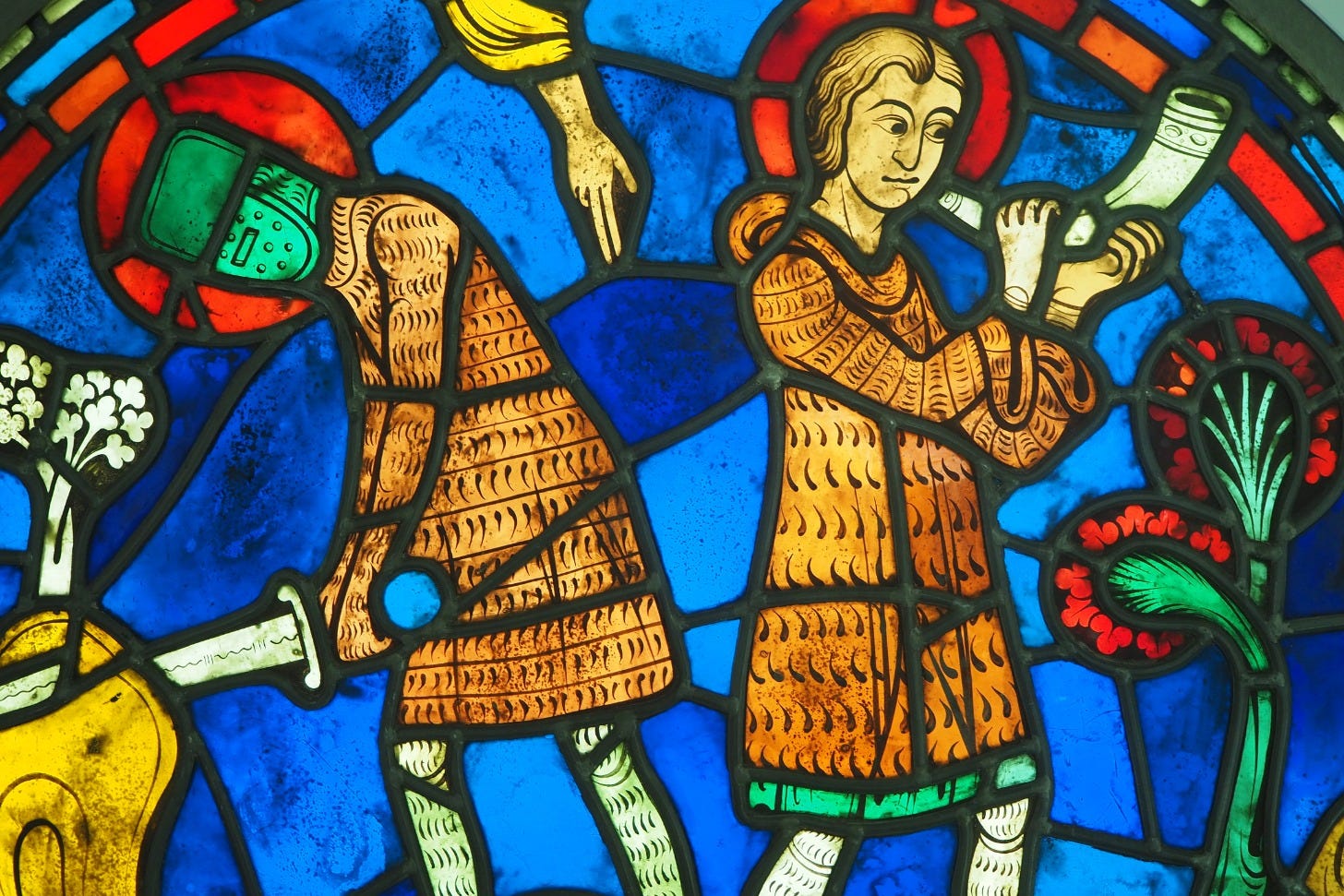
Roland Sounds the Horn | Charlemagne Window, Chartres (1942 copy)
Photo Credit: Chevaldeau28 via Wikimedia Commons
Why wouldn’t Roland blow his horn?
Key Terms for this Lesson
Chanson de Geste · Vernacular · Troubadour
Roncevaux | 778 CE–ca. 1100
On August 15, 778 CE, Charlemagne’s army was crossing the Pyrenees home from Spain (cf. Sec. 12.1). In a narrow pass called Roncevaux, Basque fighters fell on the rear guard and killed it to the last man. Charlemagne’s biographer Einhard names one of the dead: Roland, the prefect of the Breton frontier. It was a small defeat in a long reign, and in three hundred years of retelling it became the most famous of the French songs of deeds.
The Song of Roland survives in its oldest version in a manuscript copied in England in the 1100s and kept today at Oxford. It runs some 4,000 lines of Old French, in stanzas called laisses. By then the Basques have become a vast Muslim army from Saragossa, Charlemagne is said to be two hundred years old, with a flowing white beard, and the ambush is a war between Christendom and its enemies. The poem took its written form around the time of the First Crusade (cf. Sec. 13.1), and it carries that age’s view of the world. It imagines its enemies as idol worshippers, which Muslims never were (cf. Sec. 11.6).
The Song of Roland is a chanson de geste (Old French, a song of deeds), an epic poem of war, loyalty, and betrayal sung by professional performers. Like Homer’s bards (cf. Sec. 6.2) and the Anglo-Saxon scop (cf. Sec. 12.2), these singers carried the poem in memory and performed it for halls and crowds.
Roland’s Horn | Laisses 83–133
Roland commands the rear guard with his closest friend, Oliver. Roland carries an ivory horn, the oliphant (from elephant). If he sounds it, Charlemagne will hear and turn the army around. When Oliver climbs a hill and sees the enemy’s numbers, he begs Roland three times to blow the horn. Three times Roland refuses. The second time, he answers:
Never, by God, I say, / For my misdeed shall kinsmen hear the blame, / Nor France the Douce fall into evil fame! The Song of Roland (84, trans. C. K. Scott-Moncrieff)
Roland will not blow the horn because it would shame him, his family, and France. To call for help is to admit he cannot hold the pass. The poet sets the two friends side by side: “Pride hath Rollanz, wisdom Olivier hath; / And both of them shew marvellous courage” (87). (The Old French word behind “pride” also means valiant.) Like Achilles before him (cf. Sec. 6.2), Roland lives by the heroic code that Beowulf praised (cf. Sec. 12.2). Oliver has sense.
The battle turns. Only when nearly all the Franks have fallen does Roland put the horn to his lips, and the poem says its echo carried thirty leagues. Now Oliver objects. Too late, the horn can bring only vengeance, not rescue. “Vassalage comes by sense, and not folly,” Oliver tells him, “Prudence more worth is than stupidity” (131). Courage, the poem says, must serve the lord and the men who depend on it, not one man’s name. Roland dies on a hilltop facing Spain, and Charlemagne arrives to find his rear guard dead.
The Troubadours | ca. 1100–1300
While jongleurs sang of Roland in the north, a new kind of poet was singing in the courts of southern France. The troubadours wrote in the vernacular, the everyday spoken language of a people, rather than in Latin, the language of the Church and the schools. Theirs was Occitan, the tongue of Provence and Aquitaine. Latin was the language you learned. Occitan was the language you were raised in.
A troubadour was a poet-composer who wrote songs in Occitan for performance at court. The name comes from the Occitan trobar, to find or invent: a troubadour was someone who found new songs. The earliest whose songs survive was a duke, William IX of Aquitaine (d. 1126), and his granddaughter, Eleanor of Aquitaine (d. 1204), carried the art to the courts of France and England. Some 2,500 troubadour poems survive, about one in ten with its melody. A few were written by women, the trobairitz.
Their great theme was the love of a knight for a noble lady, sung as a vassal’s service to his lord (cf. Sec. 12.1). The ideal asked for patience, courtesy, and self-control, and it gave Europe a new language of refinement. Here was new music by named poets, made for the court rather than the church, and the subjects of song were no longer only religious. In the north, the trouvères sang in French. In Germany, the Minnesinger did the same in German. Around 1300, Dante would write his great poem in Italian rather than Latin (cf. Sec. 14.6). The language of the street had become a language of art.
Sec 13 • The High Middle Ages
13.1 History & Politics • The Great Schism & Crusades
13.2 Literature & Drama • Song of Roland & Troubadours
13.3 Religion • Monastic Reform & St. Francis
13.4 Music • Hildegard & Notre Dame
13.5 Art & Architecture • The Gothic Cathedral
13.6 Philosophy • Aquinas, Maimonides, & Scholasticism
Course Page: Humanities I & II