

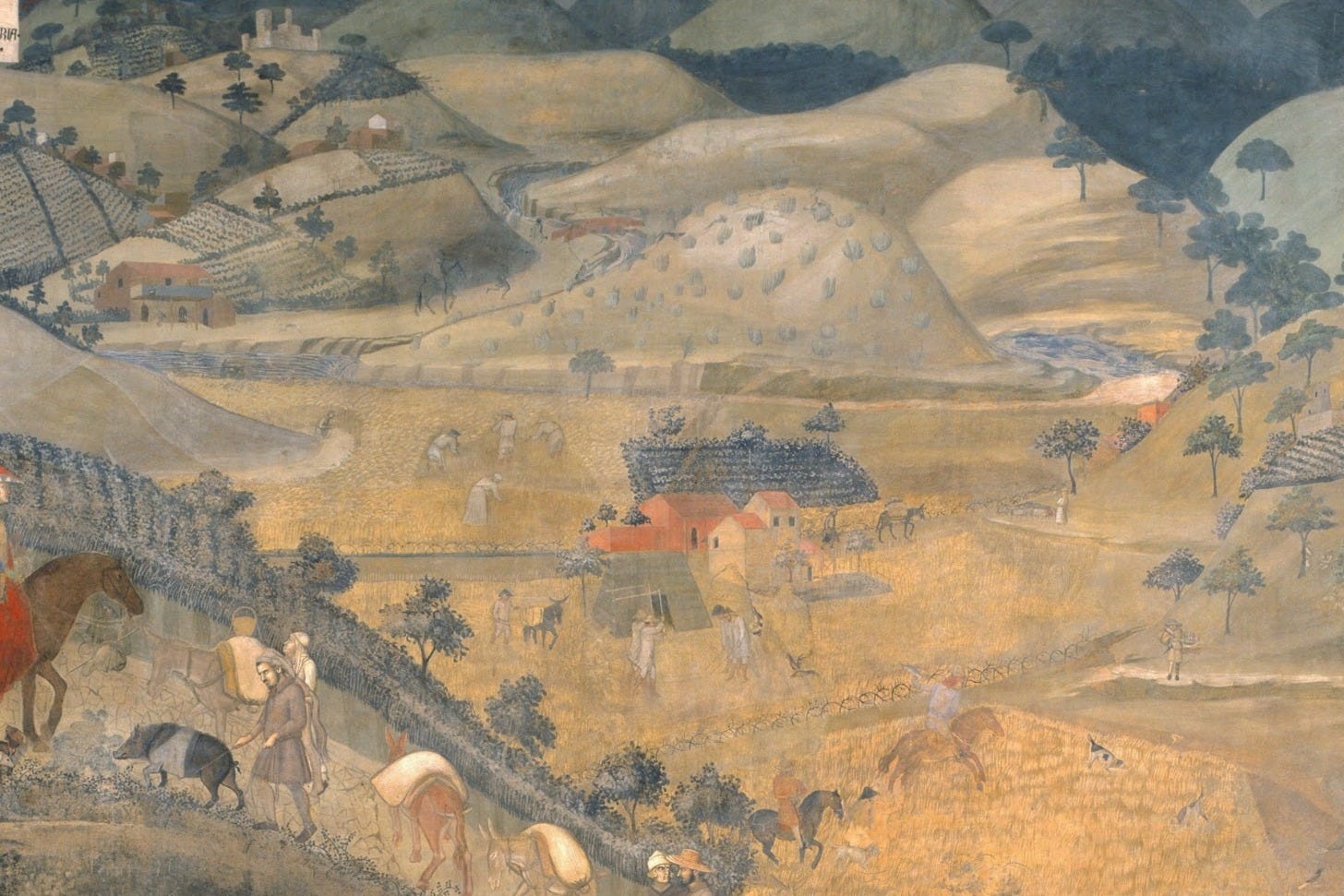
Effects of Good Government in the Countryside | Ambrogio Lorenzetti, Siena, 1338–1339
Why did wages rise after the Black Death?
Key Terms for this Lesson
Great Famine · Hundred Years’ War · Black Death
The Great Famine | 1315–1317
The High Middle Ages ended well. By 1300, Europe held perhaps twice the people it had held in the year 1000, and its towns had grown into cities (cf. Sec. 13.1). To get to the Renaissance, a time of renewed interest in the classics, invention, and innovation, Europe had to pass through the fourteenth century first. The fourteenth century was a time of natural calamity, institutional decay, and cruel violence.
The calamity came first, and it came from the sky. In the spring of 1315, the rain began and did not stop. The harvest failed that year and failed again in 1316. The Great Famine of 1315–1317 was one of the worst famines in European history, and in some towns of Flanders it killed one person in ten. The town of Ypres buried nearly 3,000 people in six months of 1316. Many climate historians date the start of a colder age to about 1300. Medieval Europe had reached the limit of the land it could feed.
The Hundred Years’ War | 1337–1453
Then came the war. In 1328, the king of France died without a son, and the crown passed to his cousin, Philip VI (d. 1350). But the king of England, Edward III (d. 1377), was the dead king’s nephew through his mother, and he held lands in France as the French king’s vassal (cf. Sec. 12.1). In 1337, Philip declared those lands forfeit. Edward defied him, and in 1340 claimed the French throne itself. The Hundred Years’ War (1337–1453) was a series of wars between the kings of England and France over the French crown and the English lands in France.
The English won the famous battles. At Crécy in 1346, common archers with the longbow brought down the knighthood of France, and at Poitiers in 1356 the king of France himself was taken prisoner. A peasant with a bow could unhorse a lord in armor. The war’s last act belonged to a farm girl, Joan of Arc (d. 1431), who in 1429 led the French army to lift the siege of Orléans, and was captured the next year and executed in 1431. By 1453, England kept only the port of Calais. The two kingdoms came out of the war as nations, each with a language, a story, and an enemy of its own.
The Black Death | 1347–1351
In 1346, a Mongol army besieging the Genoese trading post of Caffa, on the Black Sea, began to die of a sickness carried west out of Central Asia. The Mongol peace that kept the caravan roads open kept them open for the plague too. In October 1347, Genoese galleys from the Black Sea put in at Messina, in Sicily. By spring 1348 the sickness was in Florence. By summer it was in England. The Black Death was the plague that swept Europe between 1347 and 1351 and killed, by most estimates, between a third and a half of its people. It traveled with the fleas of rats, and, in its pneumonic form, from person to person on the breath. Boccaccio (cf. Sec. 14.6), who was probably in Florence at the time, wrote that upward of 100,000 died within the city’s walls, and he remembered the speed of it:
How many valiant men, how many fair ladies, how many sprightly youths, whom, not others only, but Galen, Hippocrates or Æsculapius themselves would have judged most hale, breakfasted in the morning with their kinsfolk, comrades and friends and that same night supped with their ancestors in the other world! Decameron (First Day, trans. John Payne)
How did Europeans react? Some chose to flee, like the characters in the Decameron, to a less populated area. And some looked for someone to blame. In town after town, Jews were falsely accused of poisoning the wells, and they were killed, at Strasbourg in February 1349 before the plague had even arrived. Pope Clement VI (d. 1352) issued two bulls in 1348 declaring the Jews innocent: the plague, he wrote, was killing Jews too, and raging where no Jews lived at all. Even the poet and composer Guillaume de Machaut (cf. Sec. 14.4) repeated the charge in verse the next year.
Then the dying stopped — and the survivors discovered what their labor was worth. The plague interrupted the production of goods and agriculture, and labor shortages led to higher wages for any who could work, and that led to higher prices. Lords answered with law. England’s Statute of Labourers (1351) ordered every worker to accept the wages of 1346. The workers did not. In 1381, a new tax on every head set off the Peasants’ Revolt, and a crowd of thousands marched on London to ask the boy king Richard II (d. 1400) to end serfdom (cf. Sec. 12.1). The revolt was put down within weeks. The wages kept rising anyway. Within a century, serfdom in England was all but gone, not by decree, but because the people who survived the plague could name their price.
Sec 14 • The Late Middle Ages
14.1 History & Politics • Famine, War, & Black Death
14.2 Religion • Avignon & the Great Western Schism
14.3 Philosophy • William of Ockham
14.4 Music • Ars Nova & Machaut
14.5 Art & Architecture • Giotto & the Dance of Death
14.6 Literature & Drama • Dante, Boccaccio, & Chaucer
Course Page: Humanities I & II