

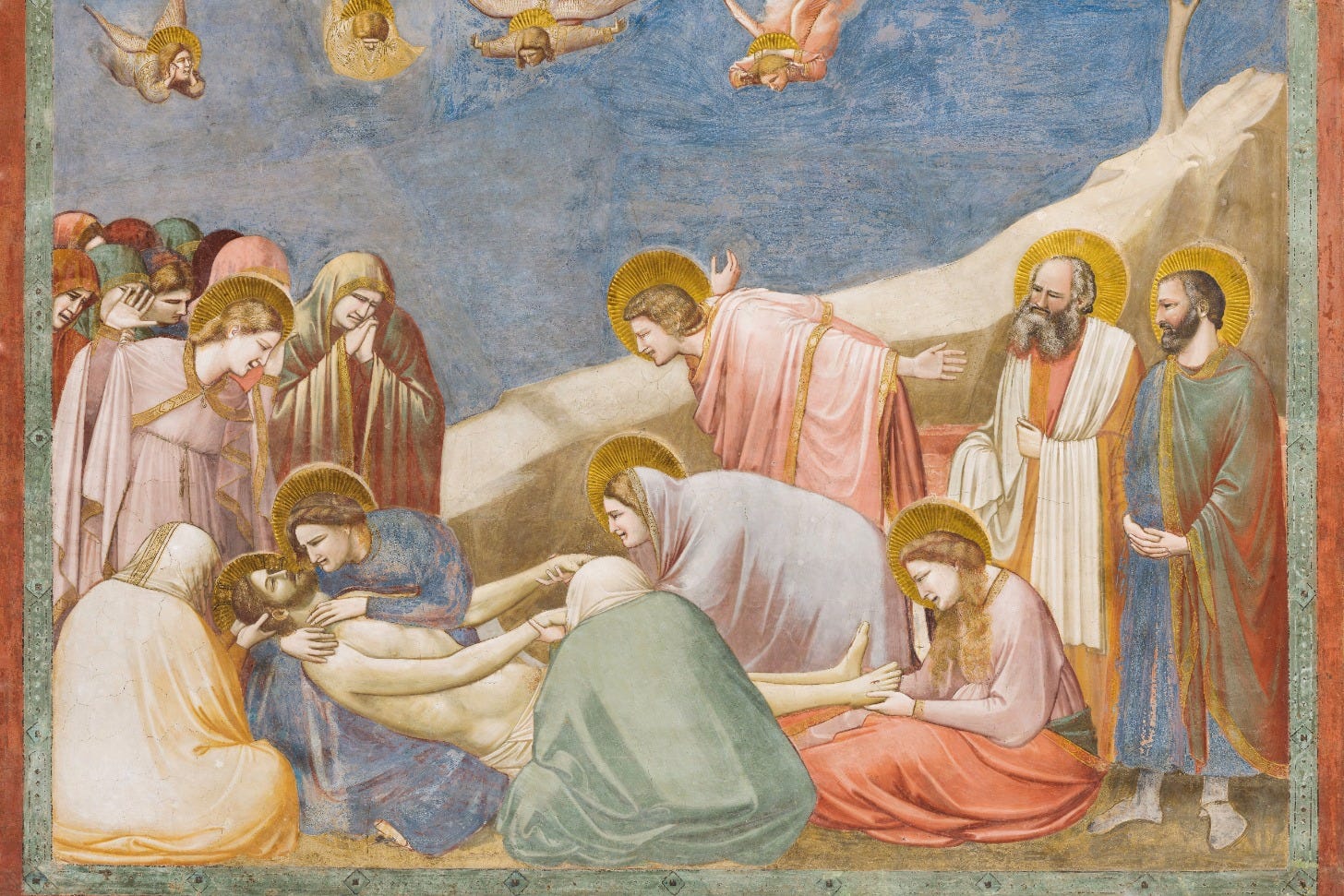
The Lamentation | Giotto, Scrovegni Chapel, Padua, ca. 1305 (detail)
Why did Giotto paint people with their backs to us?
Key Terms for this Lesson
Fresco · Naturalism · Danse Macabre
Out of Byzantium | Pisano & Duccio
In the 1200s, Italian painting was rooted in the Byzantine style (cf. Sec. 10.6): gold grounds, flat bodies, and faces of solemn calm, the manner Italians called the maniera greca, the Greek way. The break began in sculpture. Nicola Pisano (d. ca. 1278) studied the Roman sarcophagi that lay about Pisa’s cathedral, and his pulpit for the city’s baptistery (1260) is crowded with figures carved in high relief, overlapping, in motion, with the weight and faces of Roman portraits (cf. Sec. 8.4). The naturalism and emotion of Classical art, lost for a thousand years, were coming back.
Painting followed. In Siena, Duccio di Buoninsegna (d. ca. 1319) painted the great Maestà altarpiece for the cathedral (1308–1311), and on the day it was finished the whole city carried it from his workshop to the high altar in procession, with trumpets and bells. Duccio kept the gold of Byzantium, but he showed the emotional states of his subjects through their faces and gestures, and he set them in rooms and streets with a new sense of space.
Giotto & the Arena Chapel | ca. 1305
The painter Giotto di Bondone (d. 1337) was a revolutionary figure because of his break with the past. A Florentine, said to have been Cimabue’s pupil (cf. Sec. 13.3), he was famous in his own lifetime. Dante, his contemporary, put the change into three lines:
In painting Cimabue thought that he / Should hold the field, now Giotto has the cry, / So that the other’s fame is growing dim. Purgatorio (11.94–96, trans. Henry Wadsworth Longfellow)
Around 1305, a banker named Enrico Scrovegni hired Giotto to paint every wall of his new chapel in Padua, built on the site of a Roman arena. The Scrovegni Chapel, or Arena Chapel, is Giotto’s masterpiece: some forty scenes of the lives of Mary and Jesus, painted in fresco. Fresco (It. fresh) is painting done on wet plaster, so that the pigment dries into the wall itself, a day’s patch at a time. Giotto was highly concerned with the depth in his paintings, illustrating volume through the use of light and dark. In his Madonna for the church of Ognissanti (ca. 1310), you can see a figure with weight and volume under the robes, not the flat plane painting had been for centuries. His goal was to imitate nature with his paintings. Naturalism is the representation of figures and settings as they appear to the eye, with weight, space, light, and feeling.
The chapel’s Lamentation (ca. 1305) shows the people on earth in shock and the angels overhead mourning. A bare rock runs diagonally down the picture to the head of the dead Christ, and every line of grief follows it. In the foreground, two mourners sit with their backs to us, hunched, faceless. Giotto painted people with their backs to us so that we would stand behind them, inside the scene, looking over their shoulders at what they see. It was a new thing to do. The figures have backs because they have bodies, and the picture has a near side because it has a far one. In 1334, Florence made Giotto master of its cathedral works, and he designed its bell tower, the Campanile, a Gothic tower in Florentine marble (cf. Sec. 13.5). In Siena, Ambrogio Lorenzetti took Giotto’s ideas and applied them to secular painting: his frescoes of Good and Bad Government (1338–1339) in the town hall show peasants at work and daily life in the city before the Black Death. Both Lorenzetti brothers are believed to have died in the plague of 1348 (cf. Sec. 14.1).
The Dance of Death | after 1348
After 1348, the plague changed what Europe painted. A theme already old, memento mori (Lt. remember that you will die), became the century’s own. Chapels and manuscripts showed the Three Living and the Three Dead: three young nobles out hunting meet three corpses who tell them, as you are, we were. As we are, you shall be. The Danse Macabre, or Dance of Death, is a painted or printed procession in which skeletons lead the living of every rank, pope and emperor, knight and merchant, peasant and child, in a single dance toward the grave. The earliest one we know of was painted on a cemetery wall in Paris in 1424. Lübeck had one by 1463, and in the 1520s the German artist Hans Holbein (d. 1543) designed forty-one scenes of it for woodcuts.
The dance has an order — and the order is the point. The pope comes first and the child last, and death takes each by the hand with the same courtesy. Its message was that death comes to every rank, and in a century that had buried a third of Europe, no one needed to be told twice. Giotto had given painted bodies weight. The Dance of Death reminded their owners what weight was for (cf. Sec. 15.3).
Sec 14 • The Late Middle Ages
14.1 History & Politics • Famine, War, & Black Death
14.2 Religion • Avignon & the Great Western Schism
14.3 Philosophy • William of Ockham
14.4 Music • Ars Nova & Machaut
14.5 Art & Architecture • Giotto & the Dance of Death
14.6 Literature & Drama • Dante, Boccaccio, & Chaucer
Course Page: Humanities I & II