

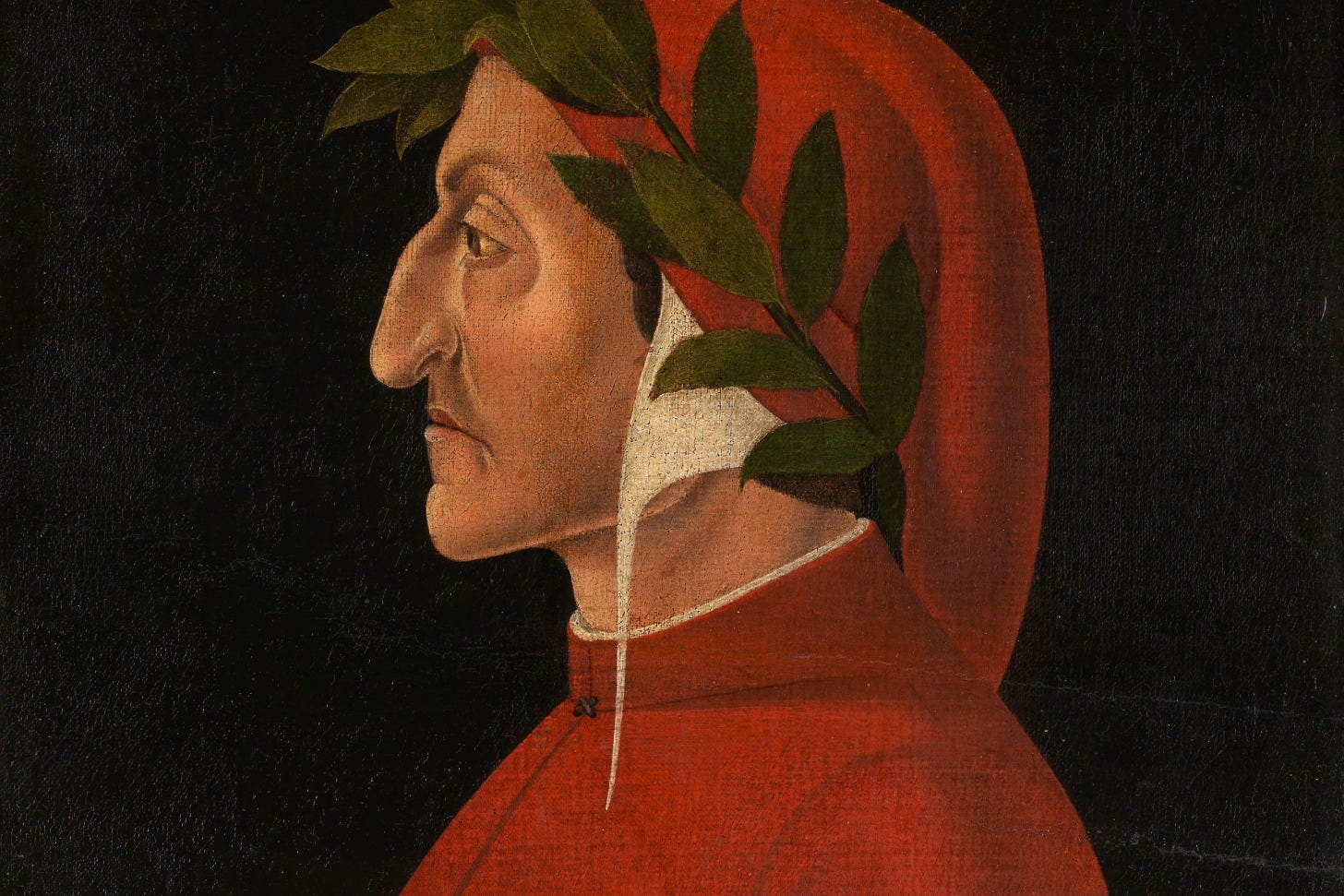
Dante Alighieri | Unknown painter, ca. 1500 (detail)
Why did Dante write his great poem in Italian?
Key Terms for this Lesson
Divine Comedy · Frame Narrative · Canterbury Tales
Dante & the Comedy | 1300–1321
Dante Alighieri (d. 1321) was a Florentine, a poet, and, for two months in 1300, one of the six men who governed his city. Two years later his party lost, and the winners banished him for life. He wrote his poem in exile and died at Ravenna in 1321. The Divine Comedy (ca. 1308–1321) is Dante’s poem of a journey through Hell, Purgatory, and Heaven, in three parts of thirty-three cantos each, plus one of introduction: one hundred in all. Dante called it his Comedy, because it begins in sorrow and ends in joy. Boccaccio called it divine. It opens in the Jubilee year of 1300 (cf. Sec. 14.2), on the night before Good Friday:
Midway upon the journey of our life / I found myself within a forest dark, / For the straightforward pathway had been lost. Inferno (1.1–3, trans. Henry Wadsworth Longfellow)
His guide through the first two realms is the Roman poet Virgil (cf. Sec. 8.3), whom he calls his master, and through the third it is Beatrice, the Florentine woman he had loved from afar, who died in 1290. In its first circle, Limbo, Dante places the great souls born before Christ or outside the faith, and he honors them: Aristotle, the master “of those who know” (cf. Sec. 7.6), Avicenna and “Averroes, who the great Comment made” (cf. Sec. 13.6), and, “alone, apart, the Saladin” (cf. Sec. 13.1). The poem is written in terza rima (It. third rhyme), a chain of three-line stanzas in which the middle line of each rhymes with the first and third of the next.
And it is written in Italian. A serious poem was supposed to be a Latin poem (cf. Sec. 13.2). Dante even wrote his treatise defending the vernacular in Latin, so that the learned would read it. But he wrote the Comedy in the Tuscan of Florence so that it could be read by the people who had no Latin: by women, by merchants, by the city. He said so himself: he wrote in the vernacular for the many whom Latin kept out. Little more than fifty years after his death, Florence was paying lecturers to read the poem aloud in public, and the Tuscan Dante chose became the Italian that Italy speaks today.
Boccaccio & the Decameron | 1349–1353
Giovanni Boccaccio (d. 1375) was the first of those public lecturers, and he wrote the earliest life of Dante. But his own great book turned from Heaven to earth. The Decameron (Gr. deka, ten, and hēmera, day) was written in the years after the plague, around 1349–1353, and it opens with the plague in Florence (cf. Sec. 14.1). Seven young women and three young men meet in the church of Santa Maria Novella, agree to leave the dying city, and withdraw to a villa in the hills, where each tells one story a day for ten days, a hundred tales in all. A frame narrative is a story that contains other stories, like the storytellers’ retreat that holds the hundred tales of the Decameron. The tales are of every kind, comic, tragic, and romantic, told in a garden while Florence buries its dead. Rather than the divine comedy of Dante, which addresses human morality, we have the human comedy of Boccaccio. It is one of the first great works of prose fiction in a European vernacular, and the next century’s storytellers borrowed its frame.
Chaucer & the Canterbury Tales | ca. 1387–1400
One of them was English. Geoffrey Chaucer (d. 1400), a London merchant’s son, was a highly placed civil servant of the king, and the king’s business took him twice to Italy. He translated Boethius’ Consolation into English (cf. Sec. 12.4). Then, around 1387, he began his own frame. The Canterbury Tales (ca. 1387–1400) is Chaucer’s unfinished collection of stories told by some thirty pilgrims riding from an inn in Southwark, across the river from London, to the shrine of Thomas Becket at Canterbury. The host proposes two tales each on the way out and two on the way home. Twenty-four survive, and the pilgrims never reach Canterbury.
The Canterbury Tales shows a cross-section of the social hierarchy: a knight and his squire, a prioress, a monk, a merchant, a clerk of Oxford, a miller, a parson and his brother the plowman, and Chaucer himself. Each tells a tale in his own voice — from the knight’s romance to a priest’s fable of a rooster and a fox. And Chaucer wrote it in English (cf. Sec. 12.2), the London English of his day, when French was still the language of law and Latin of learning. “Whan that Aprill with his shoures soote / The droghte of March hath perced to the roote,” it begins (when April with its sweet showers has pierced March’s drought to the root, my modernization). The three poets of this lesson made the same choice, and two national literatures came of it. The next section opens on the man who took the next step, Boccaccio’s friend Petrarch (cf. Sec. 15.5).
Sec 14 • The Late Middle Ages
14.1 History & Politics • Famine, War, & Black Death
14.2 Religion • Avignon & the Great Western Schism
14.3 Philosophy • William of Ockham
14.4 Music • Ars Nova & Machaut
14.5 Art & Architecture • Giotto & the Dance of Death
14.6 Literature & Drama • Dante, Boccaccio, & Chaucer
Course Page: Humanities I & II
Next Section: The Renaissance