

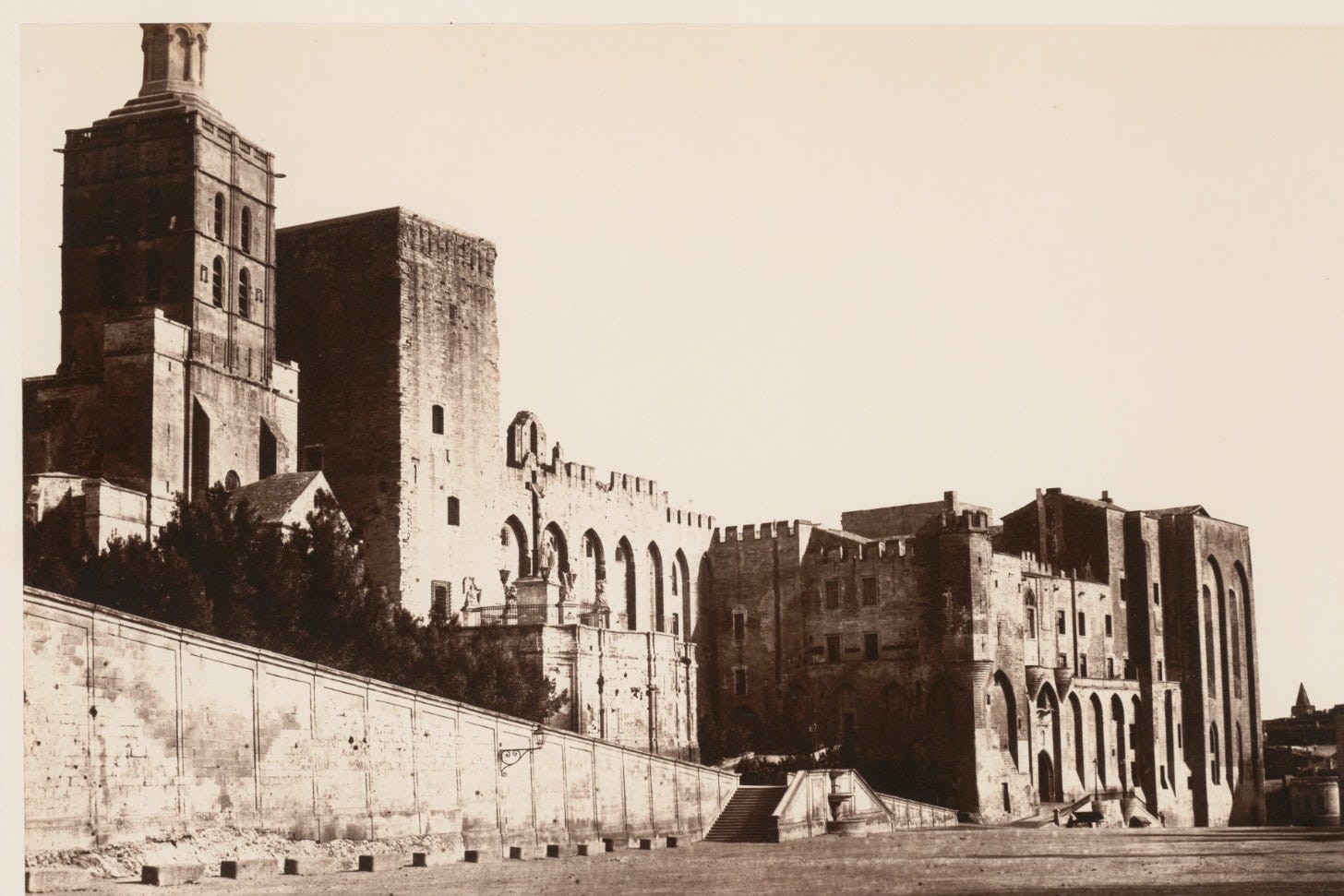
The Palais des Papes | Avignon, built 1335–1352
Photo Credit: Édouard Baldus via Wikimedia Commons, CC0
Why did Europe have two popes, and then three?
Key Terms for this Lesson
Avignon Papacy · Western Schism · Council of Constance
Pope & King | 1294–1309
In 1300, Rome was full. Pope Boniface VIII (d. 1303) had proclaimed the first Jubilee, a year of pilgrimage to the tombs of Peter and Paul, and by one chronicler’s count 200,000 pilgrims were in the city at any one time. Dante set his great poem in that year (cf. Sec. 14.6). Boniface stood at the summit of the medieval papacy (cf. Sec. 12.3), and in 1302 he set its claim down in a bull, Unam Sanctam, which declared that every human creature was subject to the Roman pontiff.
The king of France, Philip IV (d. 1314), did not agree, and the quarrel was about money and courts: whether a king could tax the clergy of his realm, and whether he could try a bishop. In 1303, Philip’s agents seized the pope at his own town of Anagni and held him for three days. Boniface died within weeks. The next pope but one was a Frenchman, Clement V (d. 1314), who never went to Rome at all. In 1309 he settled his court at Avignon, on the Rhône, beside the French king’s lands. Where the pope lived now depended on the king of France. Five centuries earlier, it had been a pope who crowned the emperor (cf. Sec. 12.1).
The Popes at Avignon | 1309–1377
The Avignon Papacy was the period from 1309 to 1377 when seven popes in a row, all of them French, governed the Church from Avignon instead of Rome. They were not idle. John XXII (d. 1334), the second of them, rebuilt the papal finances, and his successors built what is often called the largest Gothic palace in Europe, the Palais des Papes, and the most elaborate administration of the age, with hundreds of clerks collecting fees and taxes from every diocese in Christendom. Clement VI, who defended the Jews in 1348 (cf. Sec. 14.1), kept a princely court there. Petrarch, who grew up in Avignon, called the city a “Babylon” and the papacy’s stay there a captivity, and the phrase Babylonian Captivity stuck. It was his polemic — the popes were not prisoners, but they were a long way from the tomb of Peter.
Rome, meanwhile, decayed, and its people begged the pope to come home. The one most often credited with moving him was a Dominican tertiary from Siena (cf. Sec. 13.3), a dyer’s daughter who could barely write and dictated hundreds of letters. Catherine of Siena (d. 1380) traveled to Avignon in 1376, met Pope Gregory XI (d. 1378), and wrote to him from the city:
Up, father, like a man! For I tell you that you have no need to fear. You ought to come; come, then. Come gently, without any fear. Letter to Gregory XI (trans. Vida D. Scudder)
In January 1377, Gregory entered Rome. He died there fourteen months later.
Two Popes, Then Three | 1378–1417
The cardinals met in Rome to elect his successor, and a Roman crowd stood outside demanding a Roman, or at least an Italian. On April 8, 1378, they chose an Italian, Urban VI (d. 1389). Within months the French cardinals declared that they had voted in fear of the mob, that the election was void, and that the true pope was one of their own, Clement VII (d. 1394), who went back to Avignon. Each pope excommunicated the other (cf. Sec. 13.1), and each had cardinals, a court, and a treasury. This was not the Great Schism of 1054, which split East from West. The Western Schism (1378–1417) was a split inside the Latin Church itself, in which two, and then three, men claimed to be pope at once.
Christendom chose sides along the lines of politics. France, Scotland, Castile, and Aragon obeyed Avignon. England, the Empire, Scandinavia, and most of Italy obeyed Rome. The Hundred Years’ War had a pope on each side (cf. Sec. 14.1). When the first claimants died, their cardinals elected successors, and the schism outlived everyone who had started it. In 1409, cardinals from both sides met at Pisa, deposed both popes, and elected a third. Neither of the first two stepped down. Now there were three.
What finally worked was a council. The Council of Constance (1414–1418), called at the insistence of King Sigismund, the future emperor, was the general council of the Church that ended the Western Schism. It decreed that in such a crisis a general council could judge a pope. The Roman claimant resigned. The Pisan claimant fled, was brought back, and was deposed. The Avignon claimant refused to the end, and was deposed in his absence. On November 11, 1417, the council elected Martin V (d. 1431), and for the first time in thirty-nine years Western Christendom had one pope. Europe had two popes because a frightened election was followed by a second one, and three because a council tried to fix it by adding a pope instead of removing one. The question the schism raised, whether a council stood above a pope, would not go away.
Sec 14 • The Late Middle Ages
14.1 History & Politics • Famine, War, & Black Death
14.2 Religion • Avignon & the Great Western Schism
14.3 Philosophy • William of Ockham
14.4 Music • Ars Nova & Machaut
14.5 Art & Architecture • Giotto & the Dance of Death
14.6 Literature & Drama • Dante, Boccaccio, & Chaucer
Course Page: Humanities I & II