

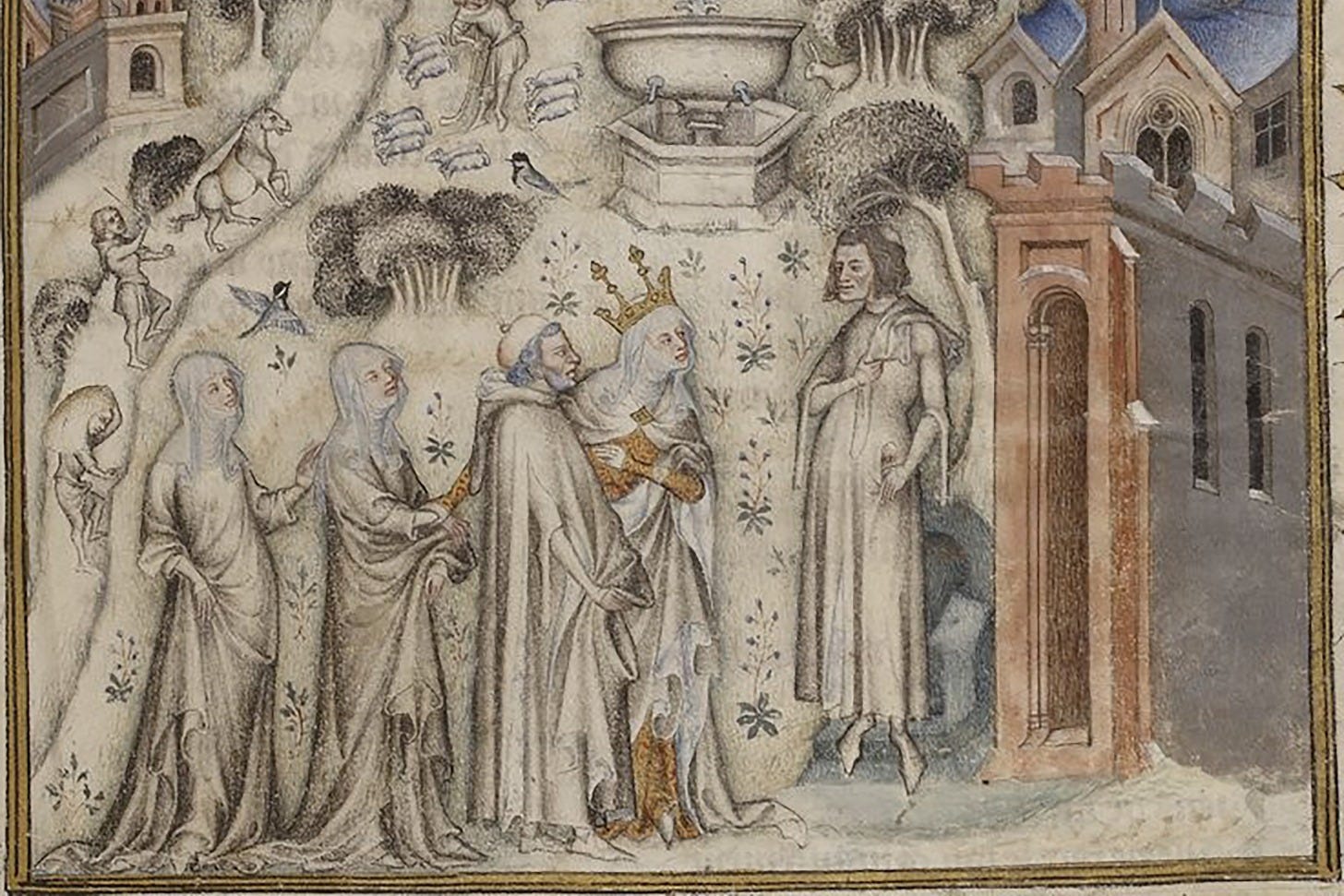
Nature Presents Her Children to Machaut | ca. 1372–1377 (detail)
Why did Machaut set the whole Mass himself?
Key Terms for this Lesson
Ars Nova · Motet · Mass Ordinary
The New Art | ca. 1320
The singers of Notre Dame had taught Europe to stack voices on the chant (cf. Sec. 13.4), but their notation could write rhythm only in a few fixed patterns, all of them in threes. Around 1320, a treatise associated with the French poet and churchman Philippe de Vitry (d. 1361) laid out a new way of writing music, and gave the century its name. Ars Nova (Lt. new art) is the music of fourteenth-century France, named for a treatise of about 1320, whose notation could divide the beat in twos as well as threes and write rhythms of new speed and precision. Older musicians called their own style the ars antiqua, the old art, and not everyone welcomed the new one. In 1324, Pope John XXII (cf. Sec. 14.2) issued a decree from Avignon complaining that the new singers chopped the chant into little notes and buried its melody under their own.
Secular song was not new. The troubadours had been singing of love two centuries earlier (cf. Sec. 13.2). What was new was the pen. Rhythm could now be written down exactly — and the composer who wrote it had a name.
Guillaume de Machaut | ca. 1300–1377
The most celebrated of those names was Guillaume de Machaut (d. 1377). A cleric from Champagne, he spent his youth as secretary to the blind king of Bohemia, John of Luxembourg, who rode to his death at Crécy in 1346 (cf. Sec. 14.1), and his later years as a canon of the cathedral of Reims. He lived through the plague year and opened his Judgment of the King of Navarre (1349) with it, repeating the charge against the Jews that had cost so many lives (cf. Sec. 14.1). Machaut was the leading poet of France as well as its leading composer, and most of his music is secular: ballades, rondeaux, virelais, and lais, songs of love in the troubadours’ line. One rondeau is written so that its melody can be sung backward, and its words say so:
My end is my beginning, and my beginning my end. Ma fin est mon commencement (Rondeau 14, my translation)
He also wrote twenty-three motets. A motet is a polyphonic composition built over a tenor drawn from chant, in which the upper voices sing their own words, often in French, above the Latin below. This was, by many accounts, the most sophisticated music of the age, typically for three voices, and the next stage of what Notre Dame had begun (cf. Sec. 13.4). Vitry and Machaut gave the tenor a repeating rhythmic pattern, a device now called isorhythm (Gr. same rhythm), so that the whole piece turned on a hidden wheel. Toward the end of his life, Machaut did something no earlier composer is known to have done: he had his complete works, the poems and the music together, copied into great manuscripts made under his own eye, with pictures of himself at work.
The Messe de Nostre Dame | ca. 1360s
Every Mass has two kinds of text. The Proper changes with the feast. The Mass Ordinary is the part of the Mass, Catholic worship, that does not change each day: the Kyrie (Lord, have mercy), the Gloria (a hymn of praise), the Credo (the creed, cf. Sec. 10.3), the Sanctus with its Benedictus, and the Agnus Dei (Lamb of God), sung before communion. Its texts lean on Scripture: the Gloria opens with the angels’ song of Luke 2:14, the Sanctus sings Isaiah 6:3, “Holy, holy, holy,” the Benedictus Matthew 21:9, and the Agnus Dei John 1:29. For centuries these had been sung in chant (cf. Sec. 12.6), and when polyphony was used at all, it was for one movement at a time.
Machaut’s Messe de Nostre Dame (Mass of Our Lady, ca. 1360s), for four voices, is the earliest surviving setting of the whole Ordinary by a single known composer. Earlier complete settings exist, but they were assembled from the work of several anonymous hands. Why did Machaut do it? The best evidence is a document from Reims: Guillaume and his brother Jean endowed a Mass to be sung every week at an altar of the Virgin in their cathedral, in memory of the two brothers after their deaths. Machaut most likely set the whole Mass himself so that one work, in his own voice, would be sung in his own church every week in his memory, and he planned it as one work, with the same four voices and the same musical ideas running through all its movements.
In Italy, the century’s star was a performer. Francesco Landini (d. 1397), blind from childhood, played the organ at the church of San Lorenzo in Florence and composed some 140 ballate, songs built on a refrain. By his contemporaries’ account, he drew a crowd when he performed. The named composer, the written rhythm, the celebrated performer: the fourteenth century gave Europe the figure of the musician as we still know him (cf. Sec. 15.4).
Sec 14 • The Late Middle Ages
14.1 History & Politics • Famine, War, & Black Death
14.2 Religion • Avignon & the Great Western Schism
14.3 Philosophy • William of Ockham
14.4 Music • Ars Nova & Machaut
14.5 Art & Architecture • Giotto & the Dance of Death
14.6 Literature & Drama • Dante, Boccaccio, & Chaucer
Course Page: Humanities I & II