

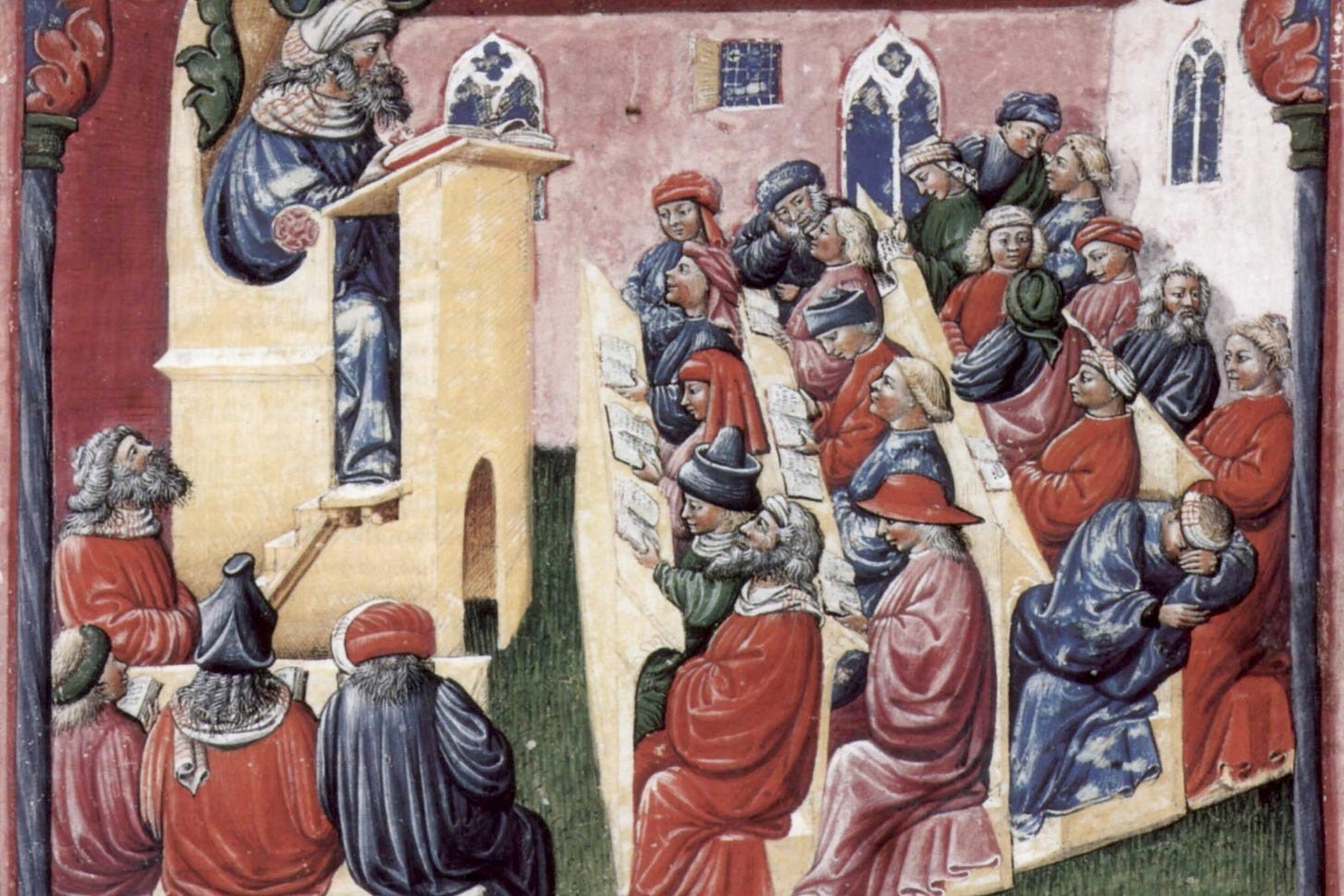
Henry of Germany Lecturing at Bologna | Laurentius de Voltolina, ca. 1350s (detail)
Why did a friar take a razor to philosophy?
Key Terms for this Lesson
Universals · Nominalism · Ockham’s Razor
The Problem of Universals | Plato to Aquinas
In the time of Aquinas, philosophers spilled an ocean of ink over one question: does the form of a tree or the redness of an apple exist independently of the physical objects they describe? Plato had answered yes: the beauty and justice we see here are copies of ideal Forms that exist apart from any one thing (cf. Sec. 7.6). Aristotle had answered that the form of a tree exists only in trees. Boethius, who translated Aristotle’s logic (cf. Sec. 12.4), carried the question into Latin in a commentary on it, and for eight centuries the schools argued it.
A universal is a general term or property, like “tree,” “red,” or “humanity,” that can be said of many individual things at once, and the problem of universals asks whether such things exist on their own or only in the mind. The schoolmen called Plato’s answer realism: universals are real, and the individual is the copy. Aquinas held a milder realism (cf. Sec. 13.6): humanity exists in every human being, and the mind draws the universal out of what it sees. Either way, the universal was real. By 1300, that realism was the foundation of the whole scholastic system.
Ockham & the Razor | 1287–1347
William of Ockham (d. 1347) was born in the village of Ockham, in Surrey, around 1287, joined the Franciscans as a boy (cf. Sec. 13.3), and studied and taught at Oxford. In 1324 he was summoned to the papal court at Avignon (cf. Sec. 14.2) to answer for his teaching, and he spent four years there under investigation. Ockham turned the old order upside down: for him, only individuals exist. “Humanity” is not a thing in the world but a name, a sign in the mind that stands for many men at once:
Every universal is one singular thing, and it is a universal only by signifying, because it is a sign of many. Summa Logicae (I.14, my translation)
Nominalism (Lt. nomen, name) is the view that universals are names or concepts, not things, and that only individuals are real. The instrument Ockham used to cut the universals away is the principle that bears his name. He wrote it several ways, one of them: plurality is not to be posited without necessity. Ockham’s Razor is the rule that an explanation should assume no more things than it needs, which is generally summarized as, “the simplest explanation is usually the best.” In effect, when we’re presented with multiple, divergent explanations, we should prefer the one with the fewest assumptions and steps until the evidence demands more. The name came later (the English phrase is nineteenth-century), but the cutting was his.
The friar did not stop at philosophy. At Avignon the Franciscans were in a quarrel with Pope John XXII (d. 1334) over their founding ideal of poverty (cf. Sec. 13.3). In 1323 the pope had condemned the teaching that Christ and the apostles had owned nothing. Ockham studied the question, concluded that the pope had erred, and wrote so. In 1328 he fled Avignon by night with the head of his order and joined the emperor Louis of Bavaria (d. 1347), settling at last in Munich. He was excommunicated, and he spent the rest of his life writing on the limits of papal power. He died in Munich in 1347, the year the plague reached Europe (cf. Sec. 14.1).
After the Razor | Faith, Reason, & the Modern
What did the razor cut? Aquinas had held that reason, working on its own, could reach a long way toward the truths of faith (cf. Sec. 13.6). Ockham held that it could not reach so far. Much of what the schoolmen had tried to prove, he argued, could only be believed. Faith and reason, which Aquinas had joined, Ockham set apart, each with its own ground. Reason was left with the world of individual things — and that is where it went to work. Ockham and others like him began to set aside the elaborate metaphysical claims of their predecessors in favor of empirical observation. At Paris, the next generation of nominalists, Jean Buridan (d. ca. 1361) and Nicole Oresme (d. 1382), studied motion and asked whether the earth might turn.
This shift is often credited with laying the groundwork for modern scientific method, which values parsimony and economy of explanation. So the next time someone starts to tell you about how aliens built the pyramids at Giza (cf. Sec. 3.4), remember Ockham’s Razor. Before we start praising aliens for our architectural marvels, we first have to rule out the far simpler and more elegant answer that humans built them. The friar took a razor to philosophy because he thought the schools had filled the world with things that were only words, and he wanted to see what was left when the words were cut away.
Sec 14 • The Late Middle Ages
14.1 History & Politics • Famine, War, & Black Death
14.2 Religion • Avignon & the Great Western Schism
14.3 Philosophy • William of Ockham
14.4 Music • Ars Nova & Machaut
14.5 Art & Architecture • Giotto & the Dance of Death
14.6 Literature & Drama • Dante, Boccaccio, & Chaucer
Course Page: Humanities I & II