

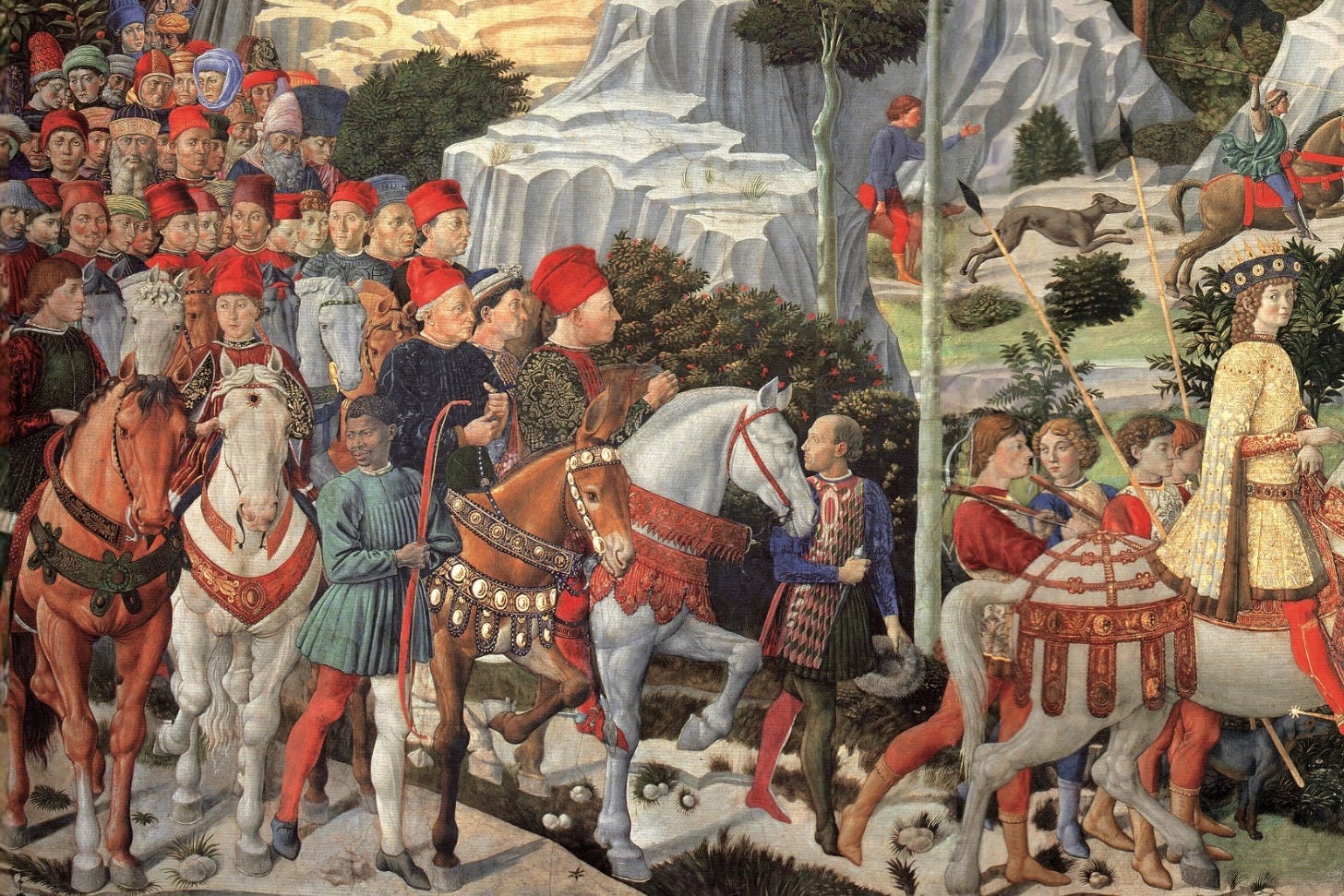
Procession of the Magi | Benozzo Gozzoli, Medici Palace, Florence, ca. 1459
Why did Florence call Cosimo de’ Medici “father of his country”?
Key Terms for this Lesson
Florin · Medici · Patronage
The Florentine Republic | Wool, Banks, & the Florin
Between 1150 and 1300, Paris had been the intellectual center of the West (cf. Sec. 13.1). Over the next two centuries the center moved south. In a period of fierce rivalry, Italian city-states developed culturally through a patronage system wherein artists, architects, and intellectuals vied for sponsorships from wealthy élites. This culminated in a cultural rebirth (Fr. Renaissance) of Southern Europe, and Florence is where it all gets started.
Florence was a republic, and representatives of the major trade guilds governed it. Every two months, the names of guild members were drawn by lot to sit in the Signoria, the city’s council of priors (cf. Sec. 14.6). The members of the major guilds were the most wealthy and influential political players at the time. Essentially, whoever ran the Florentine economy ran Florence.
Florence had been famous for wool since the late Middle Ages, but its bankers made it rich. Our word bank comes from the Italian banco, the bench or counter where money changed hands. Florentine bankers kept double-entry accounts and sent letters of credit across Europe, so that a merchant could pay in London with money deposited in Florence. The florin, the gold coin Florence first minted in 1252, became the trusted money of European trade for centuries. The plague of 1348 took half or more of the city’s people (cf. Sec. 14.1), but the banks survived it. One merchant of nearby Prato, Francesco Datini (d. 1410), headed his account books, “In the name of God and of profit.”
The Medici Bank | Cosimo & the Republic, 1397–1464
The most important family of the early Renaissance was the Medici. In 1397, Giovanni di Bicci de’ Medici (d. 1429) founded a bank that grew branches in Rome, Venice, Geneva, Bruges, and London, and served as banker to the popes. The Medici were the Florentine banking family who, from 1434 to 1494, ruled their republic without wearing a crown. Their manager in Bruges, Tommaso Portinari, commissioned one of the great Flemish altarpieces of the age. The Medici reach extended across Europe.
Giovanni’s son, Cosimo de’ Medici (d. 1464), was so powerful by 1433 that his rivals had him arrested and banished. A year later the city recalled him. Niccolò Machiavelli (d. 1527), writing nearly a century later for Cardinal Giulio de’ Medici, the future Pope Clement VII, described his return (cf. Sec. 15.5):
Cosmo… being informed of his recall, returned to Florence; and it has seldom occurred that any citizen, coming home triumphant from victory, was received by so vast a concourse of people, or such unqualified demonstrations of regard as he was upon his return from banishment; for by universal consent he was hailed as the benefactor of the people, and the FATHER OF HIS COUNTRY. History of Florence (4.7, anonymous translation)
For thirty years Cosimo ruled from his own house, and he held public office only a few times. His friends filled the councils, and his loans bound the city’s great families to him. He spent a fortune collecting and copying manuscripts, rebuilt the convent of San Marco and gave it a library open to scholars, and paid the young scholar Marsilio Ficino (d. 1499) to translate Plato (cf. Sec. 15.2). After he died in 1464, the city decreed that his tomb should carry the title Pater Patriae (Lt. father of the homeland). Florence called Cosimo “father of his country” because he ruled it the way a patron rules, by spending: his money built the city, and the city repaid him with power.
Lorenzo the Magnificent | 1469–1492
Cosimo’s son Piero (d. 1469) ruled for only five years. When he died, all the power and influence of the Medici name passed to his son, Lorenzo de’ Medici (d. 1492). Florentines called him il Magnifico, the Magnificent. Lorenzo was an accomplished poet in Tuscan, the language Dante had chosen (cf. Sec. 14.6), and in 1478 he survived a plot that killed his younger brother. There was at that time a competition for the greatest city in Italy, much in the same way that the Greek city-states rivaled for status (cf. Sec. 6.1). The city with the greatest buildings and art was the greatest city — and patronage was how a city won.
Patronage is the support of artists, scholars, and builders by the wealthy, who pay for the work and are honored by it. Lorenzo kept the painter Botticelli (d. 1510) at work, took a teenage Michelangelo (d. 1564) into his household, and refounded the university at Pisa, where Galileo would later teach. Lorenzo had such a profound influence on Florence that his years are sometimes called the Laurentian Age.
But the bank was failing as the art grew finer. Lorenzo’s branches had lent too much to princes who did not repay, and when he died in 1492 the Medici fortune was a shadow of Cosimo’s. Two years later his son Piero was driven out of the city, and Florence listened to a Dominican friar instead (cf. Sec. 15.6).
Sec 15 • The Renaissance
15.1 History & Politics • Florence & the Medici
15.2 Philosophy • Pico, Erasmus, & Humanism
15.3 Art & Architecture • Brunelleschi, Leonardo, & Raphael
15.4 Music • Josquin & the Art of Polyphony
15.5 Literature & Drama • Petrarch, Castiglione, & Machiavelli
15.6 Religion • Savonarola & the Eve of Reform
Course Page: Humanities I & II