

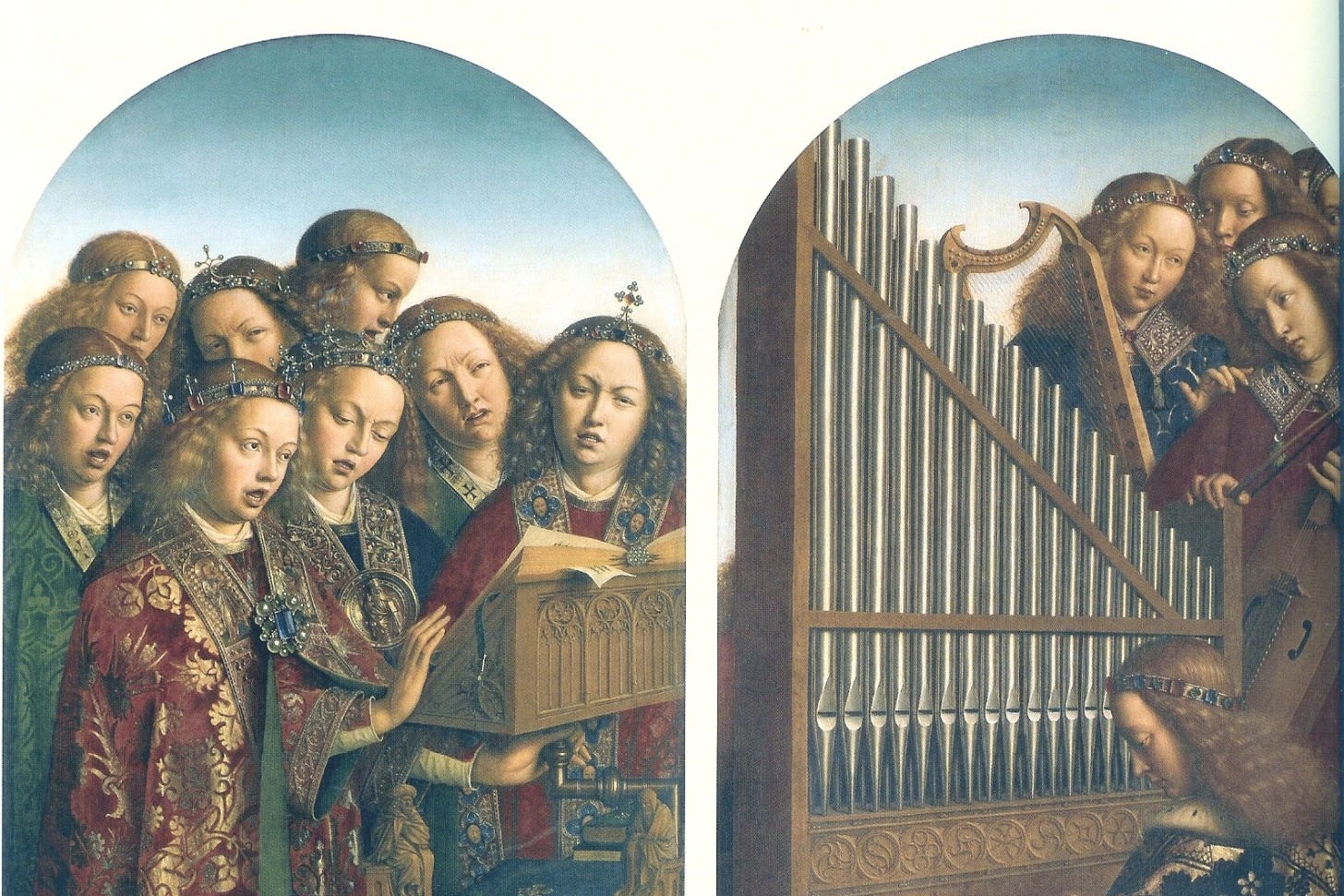
Singing Angels | Hubert and Jan van Eyck, Ghent Altarpiece, 1432
Why did a duke pay more for a composer who wrote only when he pleased?
Key Terms for this Lesson
Polyphony · Franco-Flemish School · Imitation
Many Voices | Notre-Dame to Florence, 1163–1436
Three centuries before Josquin, the singers of Notre-Dame in Paris had added voices to the chant (cf. Sec. 13.4). Polyphony (Gr. many voices) is music in which two or more independent melodic lines sound at once. The motet set new words above a chant tenor, and Machaut set the whole Ordinary of the Mass (cf. Sec. 14.4). In the 1400s, polyphony became the great art of the Renaissance, and the courts and cathedrals of Italy competed for the singers who could make it.
Music during the Renaissance contained many of the themes of humanism. Guillaume Du Fay (d. 1474), the leading composer of his generation, integrated the secular and the sacred musically. He wrote motets for special occasions like coronations and the dedication of churches. On March 25, 1436, when the pope consecrated Florence’s cathedral beneath Brunelleschi’s nearly finished dome (cf. Sec. 15.3), Du Fay’s motet Nuper rosarum flores (Lt. Lately the flowers of roses) was sung beneath it. He also built a Mass on the tune of a popular song, L’homme armé (Fr. The Armed Man), woven into the tenor. It would be like hearing the tune of a popular song on the radio in the middle of church with lyrics about God.
Du Fay trained at Cambrai, in the north, the region most of the masters who followed him came from. The Franco-Flemish School is the name for the composers from northern France and the Low Countries who led European polyphony from about 1430 to 1600, many of them in the service of Italian princes and popes. At those courts, singers were joined by lutes, the European heirs of the oud (cf. Sec. 11.5).
Josquin | ca. 1450–1521
Josquin des Prez (d. 1521) was born in the north around 1450 and spent his best years in Italy. He sang for the Sforza in Milan, and from 1489 for the pope in the Sistine Chapel, where he carved his name into the wall of the singers’ gallery. In 1502, Duke Ercole d’Este (d. 1505) of Ferrara was choosing between two famous composers, and one of his agents advised him to hire Heinrich Isaac (d. 1517) instead. Isaac got along with his colleagues and composed new works quickly. Josquin, the agent wrote, composed better, but he composed when he wanted to, not when one wanted him to, and he asked 200 ducats a year while Isaac would come for 120. The duke hired Josquin anyway, because a court that wanted the finest music in Europe had to pay for the finest composer, on his terms. Josquin wrote Ercole a Mass whose tenor spells the duke’s name in notes: the vowels of Hercules Dux Ferrariae became the syllables re, ut, re, ut, re, fa, mi, re.
The fourteenth century had given Europe the named composer and the celebrated performer (cf. Sec. 14.4). By 1500, a composer’s name alone could change what people heard. Baldassare Castiglione (d. 1529) tells of a motet sung at the court of Urbino (cf. Sec. 15.5):
And a certain motet, which was sung before my lady Duchess, found no favour and was not thought good until it was known to be the work of Josquin de Près. The Book of the Courtier (2.35, trans. Leonard Eckstein Opdycke)
Ave Maria | The Art of Imitation
Listen to the opening of Josquin’s best-known motet, Ave Maria… virgo serena, probably written in the 1480s. Its first words are the angel’s greeting to Mary, “Hail… the Lord is with thee” (Luke 1:28). The highest voice sings “Ave Maria” alone. Then the next voice down sings the same words to the same melody, then the third, then the fourth, each entering as the one before it moves on. Imitation is the technique of polyphony in which each voice enters in turn with the same melody, so that the lines echo and overlap. For the next lines, the voices pair off, two answering two, and then they come together in chords.
In Machaut’s Mass, a chant tenor had carried the music and the upper voices decorated it. In Josquin, all four voices are equal partners — no voice is the servant of another. The words come through clearly, phrase by phrase, as the humanists’ love of eloquent speech demanded (cf. Sec. 15.2). Josquin’s music sounded like no one else’s because every singer had a line worth singing. Hundreds of works circulated under his name, many of them not his, since publishers learned that his name sold music. Within a generation, his style had spread to chapels across Europe.
Sec 15 • The Renaissance
15.1 History & Politics • Florence & the Medici
15.2 Philosophy • Pico, Erasmus, & Humanism
15.3 Art & Architecture • Brunelleschi, Leonardo, & Raphael
15.4 Music • Josquin & the Art of Polyphony
15.5 Literature & Drama • Petrarch, Castiglione, & Machiavelli
15.6 Religion • Savonarola & the Eve of Reform
Course Page: Humanities I & II