

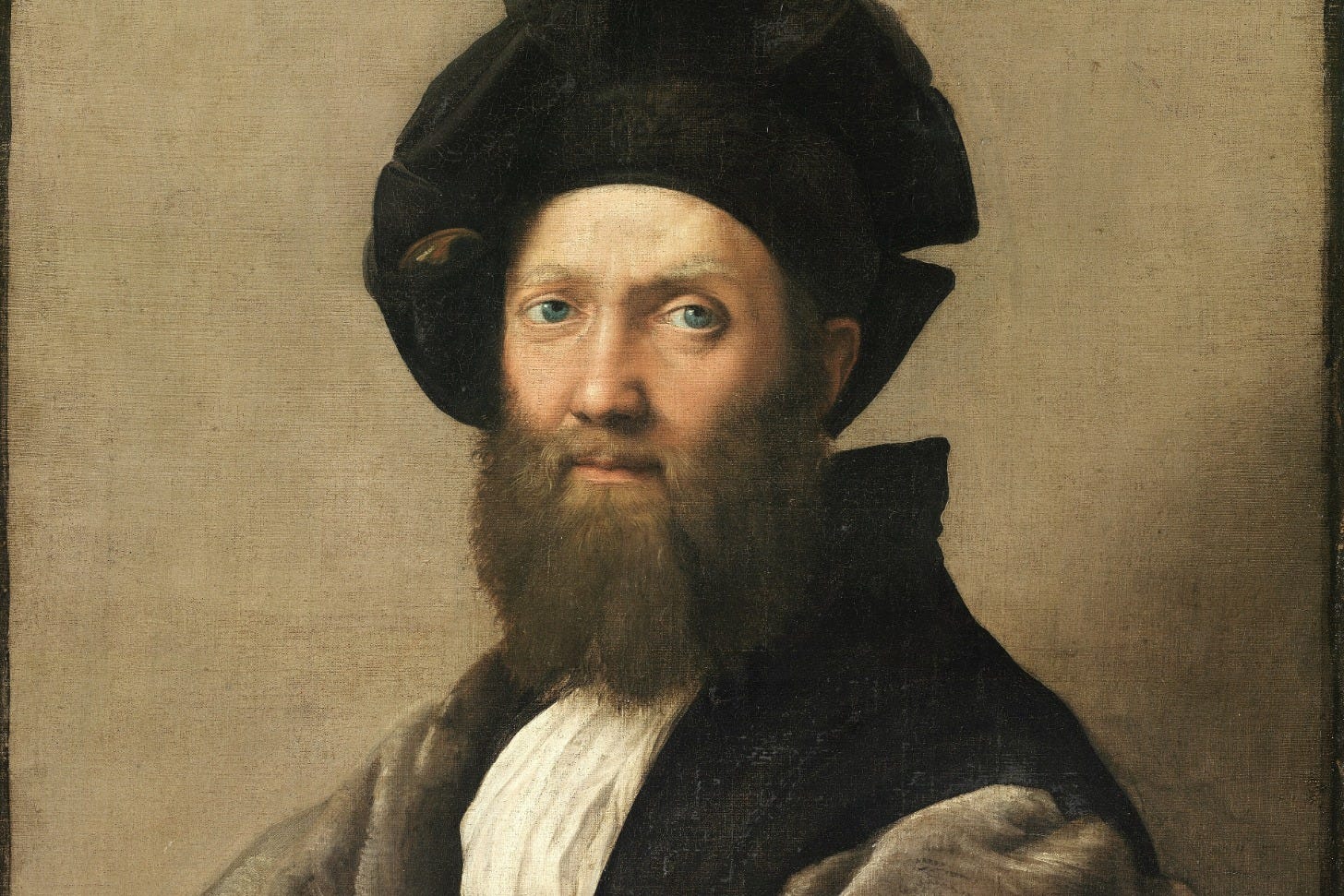
Baldassare Castiglione | Raphael, Rome, ca. 1514–1515
Why did Petrarch climb a mountain?
Key Terms for this Lesson
Sonnet · Sprezzatura · The Prince
Petrarch | 1304–1374
Boccaccio’s friend Petrarch (d. 1374) took the next step (cf. Sec. 14.6). His father, a Florentine exiled with Dante’s party, raised him near Avignon in the years of the popes there (cf. Sec. 14.2). Petrarch collected and copied ancient texts, and in this way contributed to the rebirth of the classics. He found Cicero’s speech for the poet Archias in 1333 (cf. Sec. 1.1) and Cicero’s lost letters in 1345. He is often called the father of humanism (cf. Sec. 15.2), and on April 8, 1341, Rome crowned him poet laureate on the Capitoline Hill.
Petrarch tells how in April 1336 he and his brother climbed Mont Ventoux, the “Giant of Provence.” “My only motive,” he wrote to a friend, “was the wish to see what so great an elevation had to offer.” Few people before him had climbed a mountain for the view. At the summit he looked out toward the mountains of Lyons and the bay of Marseilles. Then he opened the copy of Augustine’s Confessions that he always carried (cf. Sec. 10.5) — and his eye fell on a line about men who wonder at mountains and seas “but themselves they consider not”:
I closed the book, angry with myself that I should still be admiring earthly things who might long ago have learned from even the pagan philosophers that nothing is wonderful but the soul, which, when great itself, finds nothing great outside itself. Familiar Letters (4.1, trans. James Harvey Robinson)
Petrarch climbed the mountain to see what the world had to offer, and the view sent him back into himself. The humanists would make both journeys, outward to the world and inward to the self. Petrarch wrote his Latin works for fame, but his Italian love poems made him famous. His Canzoniere (It. songbook) gathers 366 poems, 317 of them sonnets, most of them for Laura, a woman he first saw in church at Avignon in 1327 and loved from afar. She died in the plague of 1348 (cf. Sec. 14.1). A sonnet (It. little song) is a poem of fourteen lines, which in Petrarch’s form divides into a question or problem in eight lines and an answer in six. For three centuries, poets across Europe wrote sonnets on Petrarch’s model.
Castiglione & the Courtier | 1528
Baldassare Castiglione (d. 1529) was a soldier and diplomat at the court of Urbino. The Book of the Courtier (1528) sets down four evenings of conversation there in 1507, presided over by the Duchess, Elisabetta Gonzaga. The question is what the perfect courtier should be. He should be skilled in arms and in letters, Latin and Greek, a judge of painting, a singer and musician (cf. Sec. 15.4). Above all, he should make all of it look easy. Castiglione’s Count Ludovico, “to use possibly a new word,” calls for “a certain nonchalance that shall conceal design and show that what is done and said is done without effort and almost without thought” (1.26, trans. Leonard Eckstein Opdycke). Sprezzatura is Castiglione’s word for this studied ease: the art that hides the art. Women wrote as humanists too. Laura Cereta (d. 1499) of Brescia answered, in two letters, the men who doubted a woman could write so well and the women who said she overstepped.
Machiavelli & the Prince | 1513
Niccolò Machiavelli (d. 1527) served the Florentine republic for fourteen years as a secretary and diplomat (cf. Sec. 15.1). When the Medici returned in 1512, he lost his post. Early in 1513 he was imprisoned, then released to a small farm outside the city. In the evenings, he wrote to a friend, he took off his muddy work clothes, put on the robes of a court, and entered the company of the ancients to question them. In 1513 he wrote a short book for a Medici prince.
The Prince (written 1513, printed 1532) is Machiavelli’s handbook for a ruler who means to gain and hold a state, built on what rulers do rather than on what they ought to do. It is a form of humanism that focused on practical politics, a secular study of power drawn from Roman history and his own experience. Machiavelli argued that a prince must know how to use both the law and force, as both the fox and the lion: “the lion cannot defend himself against snares and the fox cannot defend himself against wolves” (18, trans. W. K. Marriott). He asked whether it is better to be loved or feared, and answered that it is “much safer to be feared than loved,” if one must choose (17). Machiavelli never wrote “the end justifies the means,” though the phrase is pinned to him. What he wrote is that men judge princes “by the result” (18). The quality he wants in a prince is virtù, the energy and skill to master fortune. His readers have argued ever since over whether The Prince is a warning or a recipe.
Sec 15 • The Renaissance
15.1 History & Politics • Florence & the Medici
15.2 Philosophy • Pico, Erasmus, & Humanism
15.3 Art & Architecture • Brunelleschi, Leonardo, & Raphael
15.4 Music • Josquin & the Art of Polyphony
15.5 Literature & Drama • Petrarch, Castiglione, & Machiavelli
15.6 Religion • Savonarola & the Eve of Reform
Course Page: Humanities I & II