

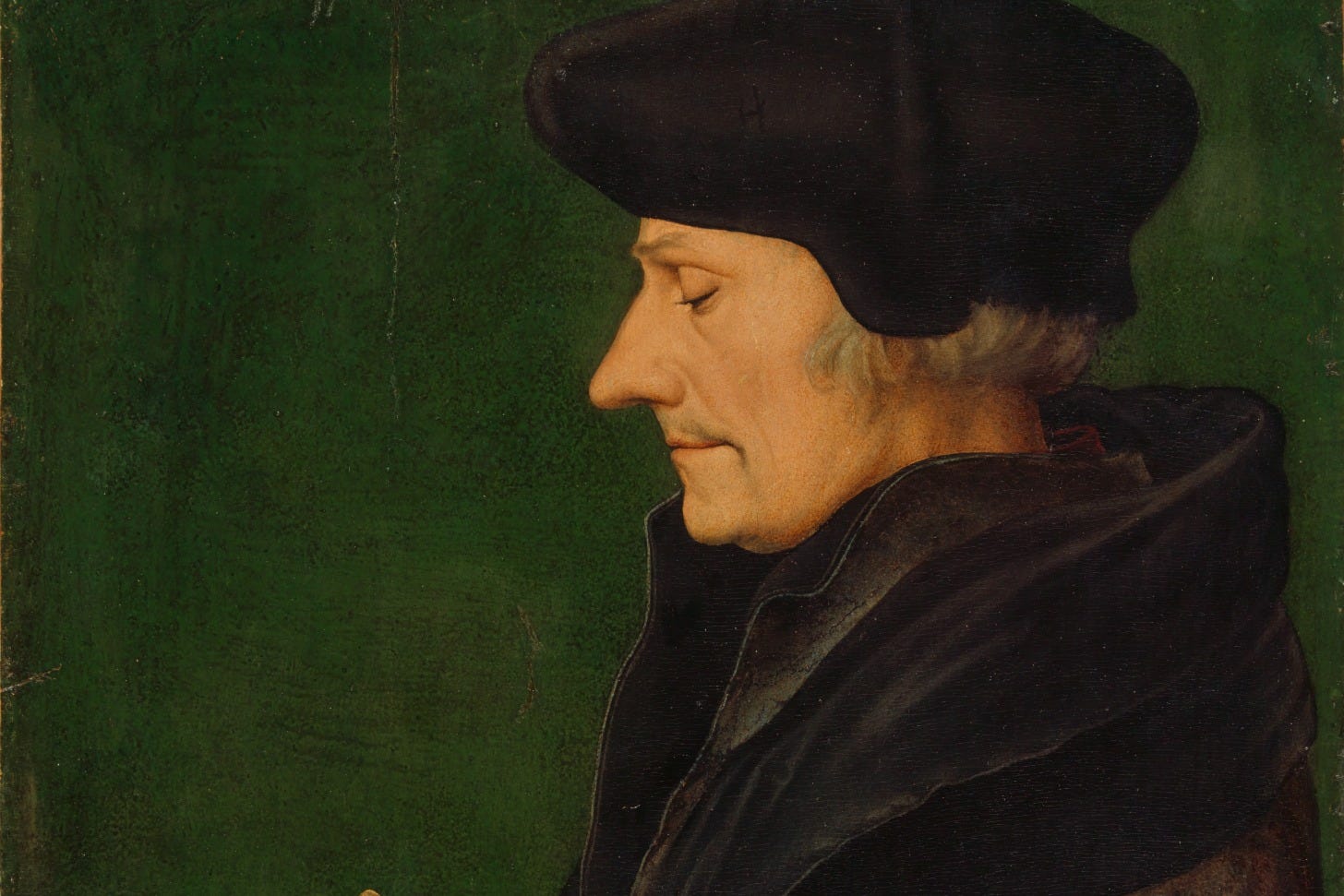
Erasmus of Rotterdam | Hans Holbein the Younger, Basel, 1523
Why did a 23-year-old offer to debate all of Rome on 900 theses?
Key Terms for this Lesson
Humanism · Oration on the Dignity of Man · Praise of Folly
Ad Fontes | The Humanists, 1333–1453
Humanists like Petrarch (d. 1374) and Erasmus (d. 1536) took another look at long-forgotten Greco-Roman ancient texts, not just philosophy but the literature and theater of antiquity. They marveled at our past achievements and dared to wonder what humanity might be capable of. In 1333, Petrarch found a forgotten copy of Cicero’s speech for the poet Archias, which praised the studia humanitatis, the studies of humanity. By the late 1400s the teachers of that curriculum were nicknamed the humanists (cf. Sec. 1.1). Humanism is the Renaissance movement to recover the languages, books, and ideals of Greek and Roman antiquity, and to educate citizens through the studies of humanity: grammar, rhetoric, poetry, history, and moral philosophy. Their motto was ad fontes (Lt. to the sources).
The humanists kept the old liberal arts (cf. Sec. 12.4) but gave them a new center. The universities trained students in logic for the disputations of Scholasticism (cf. Sec. 13.6, 14.3). The humanists trained them to write and speak like Cicero. Humanists generally skipped over the philosophical thought of the Medieval world, and many of them mocked the schoolmen’s Latin as barbarous. Humanism was a revolution in education before it was a philosophy.
Then came Greek. In 1397, Florence hired the Byzantine scholar Manuel Chrysoloras (d. 1415) to teach it. When Constantinople fell to the Ottoman Turks in 1453, Greek scholars and their books came west, and in Florence, Cosimo’s young scholar Marsilio Ficino (d. 1499) translated all of Plato into Latin (cf. Sec. 15.1).
Pico & the 900 Theses | 1486
Giovanni Pico della Mirandola (d. 1494) was a young count who studied canon law at Bologna, Aristotle at Padua and Paris, and Hebrew with Jewish teachers, and who read Plato with Ficino’s circle. He had once defended the “barbarous” schoolmen against a humanist friend: wisdom, he wrote, matters more than style. In 1486, at twenty-three, he published nine hundred theses drawn from Latin schoolmen, Arab philosophers (cf. Sec. 13.6), Greek Platonists, and Jewish mystics. He offered to pay the travel of any scholar who would come to Rome and debate him on any of them. Pico offered to debate all of Rome because he believed that every school, Plato’s and Aristotle’s, Christian, Jewish, and Arab, held a part of one truth, and that a free mind could gather them into one. He called it a philosophical peace. Pope Innocent VIII (d. 1492) suspended the debate, and a papal commission found thirteen theses suspect. When Pico defended them, the pope condemned all nine hundred, and Pico fled to France, where he was briefly held. He came back to Florence under Lorenzo’s protection.
Pico wrote a speech to open the debate — and it was never delivered. The Oration on the Dignity of Man (written 1486) is Pico’s speech arguing that human beings, alone among creatures, have no fixed place in the world and may make of themselves what they choose. It opens on a saying Pico found in the records of the Arabs, that nothing in the world is more wonderful than man. Then Pico imagines God speaking to Adam:
We have given you, Adam, no fixed seat, no form of your own, no gift peculiar to you, so that whatever seat, whatever form, whatever gifts you yourself shall choose, you may have and possess them by your own wish and judgment. Oration on the Dignity of Man (my translation)
Adam, Pico’s God goes on, may sink to the beasts or, by his own soul’s judgment, rise to the divine. It is the boldest statement of the humanists’ confidence, three centuries before Kant (d. 1804) told his readers, Sapere aude (cf. Sec. 1.1).
Erasmus & the Praise of Folly | 1509–1516
Desiderius Erasmus of Rotterdam was a wandering scholar and author, a canon regular and a priest. Often called the prince of the humanists, he argued we should combine classical learning with Christian living, in what he called the philosophy of Christ. He studied at Paris and spent three years in Italy (1506–1509), the home of the new learning. Riding north over the Alps toward England in 1509, he thought of his friend Thomas More (d. 1535), whose name sounds like the Greek moria, folly, and in More’s London house, he later said, he wrote a book in a week.
The Praise of Folly (1511) is Erasmus’ satire in which Folly gives a speech in her own honor, holding up the foolishness of every rank, scholars and churchmen included, so that readers might laugh their way toward wisdom. He resolved, he told More, “to make some sport with the praise of folly,” but “such toys are not without their serious matter” (trans. John Wilson). Written largely as a joke, it ran through dozens of editions in his lifetime.
Then Erasmus went to the sources himself. In 1516 he brought out the first published Greek New Testament, with his own Latin translation beside it. The humanists’ road had run from Cicero’s speech for a poet to the Greek of the Gospels.
Sec 15 • The Renaissance
15.1 History & Politics • Florence & the Medici
15.2 Philosophy • Pico, Erasmus, & Humanism
15.3 Art & Architecture • Brunelleschi, Leonardo, & Raphael
15.4 Music • Josquin & the Art of Polyphony
15.5 Literature & Drama • Petrarch, Castiglione, & Machiavelli
15.6 Religion • Savonarola & the Eve of Reform
Course Page: Humanities I & II