

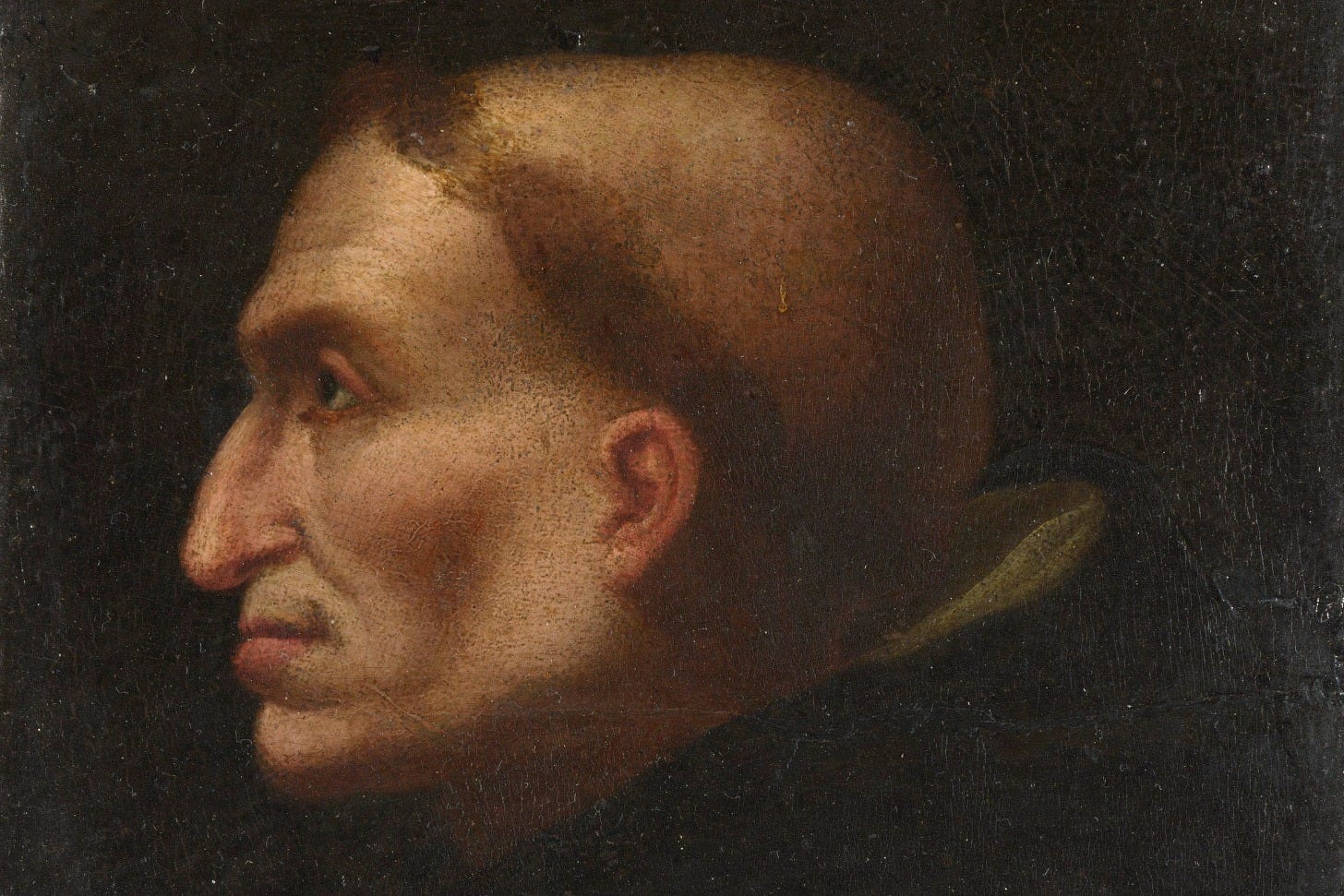
Girolamo Savonarola | Florentine painter, ca. 1520
Why did Florence burn its own paintings?
Key Terms for this Lesson
Conciliarism · Savonarola · Bonfire of the Vanities
Council & Pope | 1417–1494
The Council of Constance ended the Western Schism in 1417 (cf. Sec. 14.2). It had also decreed that, in such a crisis, a general council could judge a pope, and it called for the reform of the Church “in head and members.” Conciliarism is the movement that held that a general council of the Church had authority above the pope, strongest from the Council of Constance (1414–1418) to the Council of Basel (1431–1449). That question, whether a council stood above a pope, would not go away (cf. Sec. 14.2). The Council of Basel quarreled with Pope Eugenius IV (d. 1447) for years, and in 1460 Pope Pius II (d. 1464) forbade any appeal from a pope to a future council.
Constance had also condemned the teachings of two men who wanted the Church reformed by scripture: John Wycliffe (d. 1384) in England and Jan Hus (d. 1415) in Bohemia. Meanwhile, the Renaissance popes ruled central Italy as princes and spent as patrons, as the Medici did (cf. Sec. 15.1). Sixtus IV (d. 1484) built the Sistine Chapel, and Julius II called Raphael and Michelangelo to work in Rome (cf. Sec. 15.3). Many Christians, clergy and laity alike, longed for a simpler and more serious faith. The friars had answered that longing nearly three centuries earlier (cf. Sec. 13.3). In Florence, a friar answered it again.
Savonarola | 1452–1498
Girolamo Savonarola (d. 1498) was born in Ferrara and joined the Dominicans in 1475. In 1490, at Pico’s request (cf. Sec. 15.2), Lorenzo de’ Medici allowed him to return to the Dominican convent of San Marco in Florence, which Cosimo had rebuilt. Savonarola was the Dominican preacher who led Florence in a campaign of repentance and moral reform from 1494 to 1498, until the city turned against him. He preached against luxury, gambling, and the worldliness of the clergy, and he warned that a scourge was coming to Italy. In 1494 the scourge seemed to come. King Charles VIII (d. 1498) of France marched into Italy, the Medici were driven out, and Savonarola himself went to meet the king. Florence rebuilt its republic around a Great Council, and Savonarola preached that Christ should be its king. Botticelli and Pico came under his preaching.
The Florentine shopkeeper Luca Landucci (d. 1516), who kept a diary through these years, reported 15,000 people at the friar’s weekday sermons. He watched Savonarola organize the boys of Florence into bands — singing in the streets, collecting alms for the poor, carrying crucifixes at the corners, and going from door to door to ask families to give up their “vain things.” For a few years, Florence tried to live as a city of saints.
The Bonfire of the Vanities | 1497–1498
On the last day of Carnival, February 7, 1497, the boys built a great pyramid of these things in the Piazza della Signoria, the city’s main square, and set it alight. They did it again the next year, and Landucci recorded it:
There was made on the Piazza de’ Signori a pile of vain things… playing-boards, heretical books… mirrors, and many other vain things, of great value, estimated at thousands of florins. A Florentine Diary (February 27, 1498, trans. Alice de Rosen Jervis)
The Bonfire of the Vanities was the public burning of luxuries, games, books, and works of art that Savonarola’s followers held in Florence at Carnival in 1497 and 1498. Tradition says Botticelli brought some of his own paintings to the fire, as Vergil had once asked for his own poem to be burned (cf. Sec. 8.3). Florence burned its own paintings because, for a few years, its people believed the friar: that Italy’s sins had brought the French army to its gates, and that a city made pure would be spared.
It did not last. In May 1497 Pope Alexander VI (d. 1503) excommunicated Savonarola, and the friar kept preaching and wrote to the kings of Europe urging them to call a council against the pope. Hunger, plague, and a failed war with Pisa wore the city down, and the crowds who had cheered the friar turned. In May 1498 Florence put Savonarola to death in the same square where the vanities had burned. Landucci had seen it coming: of the city’s new modesty in 1495, he wrote that “it did not last long.”
Within twenty years, the question of reform would come back in Germany. Critics in Erasmus’ own day said that he laid the egg of religious reform that Martin Luther (d. 1546) hatched (cf. Sec. 15.2), and Humanities II begins there.
Sec 15 • The Renaissance
15.1 History & Politics • Florence & the Medici
15.2 Philosophy • Pico, Erasmus, & Humanism
15.3 Art & Architecture • Brunelleschi, Leonardo, & Raphael
15.4 Music • Josquin & the Art of Polyphony
15.5 Literature & Drama • Petrarch, Castiglione, & Machiavelli
15.6 Religion • Savonarola & the Eve of Reform
Course Page: Humanities I & II