

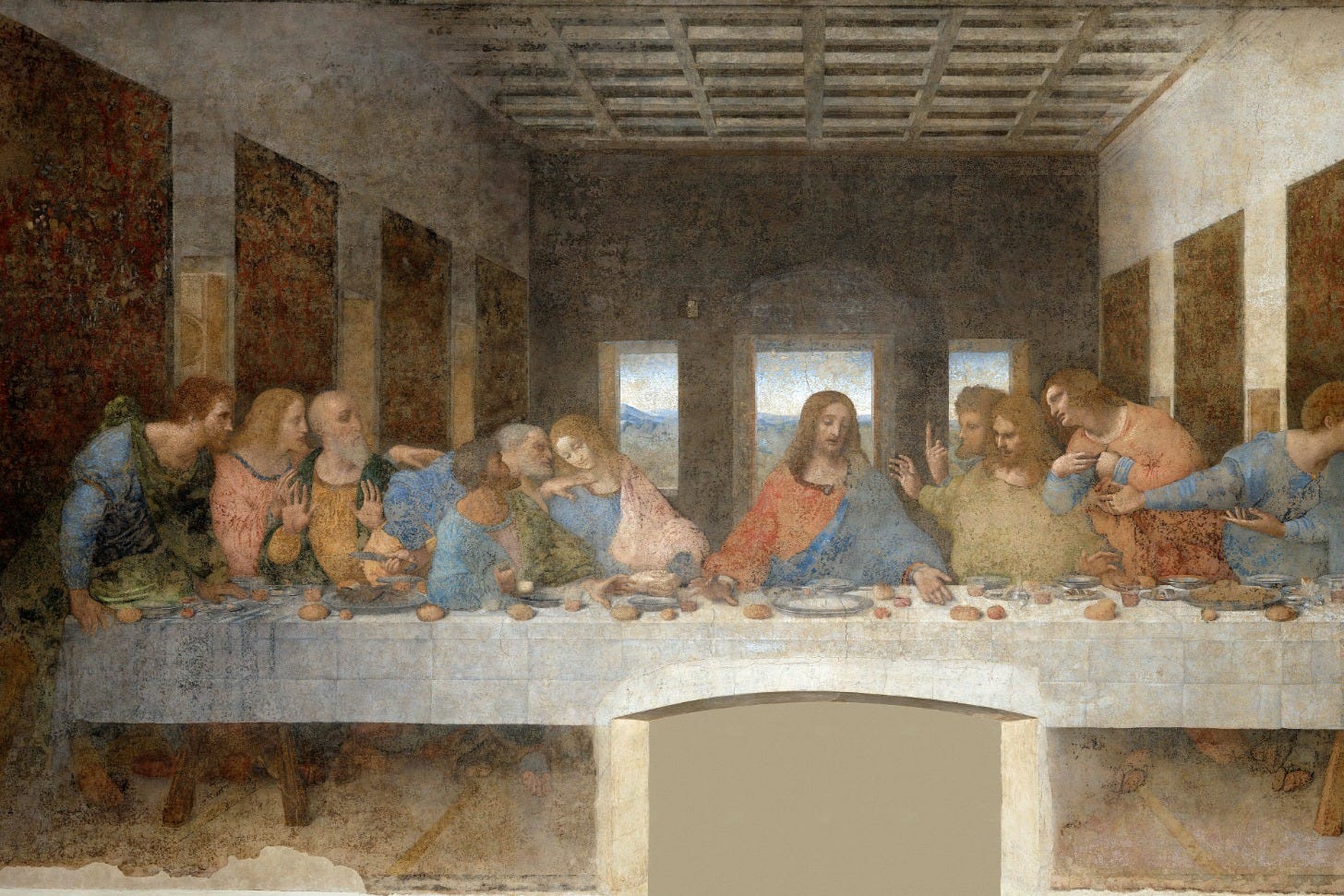
The Last Supper | Leonardo da Vinci, Milan, ca. 1495–1498
Why did Florence build a cathedral when they did not know how to build the roof?
Key Terms for this Lesson
Linear Perspective · Sfumato · High Renaissance
Brunelleschi & the Dome | 1418–1436
Florence began its new cathedral, Santa Maria del Fiore, in 1296. Giotto designed its bell tower (cf. Sec. 14.5). In 1367 the city approved a plan for an eight-sided dome some 140 feet across, about as wide as the Pantheon in Rome (cf. Sec. 8.4), and it was to stand without the flying buttresses of the Gothic north (cf. Sec. 13.5). No one alive knew how to build it. For half a century the plan waited for a builder. Florence built a cathedral when they did not know how to build the roof because they trusted that their own genius would find a way, and the man who found it looked back to Rome to do it.
Filippo Brunelleschi (d. 1446) was a goldsmith who had lost the 1401 competition for the Baptistery’s bronze doors to Lorenzo Ghiberti (d. 1455). Ghiberti’s later doors are the ones Michelangelo (d. 1564) is said to have called the “Gates of Paradise.” Brunelleschi went to Rome instead, Vasari says, to measure the ruins. In 1418 he entered the competition for the dome, and in 1420 he won it. His plan used two shells, an inner and an outer, with bricks laid in a herringbone pattern so that each ring held itself up as it rose, and no wooden frame was built from the ground. An ox-driven hoist of his own design lifted some four million bricks. The dome was closed in 1436, and it is still often called the largest brick dome ever built. Michelangelo, designing St. Peter’s dome in Rome, is said to have promised Florence a sister to Brunelleschi’s, “bigger but no more beautiful.”
Brunelleschi also worked out how to paint the world as the eye sees it. Linear perspective is the system of drawing in which parallel lines meet at a single vanishing point, so that a flat picture shows depth as the eye sees it. Leon Battista Alberti (d. 1472) wrote down the rules in 1435, and painters across Italy learned them. The painter and biographer Giorgio Vasari (d. 1574) named the age a rinascita, a rebirth, and called the medieval style the manner of the Goths. Of Brunelleschi he wrote:
[H]e was sent to us by Heaven in order to give new form to architecture, which had been out of mind for hundreds of years; for the men of those times had spent much treasure to no purpose, making buildings without order, with bad method, with sorry design, with most strange inventions, with most ungraceful grace, and with even worse ornament. Lives of the Artists (Brunelleschi, trans. Gaston du C. de Vere)
Leonardo | 1452–1519
Leonardo da Vinci (d. 1519) is often called the genius of the Renaissance. Trained in Florence, he went to Milan in 1482 to serve its ruler, and there he painted the Last Supper (ca. 1495–1498) on the wall of a convent dining hall. He chose the moment after Jesus says, “one of you shall betray me” (Matthew 26:21), and set the twelve disciples reacting in four groups of three, every line of the room’s perspective meeting at the head of Christ. He did not paint it in true fresco (cf. Sec. 14.5), and the paint began to flake within his lifetime.
Giotto had given painted bodies weight (cf. Sec. 14.5). Leonardo wanted to know how that weight was carried, and he studied the bones and muscles beneath the skin and the proportions of the body (as in the drawing that heads Sec. 1.1). His notebooks, some 7,000 pages in mirror script, also hold flying machines and plans for an ideal city. Yet fewer than twenty paintings by his hand survive. Leonardo finished so few paintings because, for him, painting was a form of research — and the research was never done. He kept his portrait of a Florentine merchant’s wife, the Mona Lisa, with him for years, softening it. Sfumato (It. smoky) is Leonardo’s technique of blending tones so softly, without hard outlines, that forms seem to emerge from shadow, as at the corners of the Mona Lisa’s mouth.
Raphael & the High Renaissance | 1500–1520
Raphael (d. 1520), a painter’s son from Urbino, came to Florence in 1504 to learn from Leonardo and Michelangelo. In 1508, Pope Julius II (d. 1513) called him to Rome to paint the rooms of the papal palace, while Michelangelo painted the ceiling of the Sistine Chapel nearby. The High Renaissance (ca. 1495–1520) is the brief summit of Renaissance art, when Leonardo, Michelangelo, and Raphael brought the Classical ideal of balance, proportion, and calm (cf. Sec. 7.2) to its fullest expression.
Raphael’s School of Athens (1509–1511) gathers the philosophers of Greece under coffered vaults like those of ancient Rome. At the center, Plato points upward to the Forms and Aristotle holds his hand level over the earth (cf. Sec. 7.6). Raphael is said to have given Plato the face of Leonardo. When Raphael died on Good Friday, 1520, at thirty-seven, Rome buried him in the Pantheon itself.
Sec 15 • The Renaissance
15.1 History & Politics • Florence & the Medici
15.2 Philosophy • Pico, Erasmus, & Humanism
15.3 Art & Architecture • Brunelleschi, Leonardo, & Raphael
15.4 Music • Josquin & the Art of Polyphony
15.5 Literature & Drama • Petrarch, Castiglione, & Machiavelli
15.6 Religion • Savonarola & the Eve of Reform
Course Page: Humanities I & II