

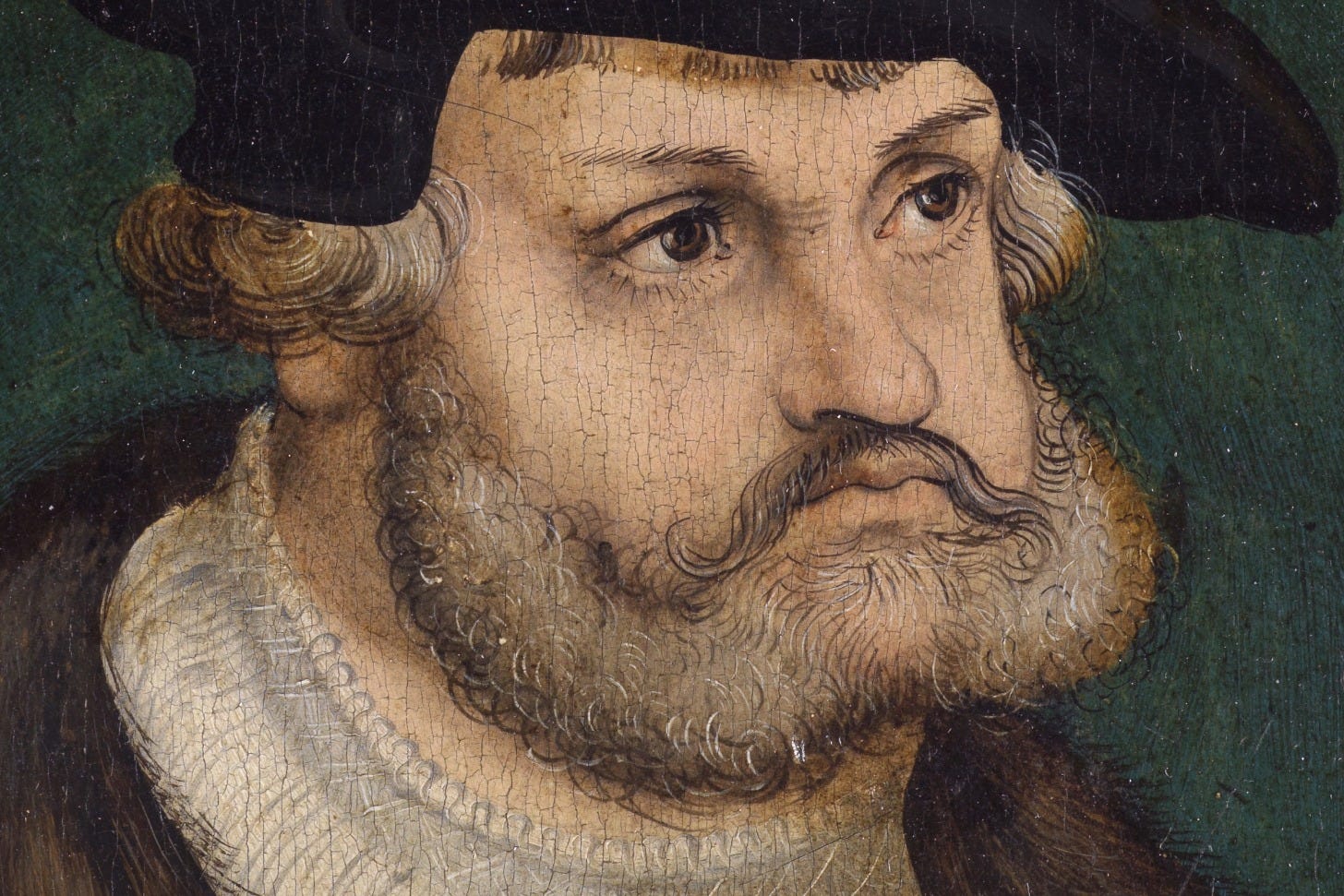
Frederick the Wise, Elector of Saxony | Lucas Cranach the Elder, 1525 (detail)
Why did German princes protect a condemned monk?
Key Terms for this Lesson
Indulgence · Protestant · Peace of Augsburg
Wittenberg, 1517 | Indulgences & the Theses
Before Luther, Roman Catholic Christianity had been the predominant religion of Europe since Roman antiquity. One Church in the West, one Latin Mass, one pope. The humanists had checked its Latin Bible against the Greek (cf. Sec. 1.6). No one had checked its finances.
An indulgence remitted the punishment still due after a sin was forgiven, time a soul would otherwise spend being purified in purgatory. Indulgences started out as rewards for pious acts: a crusade, a pilgrimage, a gift toward a church or a hospital. In time the Church sold these certificates to pay for schools, hospitals, and church upkeep. You pay the Church, and the Church remits the penance. However, the sale got out of hand when wealthy congregants could essentially pay their way out of guilt. By the 1500s indulgences were being sold to raise money, in part for the rebuilding of St. Peter’s in Rome (cf. Sec. 1.4), and a Dominican preacher named Johann Tetzel (d. 1519) was marketing them in Germany with slogans that made forgiveness a transaction. People spent a fortune on this.
Martin Luther (d. 1546), a German biblical scholar and Augustinian monk, had arrived at the University in Wittenberg in 1511. He was appalled. On October 31, 1517, he drew up the Ninety-Five Theses, scholarly propositions attacking the sale of indulgences, posted as an invitation to debate. Ensuring that everyone and not just the people in Wittenberg would hear his request, Luther also sent the document to his archbishop (cf. Sec. 2.2). Luther wanted an honest discussion. Instead he got a series of Church leaders arguing that he ought to be obedient to Rome. What turned an academic quarrel into a revolution was the printing press (cf. Sec. 1.3). Within months the Theses had been reprinted across Germany, and the prints stoked a popular movement protesting for the reform of the Church. Let’s be clear: Luther had set out to reform the church, not to leave it. But events, and his own convictions, carried him past reform.
The Emperor & the Elector | 1520–1521
In June 1520 Pope Leo X (d. 1521) threatened Luther with excommunication and commanded Christians to burn his writings. In defiance of the Church, Luther burned the bull (letter from the Pope) in Wittenberg on December 10, 1520. The people, many of whom were students and those who listened to his many arguments, cheered him on. The excommunication followed on January 3, 1521. Already, in 1520, Luther had written treatises in German to the people of Germany, not the Church leaders, but the people themselves — among them the Open Letter to the Christian Nobility of the German Nation. It was about souls. It was also about money, and he knew who was listening:
Now that Italy is sucked dry, they come into Germany, and begin oh, so gently. But let us beware, for Germany will soon become like Italy. … How comes it that we Germans must put up with such robbery and such extortion of our property, at the hands of the pope? Open Letter to the Christian Nobility (trans. C. M. Jacobs)
What was the Church’s response to all these activities? To call in the civil authorities. The newly elected Holy Roman Emperor, Charles V (d. 1558), was 21 years old when he called Luther to a formal hearing at the Diet of Worms in April 1521. Luther went, owned his books, and refused to recant (cf. Sec. 2.5). Charles kept his word: Luther left the hearing unharmed, under the safe conduct that had brought him. The Edict of Worms that followed in May made Luther an outlaw. But by then he had vanished. On the road home, armed horsemen had dragged him into the forest. The kidnappers worked for his own prince.
That prince was Frederick III (d. 1525), Elector of Saxony, called “the Wise.” He never left the Roman church. He kept a vast relic collection in his castle church, and he and Luther seem never to have spoken face to face. Yet since 1518 he had refused every demand to hand his professor over to Rome. Now he hid Luther at the Wartburg. Still in danger, Luther spent the next ten months in hiding, translating the New Testament into German (cf. Sec. 2.2). The hymns would come later (cf. Sec. 2.3). Wittenberg was his university, founded in 1502, and Luther was its star. A subject condemned without a hearing was an insult to his jurisdiction. And the money Luther complained of was leaving his Saxony for Rome. Conscience, pride, and the purse pointed the same way.
From Speyer to Augsburg | 1529–1555
Charles V could not stop it. He was at war with France, and the Ottoman Turks were at the gates: Suleiman the Magnificent (d. 1566) took Hungary at Mohács in 1526 and marched on Vienna in 1529. With Suleiman’s siege of Vienna in 1529, the Lutherans were placed in a favorable position to force concessions of the Habsburg Holy Roman Emperor Charles V. When the Diet of Speyer moved that same spring to enforce the Edict of Worms, six princes and fourteen free cities signed a formal protestatio on April 19, 1529. The word Protestant was born there — in the mouths of princes, not of theologians. In 1530 the princes handed Charles the Augsburg Confession, and in 1531 they formed the Schmalkaldic League for their defense. Luther’s struggle with Charles V could have gone very differently had Suleiman’s armies not been knocking at Germany’s door.
The princes who went Lutheran took the monasteries and bishoprics in their lands into their own treasuries, named their own pastors, and answered to no bishop in Rome. Philip of Hesse (d. 1567) did it in 1527. Luther died in February 1546. Charles went to war against the League that summer and crushed it at Mühlberg in 1547. The princes’ churches stayed Lutheran.
• 1517 | Luther’s Ninety-Five Theses, Wittenberg
• 1521 | The Diet of Worms, and Luther hidden at the Wartburg
• 1529 | The Protestatio at Speyer, and Suleiman at Vienna
• 1530 | The Augsburg Confession presented to Charles V
• 1555 | The Peace of Augsburg
On September 25, 1555, the Peace of Augsburg, signed in Charles’s name, gave German princes permission to dictate the religion of their realm, Lutheran or Catholic. A later jurist gave the rule its Latin tag, cuius regio, eius religio, “whose the region, his the religion” (1582). It ended the fighting between Lutherans and Catholics for two generations, until the Thirty Years’ War (1618–1648). But it wrote into imperial law what Frederick the Wise had done in 1521 on his own authority: the prince, not the pope, would decide what his people heard on Sunday. Western Christianity, one Church for a thousand years, now split North and South. Christendom (cf. Humanities I, Sec. 10) had become a map of territories, each with its own confession. Why did German princes protect a condemned monk? Some of them believed him. All of them gained by him.
Sec 2 • The Reformation
2.1 History & Politics • Luther & the Fracturing of Christendom
2.2 Literature & Drama • 95 Theses & the German Bible
2.3 Music • “Ein feste Burg” & the Chorale
2.4 Art & Architecture • Dürer’s Prints & the Image of Reform
2.5 Philosophy • Conscience & Authority at Worms
2.6 Religion • Trent & the Counter-Reformation
Course Page: Humanities I & II