

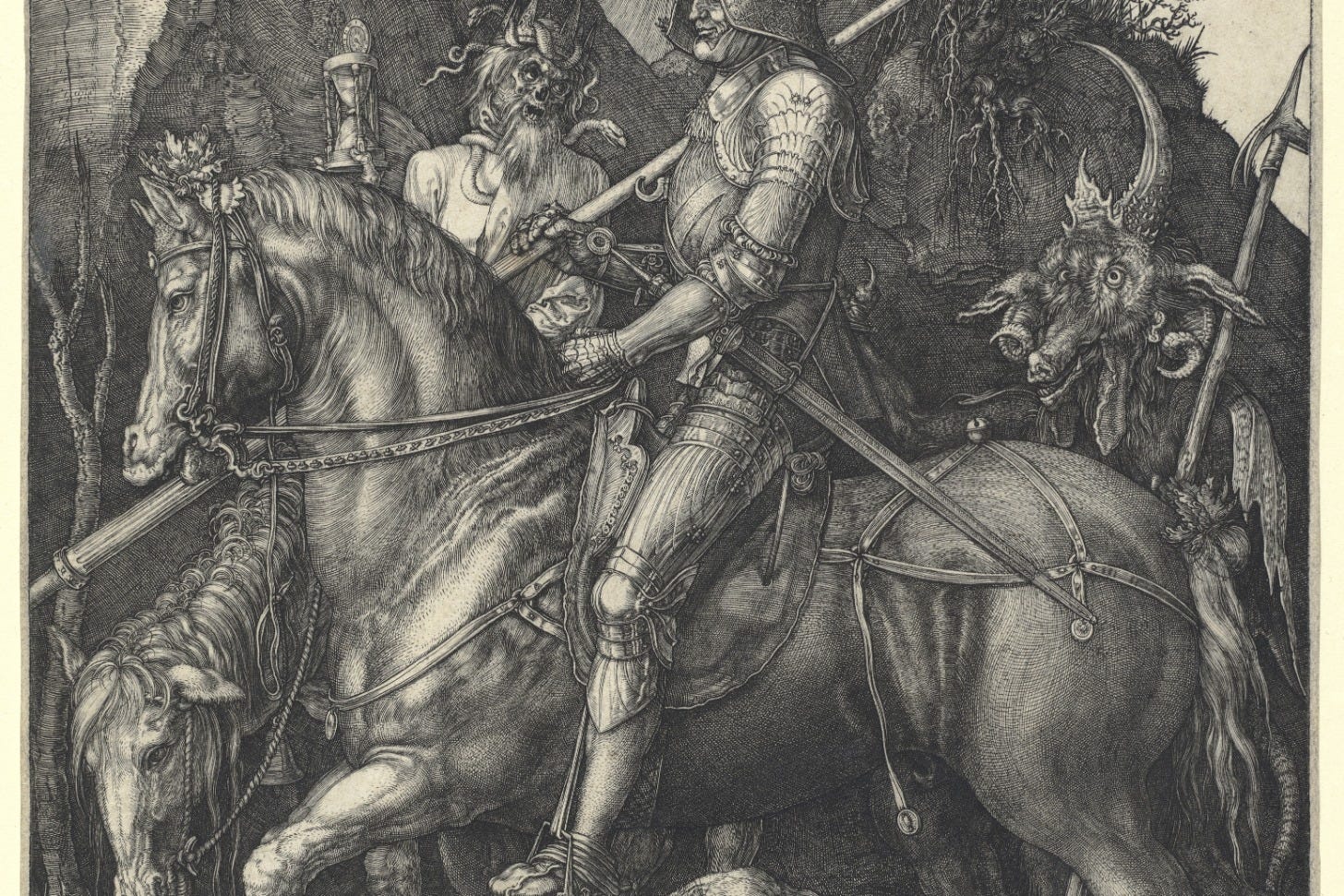
Knight, Death and the Devil | Albrecht Dürer, 1513 (detail)
Why was the Reformation fought with woodcuts?
Key Terms for this Lesson
Woodcut · Engraving · Four Apostles
Nuremberg | Dürer & the Multiplied Image
Albrecht Dürer (d. 1528) was the first great artist whose fame rested on pictures that existed in hundreds of copies. Born in Nuremberg in 1471, a goldsmith’s son, apprenticed to a woodcut maker, he went twice to Italy and came home with the perspective and anatomy of the Italians (cf. Sec. 1.4). He has been called the Leonardo of the North. But where Leonardo left a handful of paintings, Dürer left an industry.
Two techniques carried it. A woodcut is cut in relief: the artist draws on a block of wood, a cutter carves away everything that is not a line, and the raised lines take the ink. It is cheap, it prints on the same press as type, and a block survives thousands of impressions. An engraving is cut into copper with a steel tool called a burin. The ink sits in the grooves, the plate prints as a mirror image, and the line can be as fine as a hair. Woodcuts were for the many — engravings were for collectors. In 1498 Dürer published the Apocalypse, the Book of Revelation in 15 full-page woodcuts, in Latin and German editions, and sold it himself. No patron commissioned it. He was the author, the illustrator, and the publisher, and the Four Horsemen rode off his press into every corner of Europe. His three master engravings of 1513–1514, Knight, Death and the Devil, Saint Jerome in His Study, and Melencolia I, were aimed at connoisseurs who paid for the fineness of the line.
The business model mattered as much as the art. An image that could be printed could travel without its maker, be sold at a fair, be pasted on a wall, be copied in another city. Early works by reformers that were duplicated in bulk could not be destroyed as easily (cf. Sec. 1.3). Neither could their pictures.
Antwerp, 1521 | Dürer & Luther
Dürer never met Luther, but he read him. On May 17, 1521, in Antwerp, he heard that Luther had been seized after Worms (cf. Sec. 2.1), and his travel journal records a lament:
Oh God, if Luther be dead, who will henceforth expound to us the holy Gospel with such clearness? What, oh God, might he not still have written for us in ten or twenty years! … Hear, thou knight of Christ! Ride on by the side of the Lord Jesus. Guard the truth. Journal of the Journey to the Netherlands (trans. W. M. Conway)
The “knight of Christ” he calls on is Erasmus (cf. Sec. 1.6), whose portrait he engraved five years later. Scholars have doubted whether the lament is Dürer’s own or a later insertion, since the journal was first printed only in 1779. Read it as the journal gives it. In 1525 Nuremberg became a Lutheran city, and in 1526 Dürer gave its council his last great painting, the Four Apostles: John and Peter on one panel, Mark and Paul on the other, each over seven feet tall. Beneath them he had the calligrapher Johann Neudörffer (d. 1563) letter long warnings against false prophets, every word taken from Luther’s September Testament (cf. Sec. 2.2). Among them is John’s: “Beloved, believe not every spirit, but try the spirits whether they are of God: because many false prophets are gone out into the world” (1 John 4:1). A painting of saints, in a Protestant city, whose text was the German Bible. The panels hung in the town hall for a century, until a Bavarian duke took them to Munich in 1627, where they remain.
Wittenberg | Cranach’s Workshop & the Image of Reform
If Dürer was the Reformation’s sympathizer, Lucas Cranach the Elder (d. 1553) was its image-maker. Court painter to Frederick the Wise, Luther’s friend and the godfather of his son, Cranach ran the largest workshop in Germany, and from 1520 it turned out Luther’s face in series: the gaunt monk of 1520, the bearded “Knight George” of 1522, the married professor of 1529 beside his wife Katharina von Bora (d. 1552). Most Germans who knew what Luther looked like knew it from a Cranach print — not from Luther. The same workshop cut the 21 woodcuts for the September Testament’s Book of Revelation and the title pages of pamphlet after pamphlet. In 1521 it issued the Passional Christi und Antichristi, 13 pairs of woodcuts that set a scene from the life of Christ beside a scene from the life of the pope, with captions by Philip Melanchthon (d. 1560). The pictures did the arguing. A reader who could not read could still see the point. Catholic printers answered in kind, with Luther drawn as a seven-headed monster (1529).
Here the Reformers divided. In Wittenberg in 1522, while Luther was still at the Wartburg, his colleague Karlstadt (d. 1541) had the images stripped from the churches. Luther came home and preached against it. Images, he said, are neither commanded nor forbidden. The danger is in trusting them, not in having them, and a picture of a Bible story teaches the simple. Lutheran churches kept their altarpieces (Cranach painted the Wittenberg altar in 1547), while Zwingli’s Zürich and Calvin’s Geneva whitewashed theirs. In the Reformed churches, the art of the Protestant Reformation was subdued and understated, if there was any art at all. Rome’s answer, at Trent, would be the opposite (cf. Sec. 2.6).
Why was the Reformation fought with woodcuts? Because a woodcut was the only picture a peasant could own, because it printed on the same press as the pamphlet (cf. Sec. 2.2), and because it could be in a thousand places at once. Sola scriptura was a doctrine about words. Its first victories were won in pictures.
Sec 2 • The Reformation
2.1 History & Politics • Luther & the Fracturing of Christendom
2.2 Literature & Drama • 95 Theses & the German Bible
2.3 Music • “Ein feste Burg” & the Chorale
2.4 Art & Architecture • Dürer’s Prints & the Image of Reform
2.5 Philosophy • Conscience & Authority at Worms
2.6 Religion • Trent & the Counter-Reformation
Course Page: Humanities I & II