

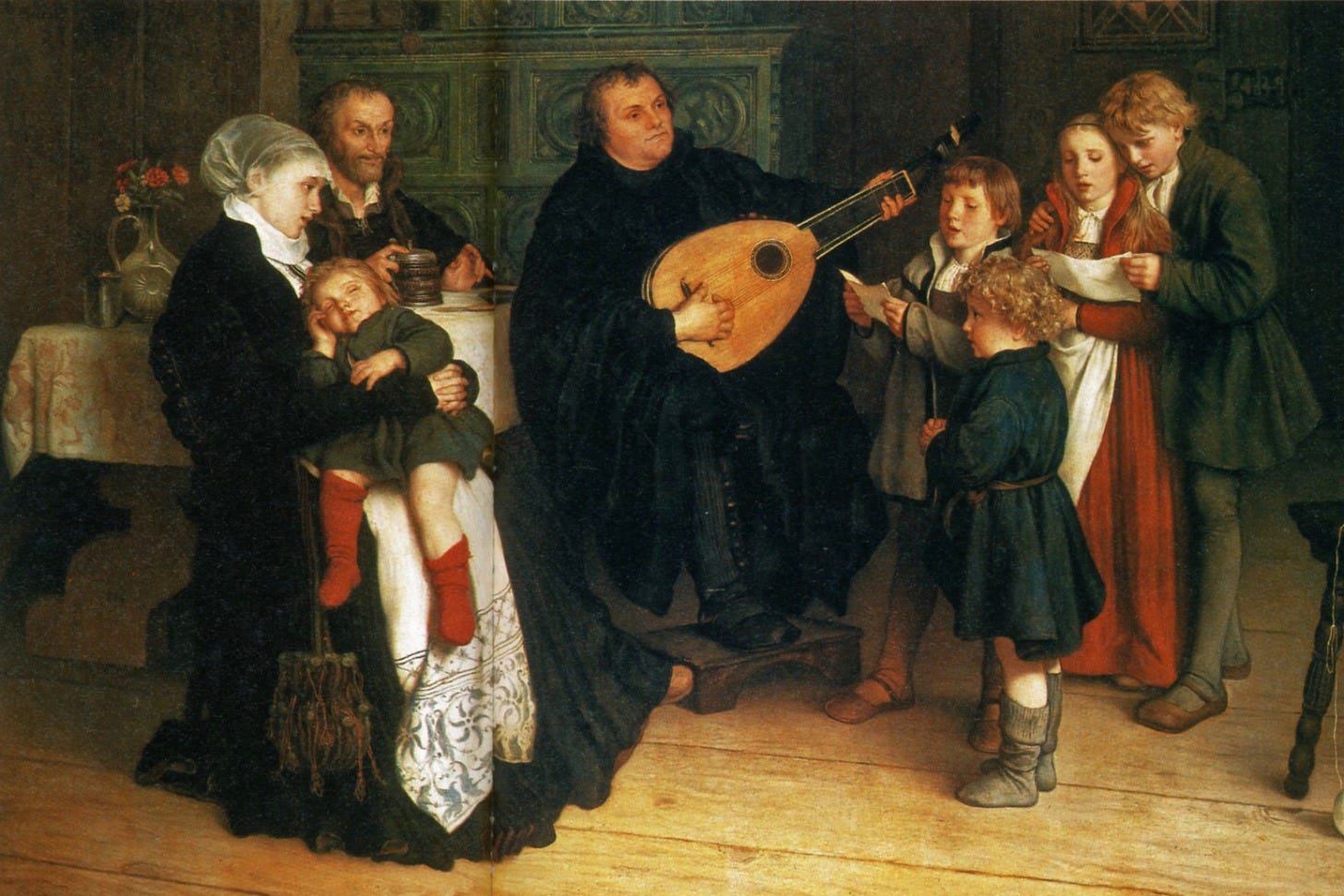
Luther Making Music in the Circle of His Family | Gustav Spangenberg, 1866 (detail)
Why did Luther want the whole congregation to sing?
Key Terms for this Lesson
Chorale · Hymnal · Ein feste Burg
Before Luther | Who Sang in Church
For a thousand years the music of the Western Church had belonged to the clergy. The congregation stood and listened. Monks and priests sang the chant (cf. Humanities I, 12.6), trained choirs sang the new polyphony (cf. Humanities I, 13.4), and in the chapels of popes and princes the finest composers in Europe, Josquin above all (cf. Humanities I, 15.4), wove four and five voices into Latin masses and motets that no congregation could have joined if it tried. The words were Latin. The music was for specialists. Print reached music before it reached Luther (cf. Sec. 1.5), but what Petrucci printed was music for those same specialists.
Luther loved that music. He had been a choirboy at Eisenach, he played the lute, and he kept Latin polyphony in the Wittenberg service all his life. Among all composers he singled out Josquin, saying that God had preached the Gospel through music too, as one could see in Josquin, whose compositions flow out freely and gladly, unforced by rules, like the song of a finch (Table Talk, 1530s, my paraphrase from the German). The Reformation did not simplify church music because Luther disliked it. It changed church music because of who Luther thought should be making it.
Wittenberg, 1524 | The Hymnal
In 1524 the Reformers printed the first Lutheran hymnals. The Achtliederbuch (the “eight-song book”) appeared in Nuremberg early that year, four of its eight hymns by Luther. The Erfurt Enchiridion followed with 26. And at Wittenberg, Johann Walter (d. 1570), the Elector’s choirmaster, issued the Geystliche gesangk Buchleyn, a book of hymns set for choir in four and five parts, with a preface by Luther himself. The preface is Luther’s charter for music:
I am not of opinion that all sciences should be beaten down and made to cease by the Gospel, as some fanatics pretend; but I would fain see all the arts, and music in particular, used in the service of Him who hath given and created them. Preface to Walter’s Hymnal (trans. Leonard Woolsey Bacon)
The form these books carried was the chorale: a hymn in German, in verses, set to a plain tune that a whole congregation could sing in unison. Some tunes were new. Many were borrowed, from Latin chant, from pilgrim songs, from secular melodies the people already knew, and fitted with German words. Luther wrote about 36 of them. Several are the catechism set to music: a hymn on the Ten Commandments, a hymn on the Lord’s Prayer, a hymn on the Creed. A congregation that could not read could still sing its doctrine. Walter’s four-part settings were for the choir, but the melody sat where the people could hear it and learn it. The chorale did for the ear what the German Bible did for the eye (cf. Sec. 2.2).
Not every reformer agreed. In Zürich, Ulrich Zwingli (d. 1531), himself a fine musician, had the organs removed and silenced singing in worship altogether (1525–1527), reading the New Testament as commanding a worship of the heart alone. In Geneva, John Calvin (d. 1564) allowed the congregation to sing, but only the Psalms, in unison, without instruments. Three Protestant answers to one question: Zwingli silenced the church, Calvin gave it the Psalter, and Luther gave it a songbook.
Ca. 1529 | Ein feste Burg
Luther’s best-known chorale is Ein feste Burg ist unser Gott, “A Mighty Fortress Is Our God,” written between 1527 and 1529. It is believed to have stood in Klug’s Wittenberg hymnal of 1529, of which no copy survives — the oldest copy we have is from 1531. It is a paraphrase of Psalm 46, which opens: “God is our refuge and strength, a very present help in trouble.” Luther’s first stanza, in the English of the New England minister Frederic Henry Hedge (d. 1890) — the 1853 version most American hymnals carry:
A mighty fortress is our God,
A bulwark never failing;
Our helper He, amid the flood
Of mortal ills prevailing:
For still our ancient foe
Doth seek to work us woe;
His craft and power are great,
And, armed with cruel hate,
On earth is not his equal. Ein feste Burg ist unser Gott (trans. Frederic H. Hedge)
The German begins Ein feste Burg ist unser Gott, / Ein gute Wehr und Waffen: “a firm castle,” “a good defense and weapon.” The stories that Luther wrote it for the Diet of Worms, or sang it on the road, are legends. The melody is his own, and it is built for crowds: it moves mostly by step, stays within an octave, and ends on the note it began, an octave below. A psalm “of the sons of Korah” had become a German hymn, and the hymn would become a monument. Bach (d. 1750) built a whole cantata on it for Reformation Day (BWV 80), and in 1830 Felix Mendelssohn (d. 1847), grandson of the Jewish philosopher Moses Mendelssohn (d. 1786) (cf. Sec. 6.1), made it the finale of his “Reformation” Symphony for the 300th anniversary of the Augsburg Confession (cf. Sec. 2.1).
Why did Luther want the whole congregation to sing? For the same reason he wanted them to read: the priesthood of all believers (cf. Sec. 1.6) meant that worship belonged to the whole church, not to those at the altar. A peasant who sang Ein feste Burg on Sunday carried a psalm home in his mouth. Luther put the Word in the people’s language. The chorale put it in their lungs.
Sec 2 • The Reformation
2.1 History & Politics • Luther & the Fracturing of Christendom
2.2 Literature & Drama • 95 Theses & the German Bible
2.3 Music • “Ein feste Burg” & the Chorale
2.4 Art & Architecture • Dürer’s Prints & the Image of Reform
2.5 Philosophy • Conscience & Authority at Worms
2.6 Religion • Trent & the Counter-Reformation
Course Page: Humanities I & II