

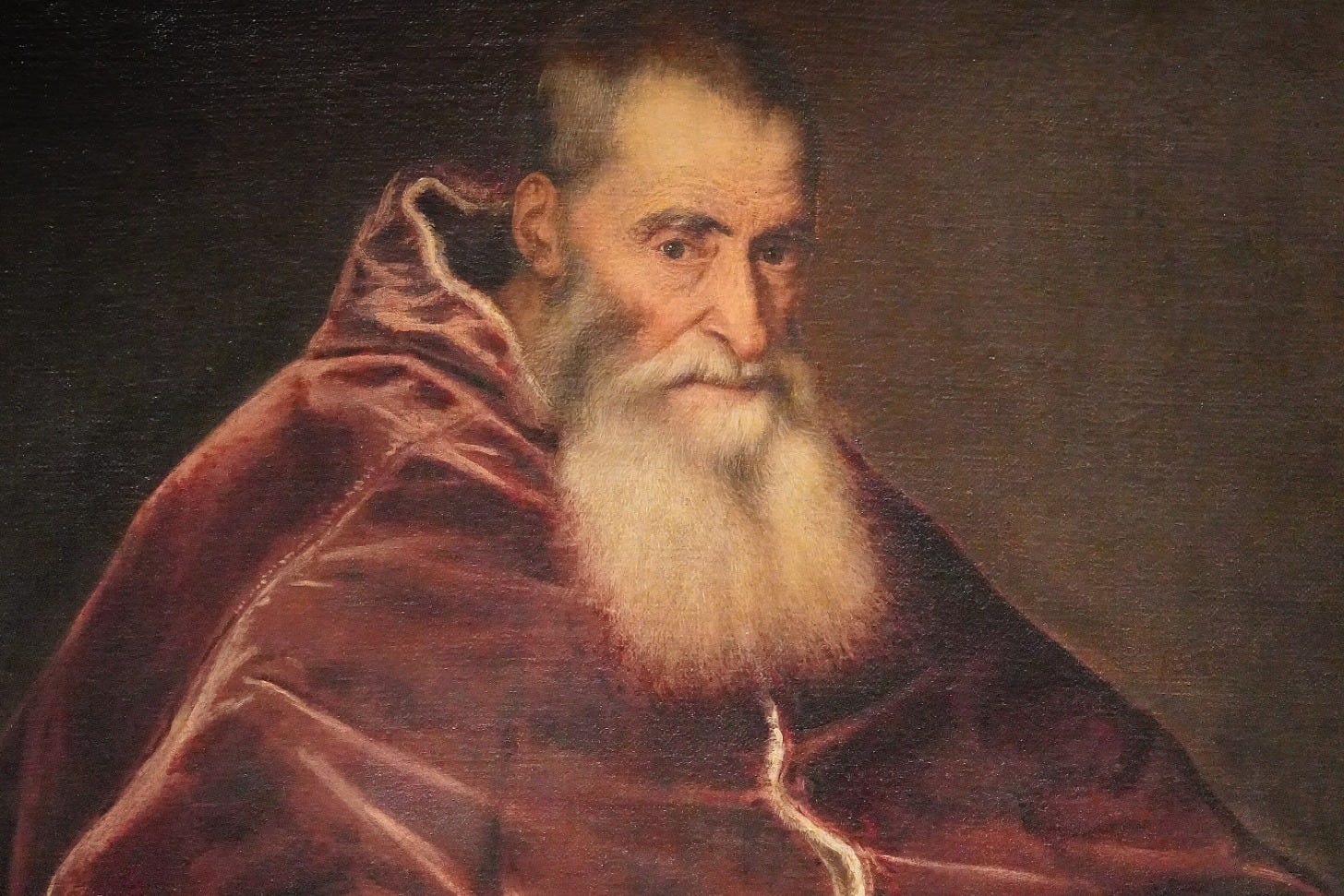
Pope Paul III | Titian, 1543 (detail)
Why did the Catholic Church spend eighteen years in council at Trent?
Key Terms for this Lesson
Council of Trent · Counter-Reformation · Jesuits
Rome Answers | Paul III & the Council, 1534–1563
Rome answered with a renewal of its own. The pope who began it was Paul III (d. 1549), elected in 1534 at the age of 66, a Renaissance prince of the Farnese family who, in his old age, put the reform of the Church first. He named reforming cardinals, he sanctioned the new religious orders, and in 1537 he received a commission’s report that listed the abuses Luther had named and conceded most of them. It was to Paul III that Copernicus (d. 1543) dedicated On the Revolutions of the Heavenly Spheres in 1543 (cf. Sec. 3.4). In 1545 he convened the Council of Trent.
It met in three periods, 1545–1547, 1551–1552, and 1562–1563, in Trento in northern Italy, a city of the Empire on the Italian side of the Alps. Eighteen years, three popes, and about four years of actual sitting. It kept sitting through the Emperor’s war against the Lutheran princes in 1546 (cf. Sec. 2.1). Then an outbreak of fever moved it to Bologna in 1547, a revolt of Protestant princes against the Emperor closed it in 1552, and one pope, Paul IV (d. 1559), refused to recall it at all. The delays were the point as much as the decrees. A universal Church cannot change by a prince’s signature, as Saxony had (cf. Sec. 2.1), and every bishop present knew that what Trent defined would bind Catholics everywhere, for centuries.
What it defined was a line. Against sola scriptura, Trent decreed in 1546 that Scripture and the Church’s unwritten tradition are received “with an equal affection of piety, and reverence.” Against sola fide, it decreed in 1547 that justification comes through faith and works, as Catholics had always maintained: “Even so faith, if it hath not works, is dead, being alone” (James 2:17). It reaffirmed the seven sacraments of the church, in contrast with the dogma promoted by the Protestants. It also reformed the abuses that had given the Reformers their opening, abolishing the indulgence-sellers (1562) and founding seminaries to train priests who could preach. The Counter-Reformation, as it came to be called, was the Church’s attempt to win back parishioners who had joined the new Protestant movement, and it was done through a process of concessions, repression, and elaboration. The Church conceded that the sale of indulgences and other papal practices had grown corrupt and sought to correct those. It repressed Protestantism through warfare throughout Europe and through the Inquisition, with an Index of Prohibited Books from 1559. (The need for a counter reformation in Spain was minor, because fear of the Spanish Inquisition kept most Protestants out of Spain. The Inquisition, which began in 1478, prosecuted only a few hundred Protestants.) And it elaborated.
New Orders | Jesuits, Ursulines, & Mystics
The elaboration began with people. In 1540 Paul III sanctioned the Society of Jesus, the Jesuits, co-founded by Ignatius of Loyola (d. 1556), a Basque soldier whose leg had been shattered by a cannonball, and Francis Xavier (d. 1552), who would die on an island off the coast of China. The Catholics had formed a new traveling order of priests based in scholarship: not monks in a cloister but scholar-priests on the road, bound by a vow of obedience to the pope, who built schools across Catholic Europe and carried the faith to India, Japan, and China. Ignatius’s handbook, the Spiritual Exercises, opens its First Week with a sentence that every Jesuit novice still learns:
Man is created to praise, reverence, and serve God our Lord, and by this means to save his soul. Spiritual Exercises (trans. Elder Mullan)
In 1544 the same pope sanctioned the Ursulines, the first women’s order devoted to teaching girls. And in Spain the old contemplative life revived: Teresa of Ávila (d. 1582), whose writings detail the ascent of the soul, and John of the Cross (d. 1591), whose writings describe the union of the soul with God, reformed the Carmelite order from within. Luther had answered the medieval Church with a doctrine. Trent answered Luther with schools, missions, and saints.
Christianity in IMAX | Trent & the Image
Among Trent’s last decrees, in December 1563, was one about pictures. Where Zwingli and Calvin had whitewashed their churches (cf. Sec. 2.4), the council ruled that the images of Christ, the Virgin, and the saints are to be kept in churches and honored, not because any divinity is in them but because the honor passes to what they represent, and that bishops must see that they teach the people. The Council of Trent encouraged the communication of religious themes through emotion, and thus the development of the Baroque artistic movement (cf. Sec. 4.3). Protestants, especially Calvinists, believed nothing should deter one’s focus on God, and therefore kept minimal decoration in churches. The Church invested money in church art, prompting the birth of Baroque art, which illustrated the grandeur of Catholic worship. Two answers to one question: where should the worshipper’s eye go? Think of it as the difference between watching a movie on an 8-inch iPad Mini and watching it in an IMAX theater — each side chose its screen.
Why did the Catholic Church spend eighteen years in council at Trent? Because it was answering two things at once: Luther’s doctrines, which it rejected line by line, and Luther’s charges, which it largely conceded and repaired. Because war and fever kept closing the doors. And because the men at Trent were not founding a church but defining one, and a definition meant for the whole world is slow. The Council of Trent established the Catholic Church as it would be for the next 400 years. The next century’s wars of religion were fought between two reformed churches — not between a reformed one and an unreformed one.
Sec 2 • The Reformation
2.1 History & Politics • Luther & the Fracturing of Christendom
2.2 Literature & Drama • 95 Theses & the German Bible
2.3 Music • “Ein feste Burg” & the Chorale
2.4 Art & Architecture • Dürer’s Prints & the Image of Reform
2.5 Philosophy • Conscience & Authority at Worms
2.6 Religion • Trent & the Counter-Reformation
Course Page: Humanities I & II
Next Section: Elizabeth & the New Heavens