

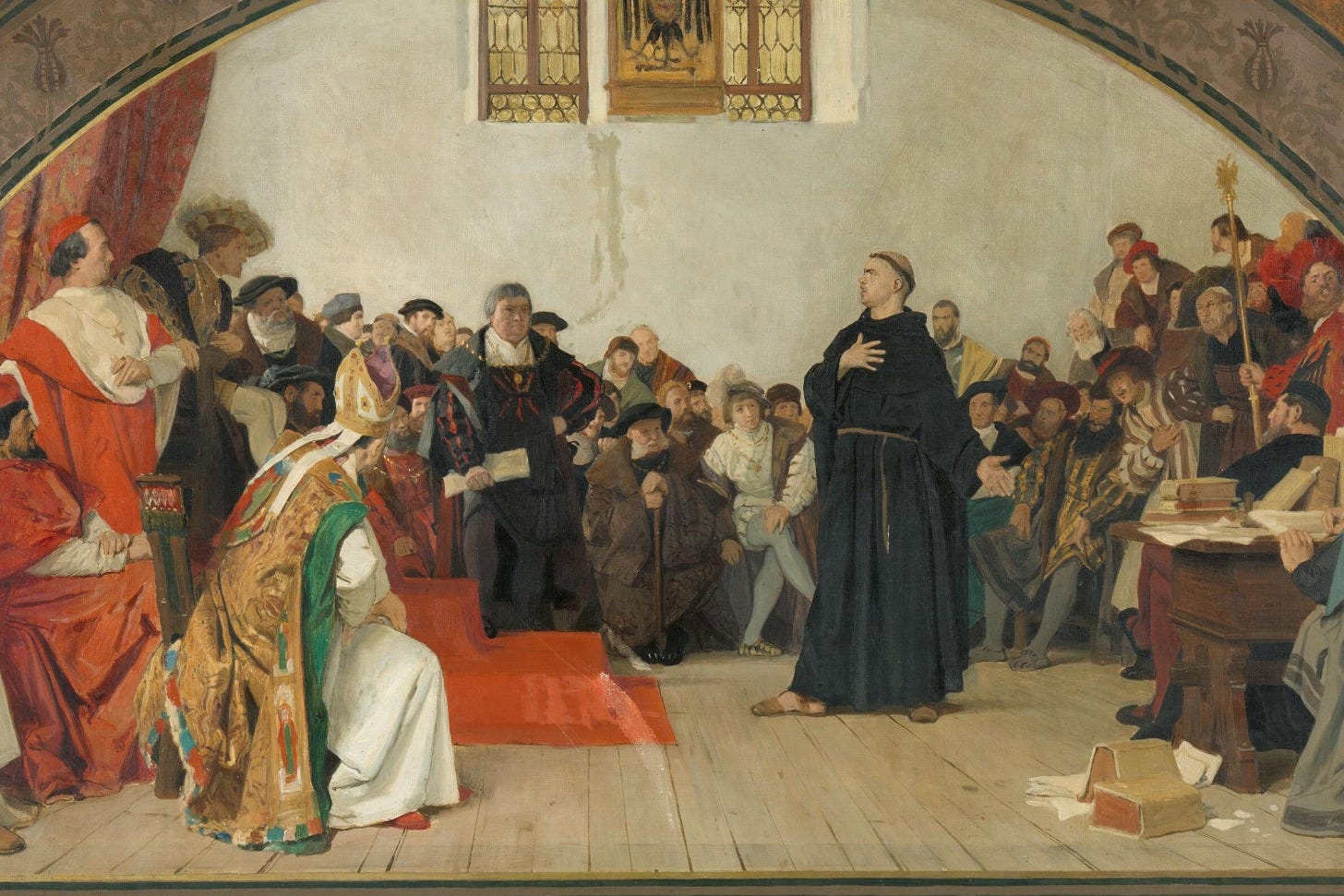
Luther before the Diet of Worms | Anton von Werner, 1870 (detail)
What did Luther mean when he said his conscience was captive?
Key Terms for this Lesson
Conscience · Sola Scriptura · Diet of Worms
Worms, April 1521 | The Hearing
On April 17, 1521, a 37-year-old friar stood before the Holy Roman Emperor and the assembled electors and princes of Germany in the bishop’s palace at Worms. A table held a pile of his books. The Emperor’s spokesman asked two questions. Were these his? Would he take back what was in them? Luther owned the books. On the second question he asked for a day to think. He had been summoned under a safe conduct, and he knew what had happened to Jan Hus (d. 1415) under one (cf. Humanities I, 14.2).
The next evening he gave his answer, in German and then in Latin. He sorted his books into three kinds, defended each, and said that if he revoked them, all he would achieve was to add strength to tyranny. Then the spokesman demanded a plain answer, without horns, and Luther gave it:
Unless I am convinced by the testimony of the Scriptures or by evident reason (for I believe neither the pope nor councils alone, since it is well known that they have often erred and contradicted themselves), I am bound by the Scriptures I have cited, and my conscience is captive to the Word of God. I cannot and will not revoke anything, since to act against conscience is neither safe nor honest. Luther’s reply at Worms, April 18, 1521 (my translation from the Latin)
The words “Here I stand. I can do no other” are tradition’s rendering, added in the first printed version and absent from the transcripts. The Emperor, to his credit, did not execute Luther, but permitted him to leave the hearing unharmed (cf. Sec. 2.1). The next day Charles V (d. 1558) read out his own declaration: a single friar who set his opinion against the whole of Christendom for a thousand years must be wrong, and he would stake his lands and his life on it. Two consciences, both captive — facing each other across a table.
Conscience | A Captive Word
The word Luther reached for was conscience, Latin conscientia, “knowing-with”: the knowledge a person has together with a judgment about what it demands. The medieval schoolmen had given it a careful place (cf. Humanities I, 13.6). For Thomas Aquinas (d. 1274), conscience is reason applying what one knows to what one is about to do. It binds, so that to act against it is always wrong. But it can also err, and so a person is bound as well to form it rightly, by the teaching of the Church. Luther kept the first half and moved the second. A conscience, he said, is not bound by popes or councils. It is bound by the Word of God.
Read the key sentence again. He did not say his conscience was free. He said it was captive (Lt. capta, “taken prisoner”). This is the opposite of what the phrase “freedom of conscience” has come to mean. The modern individual claims the authority to decide for himself what is right, wrong, and true (cf. Sec. 1.6). Luther claimed no such thing. He claimed that a text had taken him prisoner and that no human authority could ransom him from it. Sola scriptura, “by scripture alone” (cf. Sec. 1.6), was not a doctrine about the individual’s authority. It was a doctrine about what the individual was under. Pope Benedict XVI (d. 2022), visiting Luther’s old monastery at Erfurt in 2011, put it this way: for Luther, theology was no mere academic pursuit, but the struggle for oneself, which in turn was a struggle for and with God. He called Luther’s thinking “thoroughly Christocentric.” A pope, on a Reformer, five centuries later.
Yet the modern reading is not simply wrong. Once a single friar could say that his reading of Scripture outranked the pope and the councils together, the question “who decides?” had a new possible answer: I do, with my Bible. Luther handed the individual believer, Bible in hand, an authority the medieval church had reserved to itself (cf. Sec. 1.6). He meant the Bible to do the deciding. In practice it would be the believer.
Authority | After Worms
The test came fast. In 1529 Luther and Ulrich Zwingli met at Marburg to settle one sentence, Jesus’s “This is my body” (Matthew 26:26). Both men held sola scriptura. Both had read the same Greek. Luther took the words literally and Zwingli took them as a figure, and after three days they parted agreed on everything but that. Scripture alone, read by two captive consciences, had given two answers. Luther’s courage in facing the empire is rightly remembered. So is the darker turn of his later years. When German peasants rose in revolt in 1525, partly in his name, Luther urged the princes to strike them down without mercy, and in 1543 he wrote viciously against the Jews, writings the Lutheran churches have since formally repudiated (ELCA, 1994).
From 1521 forward, there would no longer be one universal (Gr. katholikos) religious voice in Europe. As a result, the primary challenge of modern ethics would be to talk about right and wrong without recourse to religious texts, as no one in Europe after Luther could agree on how to interpret those texts. That challenge is where Hobbes begins (cf. Sec. 5.4) and where Kant ends (cf. Sec. 6.1). What did Luther mean when he said his conscience was captive? He meant that he was not free. He meant that something outside him, a book, held him faster than an emperor could. The modern world kept his sentence and changed one word — captive became free.
Sec 2 • The Reformation
2.1 History & Politics • Luther & the Fracturing of Christendom
2.2 Literature & Drama • 95 Theses & the German Bible
2.3 Music • “Ein feste Burg” & the Chorale
2.4 Art & Architecture • Dürer’s Prints & the Image of Reform
2.5 Philosophy • Conscience & Authority at Worms
2.6 Religion • Trent & the Counter-Reformation
Course Page: Humanities I & II