

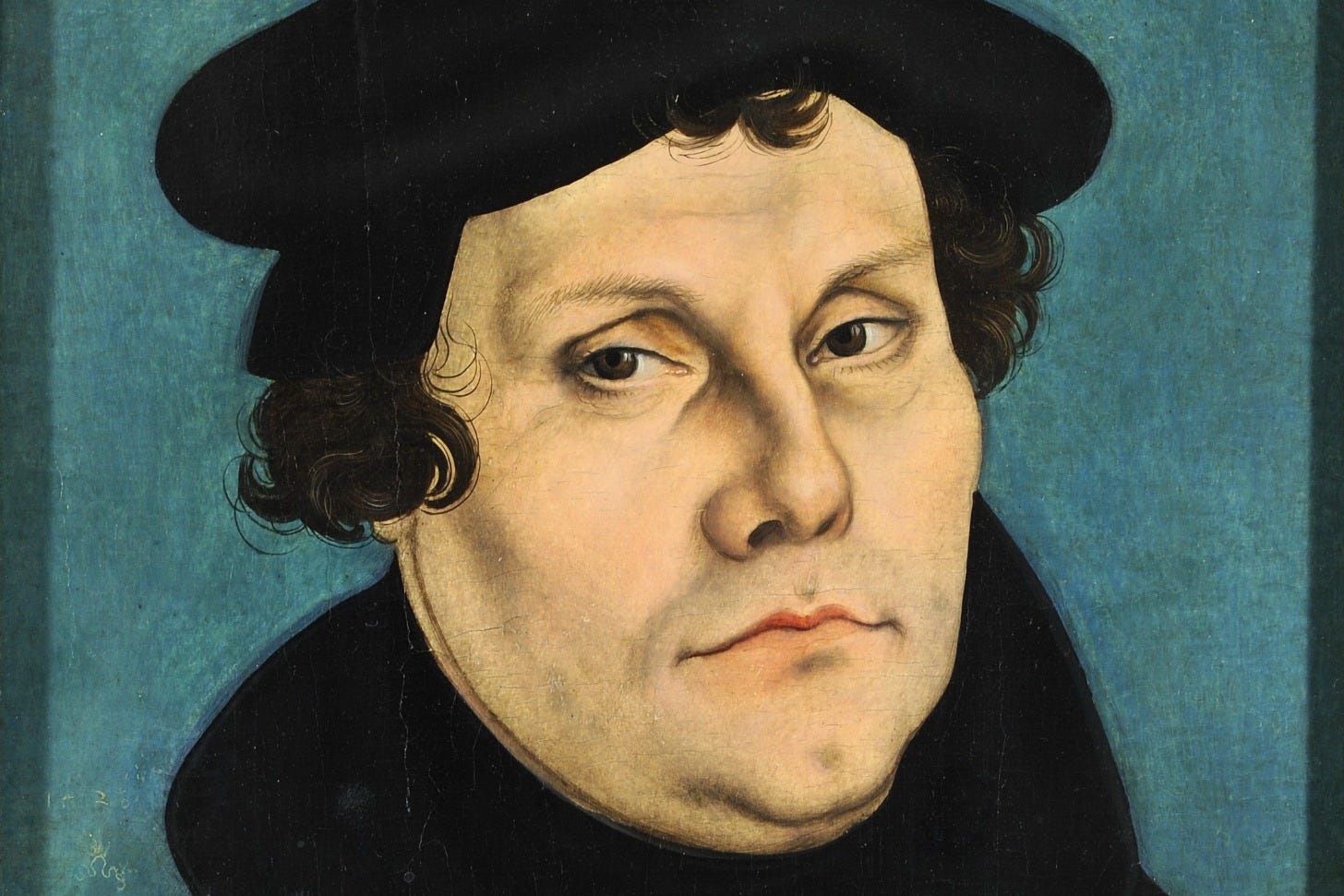
Martin Luther | Lucas Cranach the Elder, 1528 (detail)
Why did Luther translate the Bible into German?
Key Terms for this Lesson
Ninety-Five Theses · Pamphlet · Luther Bible
Wittenberg, 1513–1517 | A Lecturer & His Theses
Luther started things off differently than most lecturers in Wittenberg. He didn’t use medieval strategies for teaching, avoided talk of Aristotle in theological discussions, and spoke against the idea of a salvation contract between God and humanity. In 1513, when he began lecturing on the Psalter, a book of the Psalms, he had a batch of psalters printed up that omitted the notes attributed to medieval scholars, opting instead for blank pages so students could make their own notes. In 1515, he began lecturing on Paul’s letter to the Romans, focusing on what Paul said about salvation. We have Luther’s notes from these two lecture courses, and they clearly show the foundation of his reformation thinking. He specifically focuses on one verse: “The just shall live by faith” (Romans 1:17).
The Ninety-Five Theses were a university document before they were anything else. Their real title is A Disputation on the Power and Efficacy of Indulgences. They are 95 numbered propositions in Latin, written for a disputation, the formal academic debate of the universities, and they open with an invitation:
Out of love for the truth and the desire to bring it to light, the following propositions will be discussed at Wittenberg, under the presidency of the Reverend Father Martin Luther, Master of Arts and of Sacred Theology, and Lecturer in Ordinary on the same at that place. Wherefore he requests that those who are unable to be present and debate orally with us, may do so by letter. The Ninety-Five Theses (trans. C. M. Jacobs)
Read them as literature and they have a shape. The first thesis plants the flag in a single word: when Jesus said Poenitentiam agite, “do penance” in the Vulgate’s Latin, metanoeite in the Greek (Matthew 4:17), he “willed that the whole life of believers should be repentance” — the same verse Erasmus had just retranslated (cf. Sec. 1.6). The middle theses turn satirical: “They preach man who say that so soon as the penny jingles into the money-box, the soul flies out” (27). The sixty-second lands the thesis under all the theses: “The true treasure of the Church is the Most Holy Gospel of the glory and the grace of God.” And the eighty-sixth asks the question the German princes would remember (cf. Sec. 2.1): “Why does not the pope, whose wealth is to-day greater than the riches of the richest, build just this one church of St. Peter with his own money, rather than with the money of poor believers?”
Print | From Latin Theses to German Pamphlets
Luther wrote the Theses in Latin for professors. Printers turned them into German for everyone. Within weeks of October 31, 1517, printers in Nuremberg, Leipzig, and Basel had reprinted them, first as single sheets and then in translation. Luther had not asked them to. The form that carried the Reformation was the pamphlet (Ger. Flugschrift, “flying writing”): a few quarto sheets, unbound, cheap, read aloud in inns and markets to people who could not read. Luther became its master. In 1520 alone he published more than two dozen works.
After the pope’s bull of June 1520 threatened him, Luther wrote to the German people. The Open Letter to the Christian Nobility of the German Nation condemned the papacy’s claim to stand above emperor and Scripture, and asked the princes to reform the Church themselves. The Babylonian Captivity of the Church argued in Latin to the clergy themselves that the sacraments had been perverted. The Freedom of a Christian addressed the paradoxical responsibilities of a Christian who is both free and servant. Three treatises, one year, three audiences: the nobles, the clergy, and the ordinary Christian. The ordinary Christian still could not read the book all three were arguing about.
The Wartburg, 1522 | The September Testament
Hidden at the Wartburg after Worms (cf. Sec. 2.1), Luther translated the entire New Testament into German in about eleven weeks, working from Erasmus’s Greek (cf. Sec. 1.6) rather than the Latin Vulgate. It was printed at Wittenberg in September 1522, with no translator’s name on the title page, and sold out by December. The September Testament carried 21 full-page woodcuts for the Book of Revelation from Lucas Cranach’s (d. 1553) workshop (cf. Sec. 2.4). In his table of contents Luther numbered 23 books and set 4 apart at the end, unnumbered: Hebrews, James, Jude, and Revelation — whose apostolic authorship he doubted. The Old Testament, from the Hebrew, followed in parts, and the complete Luther Bible appeared in 1534.
One choice became famous. At Romans 3:28, where Paul writes that a man is justified by faith “without the deeds of the law,” Luther wrote allein durch den Glauben, “by faith alone.” The word is not in the Greek. Critics said so at once. In 1530 he answered them in an Open Letter on Translating, and his defense of that one word is also his answer to this lesson’s question:
You must not ask the letters of the Latin language how to speak German… You must ask the mother in the home, the children in the street, the common man in the marketplace, and watch their mouths to see how they speak, and translate accordingly. Then they understand it, and notice that someone is speaking German with them. Open Letter on Translating (my translation)
Why did Luther translate the Bible in the language of the marketplace? Because that is where the people were, and because sola scriptura (cf. Sec. 1.6) is an empty principle if the Scriptures are in a language the believer cannot read. With the rise of the middle class and literacy, the Reformers wanted people to be able to read the Bible in their own languages, rather than hear it in Latin in church. The consequences ran past theology. The Saxon German Luther wrote became the backbone of the written language that Goethe (d. 1832) would inherit (cf. Sec. 8.1). In England, William Tyndale (d. 1536) used Erasmus’s third edition of the Greek New Testament, published in 1522, to translate the New Testament into English, printed complete at Worms in 1526. He also used Erasmus’s Latin, the Luther New Testament, and the Vulgate. Tyndale was condemned for heresy and executed before he could complete his Old Testament, and the greater part of the King James New Testament of 1611 is his English (cf. Sec. 3.2). Eleven weeks at the Wartburg gave German its Bible, and English a model.
Sec 2 • The Reformation
2.1 History & Politics • Luther & the Fracturing of Christendom
2.2 Literature & Drama • 95 Theses & the German Bible
2.3 Music • “Ein feste Burg” & the Chorale
2.4 Art & Architecture • Dürer’s Prints & the Image of Reform
2.5 Philosophy • Conscience & Authority at Worms
2.6 Religion • Trent & the Counter-Reformation
Course Page: Humanities I & II