

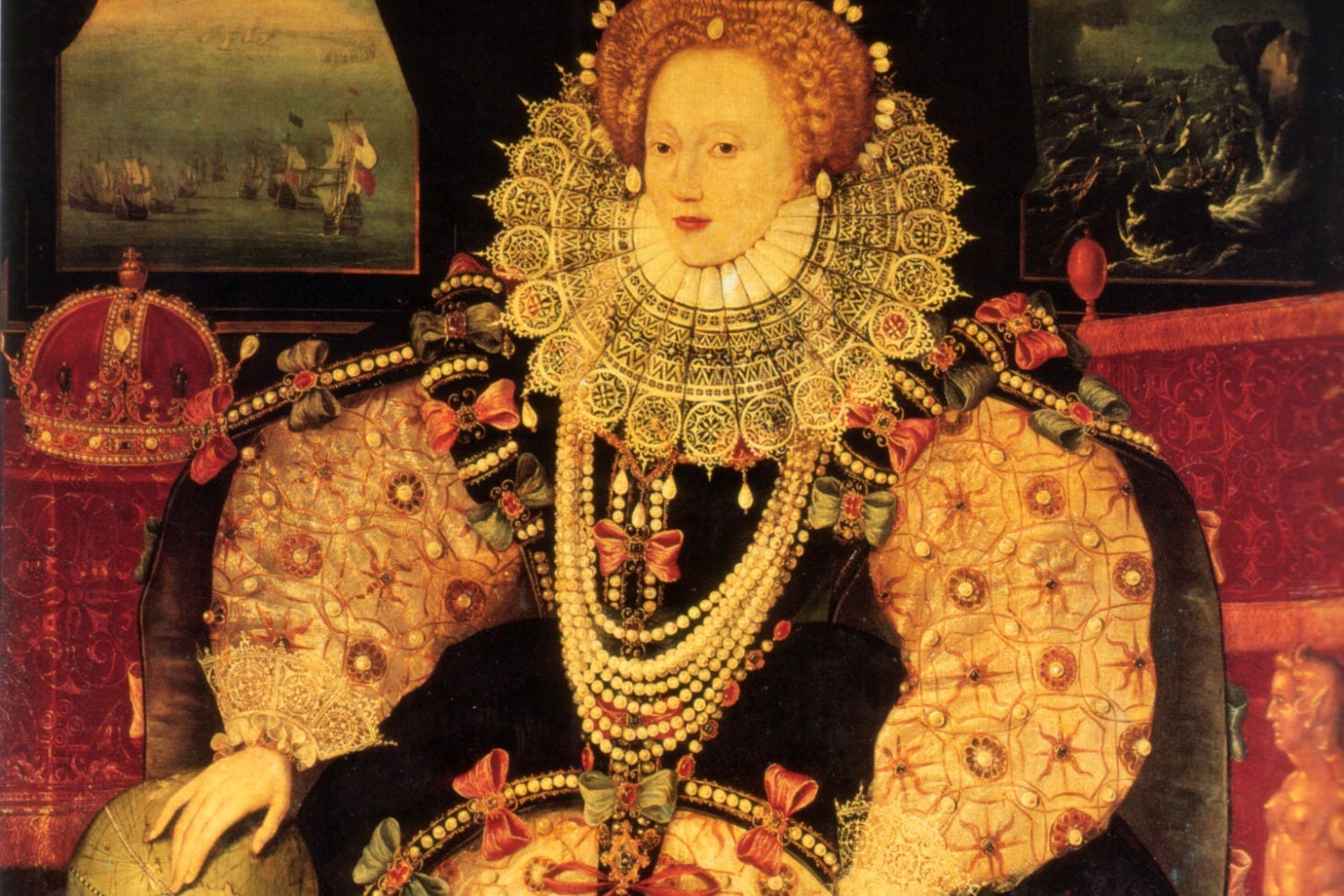
The Armada Portrait of Elizabeth I | English School, ca. 1588 (detail)
Why did a Protestant queen seek an alliance with the Sultan?
Key Terms for this Lesson
Capitulations · Spanish Armada · Levant Company
The Queen & the Pope | 1533–1570
The reign of England’s Henry VIII (d. 1547) brought about the end of Catholic monasticism and papal interference in England. When his marriage to Catherine of Aragon (d. 1536) was annulled in 1533, Henry strained England’s political ties with Habsburg Spain for years, the house of Catherine’s nephew, the Emperor Charles V (cf. Sec. 2.1). Henry’s Tudor dream of English independence from Catholic hegemony was the final nail in the coffin of the old medieval parish system, and his children would be left to pick up the pieces. Edward, Mary, and Elizabeth all struggled back and forth with Catholic and Protestant visions of England until Queen Elizabeth I (d. 1603) and her Act of Uniformity of 1559 set the Church of England down its famous via media (cf. Sec. 3.2).
Elizabeth became queen on November 17, 1558, at the age of 25. Her late sister Mary I (d. 1558) had been married to Philip II (d. 1598) of Spain, the most powerful king in Europe, whose galleons carried home the silver of the New World. In 1570 Pope Pius V (d. 1572) excommunicated Elizabeth in the bull Regnans in Excelsis and released her subjects from their obedience to her (cf. Humanities I, Sec. 13.1). A small island kingdom of some three million people needed friends, and it found one at the far end of the Mediterranean.
London & Constantinople | 1578–1585
In 1578 a merchant named William Harborne (d. 1617) made his way to Constantinople. In 1580 Sultan Murad III (d. 1595) granted the English their own capitulations: a charter, named for its chapters (Lat. capitula), that let a foreign nation trade, travel, and settle disputes before its own consul in the Sultan’s lands, as the French already did. In the late sixteenth century, England was still a relative unknown to the Ottomans. As late as 1601, an English traveler to Jerusalem was told that Englishmen before him had passed themselves off as “Frenchmen,” because the local Turks had no idea what an “Englishman” was.
By the 1580s, when it became clear that England was leaving the Catholic Church once and for all, it became incumbent on Queen Elizabeth to find ways of reaching out to Sultan Murad III. London merchants chartered the Turkey Company in 1581, and Elizabeth made the daring move to send the first English ambassador to Constantinople — Harborne himself, who presented his credentials in 1583. Through her ambassador, Elizabeth and Murad corresponded back and forth, each concerned with Spanish and Habsburg dominance. They found a common language in religion. Protestant England, like the Reformed churches of Zürich and Geneva (cf. Sec. 2.4), had stripped the images from its churches, and mosques held no images of people at all (cf. Humanities I, Sec. 11.6). So, in essence, Elizabeth framed her hopes of political alliance as a partnership between the monotheists of England and Turkey against the Spanish “idolaters,” as she called them. Her letter of 1584 opens with her own title:
Elizabeth, by the grace of the Most High God and only Maker of Heaven and Earth, of England, France, and Ireland Queen, and of the Christian faith, against all the idolaters and false professors of the name of Christ dwelling among the Christians, most invincible and puissant Defender; to the most valiant and invincible Prince, Sultan Murad Can, the most mighty ruler of the Kingdom of Mussulman and of the East Empire… The Queen’s Letters to the Turk (ed. Richard Hakluyt, modernized by Henry Morley)
The same letter names the hope beneath the titles, the hope of all the Sultan’s trading partners: that “by mutual traffic the East may be joined and knit to the West.” Since 1179 the Church had forbidden Christians to sell weapons to Muslim powers. England no longer answered to Rome. England even exported tin, lead, and ammunition to the Ottoman Empire for use in cannon casting. Intriguingly, some of the tin and scrap metal that Protestant England sold to the Ottomans came from its recent dismantling of Catholic buildings, bells, and metal statuary.
The Armada | 1585–1603
In 1585 England and Spain went to war, and Philip began to gather an invasion fleet, the Spanish Armada. Elizabeth’s ultimate goal was to persuade Murad to attack Spain as a diversion, so that England would have time to prepare for Spain’s assault of the English coast. But Murad was at war with Persia, and no Ottoman fleet sailed west. In the summer of 1588 the Armada entered the Channel with some 130 ships. The English fleet under Lord Howard of Effingham (d. 1624), with Francis Drake (d. 1596) as his vice admiral, broke its formation with fireships off Calais. Storms finished the work — dozens of Spanish ships were wrecked off the coasts of Scotland and Ireland on the long way home.
• 1558 | Elizabeth I becomes queen
• 1570 | Regnans in Excelsis excommunicates her
• 1580 | Murad III grants the English capitulations
• 1588 | The Spanish Armada is defeated
• 1592 | The Levant Company is chartered
While Elizabeth’s proposed Anglo-Ottoman alliance was never quite realized, trade between England and the Ottoman Empire flourished. In 1592 the Turkey and Venice companies merged into the Levant Company, which held England’s trade with the eastern Mediterranean for more than two centuries. The late 1500s also saw the Golden Age of England (cf. Sec. 1.2), with the reign of Queen Elizabeth and London’s first lasting public playhouse, built in 1576. With trade came a market for stories of the exotic East, and England’s finest writers and playwrights rose to the challenge: Christopher Marlowe’s (d. 1593) Tamburlaine (ca. 1587) and, a little later, William Shakespeare’s (d. 1616) Othello (ca. 1603–04) (cf. Sec. 3.5). The colony of Virginia was named for the Virgin Queen, and in 1600 she chartered the East India Company.
Why did a Protestant queen seek an alliance with the Sultan? Because England was a Protestant state, outside of papal authority, it was in a favored position to seek an alliance with the Ottoman Empire. Both courts feared the same Spanish king, both could speak the same language against images, and England, free of Rome’s canon law, could sell what the Sultan’s foundries needed. The alliance never sailed. The trade did.
Sec 3 • Elizabeth & the New Heavens
3.1 History & Politics • England’s Golden Age & the Sultan
3.2 Religion • The Book of Common Prayer & the King James Bible
3.3 Art & Architecture • Holbein’s The Ambassadors
3.4 Philosophy • Copernicus & the De-Centered Cosmos
3.5 Literature & Drama • Hamlet’s Modern Mind
3.6 Music • Dowland’s “Flow, My Tears”
Course Page: Humanities I & II