

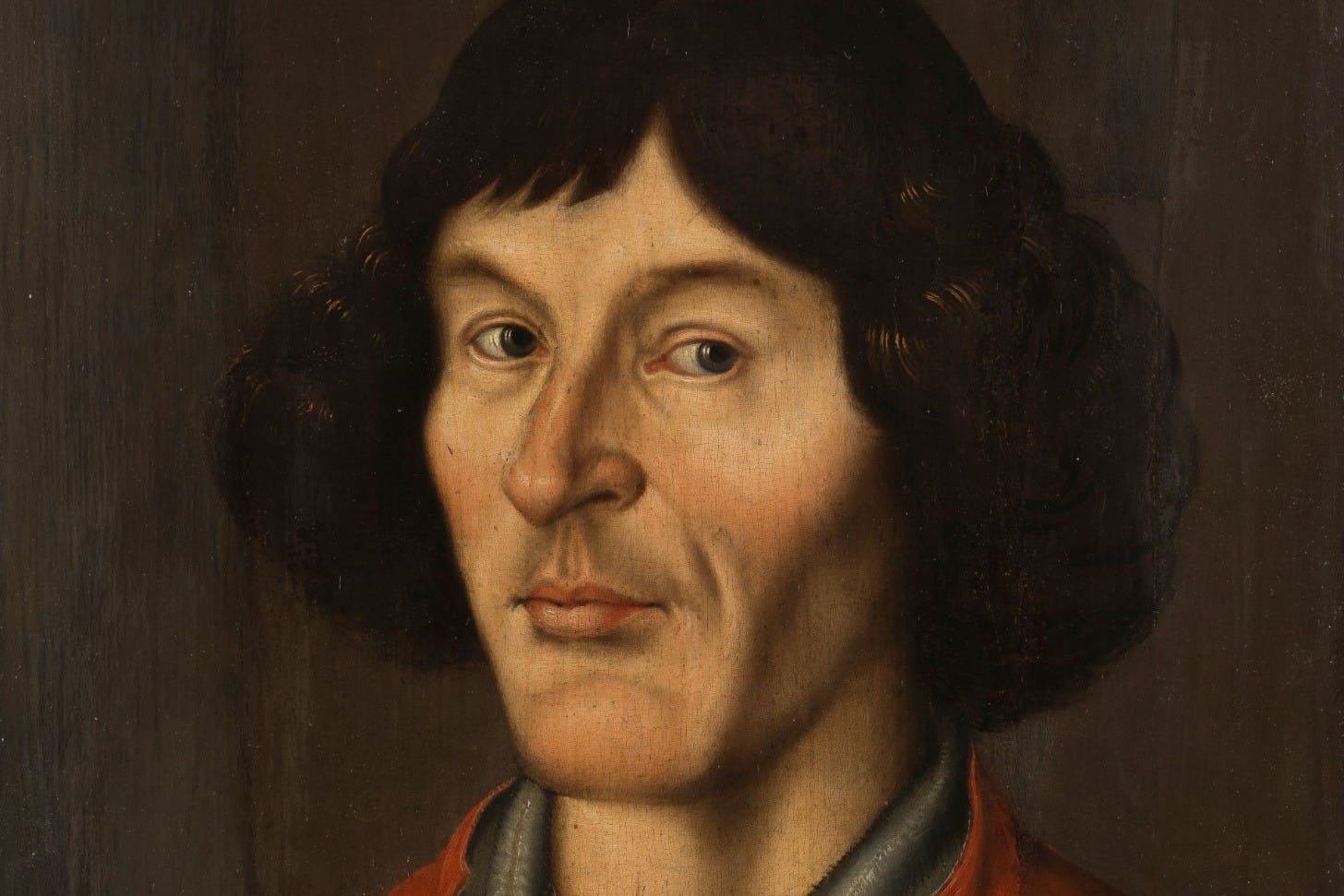
Nicolaus Copernicus | Anonymous, Toruń portrait, ca. 1580 (detail)
Why did Copernicus hold his book back for thirty years?
Key Terms for this Lesson
Geocentrism · Heliocentrism · Paradigm Shift
The Earth Moves | Frombork, ca. 1514
For fourteen centuries, educated Europeans, Muslims, and Jews had placed the Earth at the center of the universe. The model was geocentrism, set out by the astronomer Ptolemy (d. ca. 170) in the Almagest and built on Aristotle’s physics: a still Earth at the middle, and the Moon, Sun, planets, and stars wheeling around it on nested spheres. One’s intuitive reasoning may lead us to claim that the sun revolves around the Earth. It rises in the east and sets in the west. To make the planets’ wandering paths fit, Ptolemy’s system needed circles upon circles, and its tables drifted from the sky.
Nicolaus Copernicus (d. 1543) was a canon of the cathedral chapter of Frombork, on the Baltic coast of Royal Prussia, in the Kingdom of Poland. He had studied at Kraków, Bologna, and Padua, and taken a doctorate in canon law at Ferrara in 1503. He kept the chapter’s accounts, practiced medicine, and wrote on the coinage. At night he watched the sky. Around 1514 he wrote out a short sketch by hand, the Commentariolus (“Little Commentary”), and passed it among a few friends. Its claims were few and startling: the Earth is not the center of the universe, the Sun is, and the Earth turns daily on its axis and travels yearly around the Sun. The idea had an ancient precedent, Aristarchus of Samos in the 200s BCE, but no one had worked it out in numbers. That was heliocentrism, from the Greek hēlios, “sun.” Copernicus was the first to challenge the geocentric model of the solar system with a full system of reason and mathematical data. Then he waited.
Thirty Years | Nuremberg, 1543
He spent the next three decades turning the sketch into tables and proofs, and showing them to almost no one. In 1536 Cardinal Nikolaus von Schönberg (d. 1537) wrote from Rome asking for a copy. His friend Tiedemann Giese (d. 1550), Bishop of Chełmno, urged him for years. The push that finally worked came from Wittenberg. In 1539 a young Lutheran mathematician named Georg Joachim Rheticus (d. 1574) arrived at Frombork, stayed two years, and published the first account of the theory, the Narratio prima (1540). A Catholic canon, a cardinal, a bishop, and a Lutheran from Luther’s own university urged one book into print (cf. Sec. 2.1). The finished work, On the Revolutions of the Heavenly Spheres, was printed in Nuremberg in 1543, with an unsigned preface by the Lutheran theologian Andreas Osiander (d. 1552) calling its motions mere hypotheses. Copernicus dedicated it to Pope Paul III (cf. Sec. 2.6), and in the dedication he gave his reasons for waiting:
I can well judge, Most Holy Father, that as soon as certain people learn that in these books of mine, which I have written on the revolutions of the spheres of the world, I attribute certain motions to the globe of the Earth, they will at once cry out that I must be hissed off the stage with such an opinion. … [The book,] kept back with me, had lain hidden not only into a ninth year, but now into a fourth period of nine years. On the Revolutions (my translation)
Three nines had passed, and a fourth was running: nearly thirty years. His dedication speaks of ridicule, not punishment: an opinion that looked absurd, he wrote, might be best kept like the secrets of the Pythagoreans, who passed their teaching on by word of mouth, only to relatives and friends. A story told about him, by Giese, is that the first printed copy reached him on May 24, 1543, the day he died.
The De-Centered Cosmos | Paradigm Shift
There would be a seismic epistemological shift toward precision, observation, and objective proof that would eventually culminate in the Scientific Revolution under Copernicus, Brahe (d. 1601), and Kepler (d. 1630). Tycho Brahe measured the heavens more exactly than anyone before him. Kepler, working from Tycho’s numbers, showed in 1609 that Mars moves in an ellipse, and later extended the law to every planet. In 1610 the telescope of Galileo Galilei (d. 1642) showed Venus waxing and waning in phases like the moon — Ptolemy’s arrangement could not produce them (cf. Sec. 4.5). The proof Copernicus most needed came last of all. The positions of stars regularly shift as Earth’s position changes throughout the year (stellar parallax), but the shift was too small for any instrument until 1838. In 1616, seventy-three years after its printing, the Church put On the Revolutions on the Index of Prohibited Books “until corrected.”
The historian of science Thomas Kuhn (d. 1996) called this kind of change a paradigm shift. Scientists work within an existing framework of scientific theories that guide their research, called a paradigm. At first, the anomalies are ignored or hand-waved away. But eventually a new scientific paradigm results that is robust enough that it can not only answer all those pesky anomalies but can make predictions that are not disproven for a very long time. A new approach is posited, and the language changes, the questions change, and the representation of the world changes. Kuhn’s first case study, in 1957, was The Copernican Revolution. Copernicus did not think he had made the cosmos smaller or colder — he thought he had made it more orderly. In Book I of On the Revolutions he set the Sun at the center “as if on a royal throne,” and he called the universe “the most beautiful temple.” The Earth was no longer the center. It was still a planet in a temple.
Why did Copernicus hold his book back for thirty years? Because he feared being laughed off the stage for an opinion that contradicted the senses, because his mathematics took that long to finish, and because by temperament he shared his thinking only with friends. It took a cardinal’s letter, a bishop’s patience, and a Lutheran student’s visit to bring the Earth into motion.
Sec 3 • Elizabeth & the New Heavens
3.1 History & Politics • England’s Golden Age & the Sultan
3.2 Religion • The Book of Common Prayer & the King James Bible
3.3 Art & Architecture • Holbein’s The Ambassadors
3.4 Philosophy • Copernicus & the De-Centered Cosmos
3.5 Literature & Drama • Hamlet’s Modern Mind
3.6 Music • Dowland’s “Flow, My Tears”
Course Page: Humanities I & II