

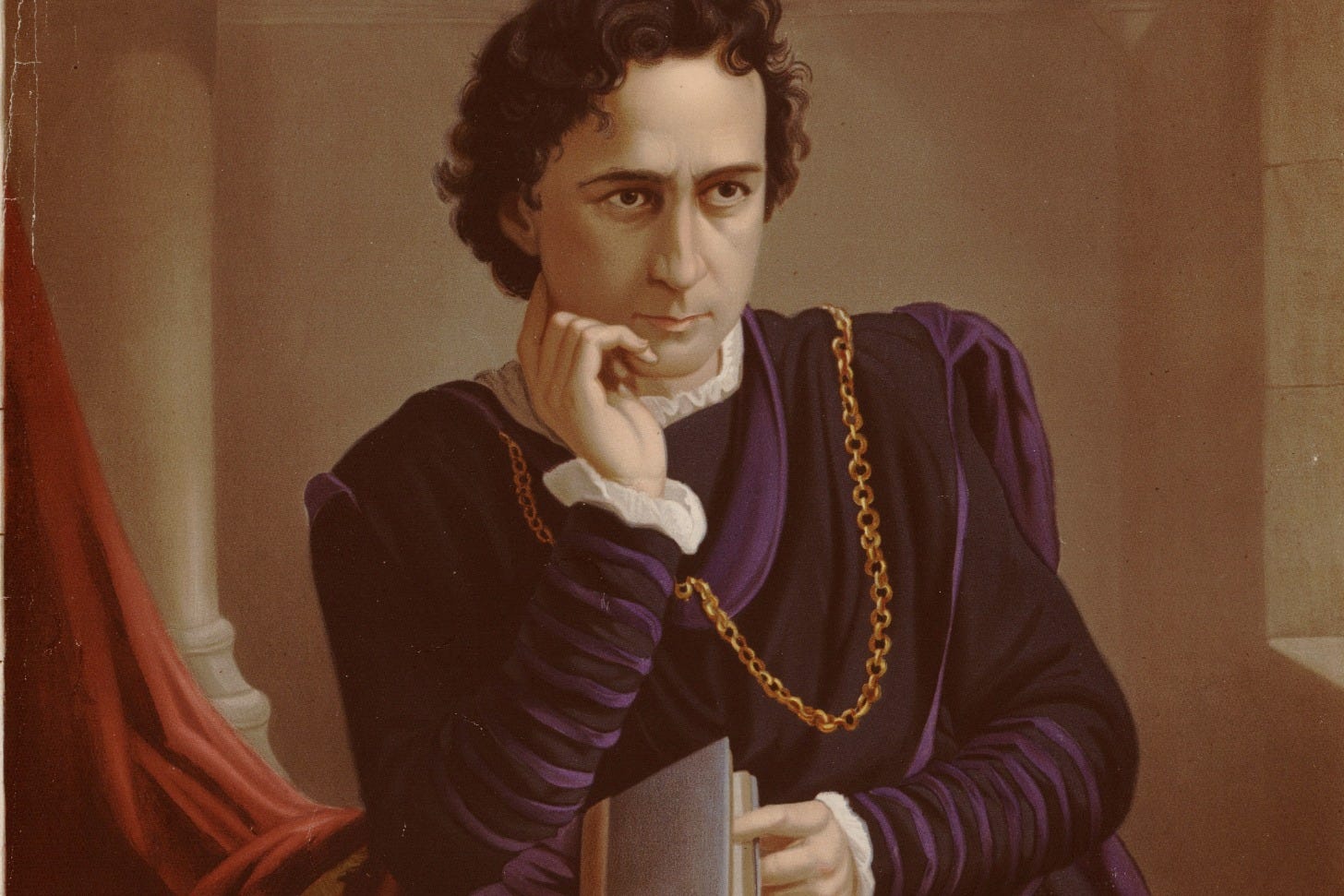
Edwin Booth as Hamlet | Bencke & Scott, 1873 (detail)
Why does Hamlet talk to himself?
Key Terms for this Lesson
Revenge Tragedy · Blank Verse · Soliloquy
The Stage | London, 1576–1601
London’s first lasting public playhouse, the Theatre, opened in 1576 (cf. Sec. 3.1), and within twenty years the city had a new art form and a new audience. In contrast with the morality plays of the Middle Ages, which told religious parables to instruct the public, William Shakespeare (d. 1616) used a sophisticated vocabulary in his incredibly popular studies of human personality, passions, and problems. Born in Stratford-upon-Avon in 1564, he acted in his company, wrote for it, and owned part of it — including a share in the Globe theatre, built in 1599. He wrote in blank verse, unrhymed lines of ten syllables with five beats, the line Christopher Marlowe (d. 1593) had made famous in Tamburlaine (cf. Sec. 3.1). It is close enough to speech to sound like a man thinking.
Hamlet was written around 1600 and printed in 1603 and 1604. Its story was old: a Danish prince’s revenge, told by the chronicler Saxo Grammaticus around 1200 and already staged in London in a lost earlier play. The story was borrowed. What Shakespeare did with it was not. It belongs to the genre of revenge tragedy, made popular by Thomas Kyd’s (d. 1594) The Spanish Tragedy (ca. 1587): a murder, a ghost who demands vengeance, a hero who must act, and a final scene that leaves the stage full of the dead (cf. Humanities I, Sec. 7.5). The genre asks its hero to act. Shakespeare’s hero stops to think. Hamlet is a university student, and his university is Wittenberg, Luther’s own (cf. Sec. 2.1).
The Ghost & the Prince | Elsinore
As the play begins, a darkness, both physical and psychological, surrounds and penetrates Elsinore castle. A voice calls out to the young sentry, a voice he does not recognize. To his relief, it is only his friend. Then the ghost of the late king appears, and the officers find no peace until they draw the young Prince Hamlet into a meeting with it. The Ghost of the murdered king accuses Hamlet’s uncle Claudius of killing him, sending Hamlet to discover the truth of the matter. Claudius now wears the crown and has married Hamlet’s mother, the queen. Almost every person Hamlet might confide in is compromised: his mother, his uncle, the courtier’s daughter he loves, and the two school friends Claudius sends to spy on him. Only one friend, Horatio, stands by him.
And the Ghost itself is a question. It says it comes from a place of purging fire, but Protestant England had rejected purgatory (cf. Sec. 2.1) along with the old Mass (cf. Sec. 3.2), and a ghost walking the earth was, to many in the audience, more likely a demon in disguise. Hamlet knows this: “The spirit that I have seen / May be the devil.” Hamlet is psychologically tortured by the binary choices before him. Did he see the ghost or imagine it? Did his uncle murder his father or not? Hamlet decides that before he does anything, he must first seek out the truth of these claims. When a troupe of actors arrives at the castle, Hamlet devises a plan wherein he will reveal the “truth” through the “lies” of the theatre: “the play’s the thing / Wherein I’ll catch the conscience of the king.”
The Soliloquy | The Modern Mind
A soliloquy is a speech a character delivers alone on stage, thinking aloud for the audience to overhear. Many earlier plays used it to explain the plot. Hamlet uses it to argue with himself. He has seven of them — seven arguments held with no one but himself. In one he berates himself as “a rogue and peasant slave” for feeling less than an actor weeping over an old story. In the most famous soliloquy in English, “To be, or not to be,” he weighs whether it is nobler to suffer his “outrageous fortune” in silence or to “take arms.” Each speech ends somewhere other than where it began. Even in prose, to the two school friends sent to spy on him, he marvels at humanity and then turns on it:
What a piece of work is a man! How noble in reason! How infinite in faculty! In form and moving how express and admirable! In action how like an angel! In apprehension how like a god! The beauty of the world! The paragon of animals! And yet, to me, what is this quintessence of dust? Hamlet (Act II, scene 2, Folio text)
Across the Channel, the French essayist Michel de Montaigne (d. 1592) was doing the same thing in prose. His Essays (1580) begin with a warning to the reader: “I am myself the matter of my book” (my translation). His motto was a question: “What do I know?” (cf. Sec. 1.6). In his essay on the inconstancy of our actions, he found that a man differs from himself from one hour to the next. John Florio’s (d. 1625) English translation appeared in 1603, the year Hamlet first reached print. The two never met, but they share a discovery: the self is not a fixed thing to be reported but a conversation to be overheard.
Why does Hamlet talk to himself? Because there is no one at court he can trust but one friend, and the question he must answer, whether a ghost tells the truth, can only be tried inside his own mind. Because Shakespeare turned the soliloquy from a plot device into a mind at work, and the audience in the yard became the only confidants the prince had. And because the modern self, divided and watching itself, needed a stage. Hamlet’s last words are, fittingly, about the end of talk: “The rest is silence.”
Sec 3 • Elizabeth & the New Heavens
3.1 History & Politics • England’s Golden Age & the Sultan
3.2 Religion • The Book of Common Prayer & the King James Bible
3.3 Art & Architecture • Holbein’s The Ambassadors
3.4 Philosophy • Copernicus & the De-Centered Cosmos
3.5 Literature & Drama • Hamlet’s Modern Mind
3.6 Music • Dowland’s “Flow, My Tears”
Course Page: Humanities I & II