

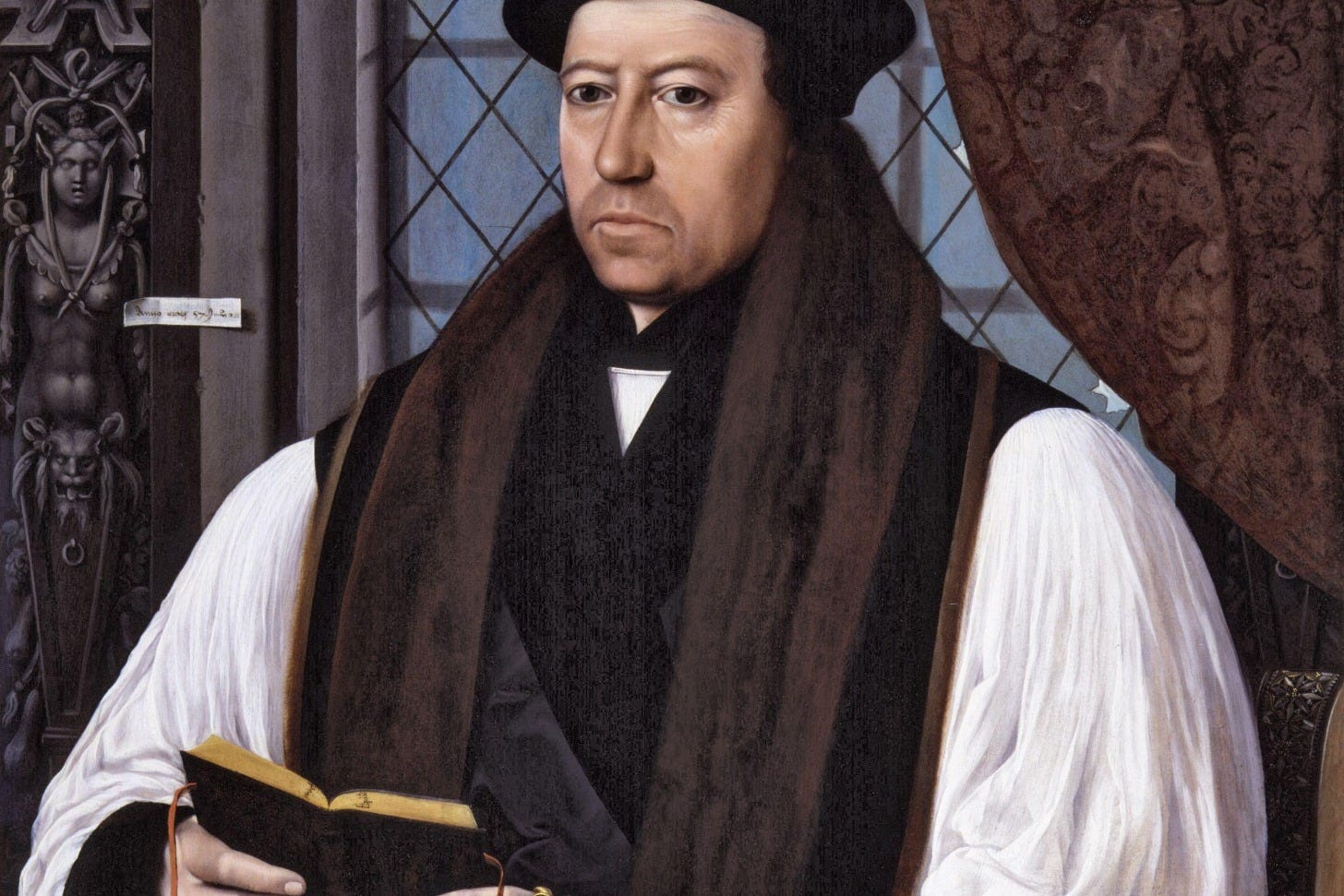
Thomas Cranmer | Gerlach Flicke, ca. 1545 (detail)
Why did England order every parish to pray from the same book?
Key Terms for this Lesson
Book of Common Prayer · Act of Uniformity · King James Bible
Cranmer’s Book | 1532–1559
Unlike Lutheranism, the Protestant Reformation, developing in England around the same time, began at the top largely because of politics. Henry VIII needed a male heir, the pope would not annul his marriage, and so he intimidated the clergy into proclaiming him head of the English Church. In 1532 the Submission of the Clergy placed the clergy entirely under the king’s control, and the Act of Supremacy of 1534 named him Supreme Head of the Church of England. He had complained to Parliament that his bishops “seem to be his subjects, and not ours,” meaning the pope’s. In practice, Henry’s church kept much of the old Catholic form while rejecting Roman authority. It still prayed in Latin.
The man who changed that was Thomas Cranmer (d. 1556), Archbishop of Canterbury. He wrote an English Litany in 1544, and under Henry’s young son, Edward VI (d. 1553), he compiled the first Book of Common Prayer (1549): every service of the Church, from morning prayer to burial, in one English book for the whole kingdom. “Common” meant shared — the same words in every church. An Act of Uniformity made it the only lawful form of worship, and a revised book followed in 1552. Then Edward died, and his Catholic sister Mary I (d. 1558) restored the Latin Mass, and with it the old prayers for souls in purgatory (cf. Sec. 2.1). Mary’s government burned some 280 Protestants as heretics, Cranmer among them, at Oxford in 1556. His book outlived him. In 1559 Elizabeth’s Parliament restored it, with a new Act of Uniformity, and every subject was to attend the parish church on Sundays, with a fine of twelve pence for each absence. Cranmer’s preface, in the words it still carries in the 1662 book, gave the reason:
And whereas heretofore there hath been great diversity in saying and singing in Churches within this Realm; some following Salisbury Use, some Hereford Use, and some the Use of Bangor, some of York, some of Lincoln; now from henceforth all the whole Realm shall have but one Use. Book of Common Prayer (Thomas Cranmer, 1662 text)
The Middle Way | 1559–1603
Elizabeth took the title Supreme Governor rather than Supreme Head, and her church aimed at what later Anglicans would call a via media, a middle way between Rome and the Reformers. Anglicanism would be a Middle Path between Protestantism and Catholicism, and a Book of Common Prayer was written with both communities in mind. Its words at the Lord’s Supper joined the older-sounding words of 1549 (“preserve thy body and soul unto everlasting life”) to the Reformed words of 1552 (“Take and eat this in remembrance that Christ died for thee”), so that a worshipper could hear either faith in them. A short verse long attributed to the queen, and said to date from her questioning under Mary, kept the same silence on the question that divided Rome from Geneva:
“Christ was the word that spake it, / He took the bread and brake it, / And what his word did make it, / That I believe and take it.”
That compromise satisfied the hardliners at neither end. It was not Roman enough for England’s remaining Catholics, and not Reformed enough for the English Protestants who wanted the Reformation carried all the way through. Those who wished to purify the national church of every trace of Catholicism were mocked by their opponents as the Puritans (cf. Sec. 5.2). Their Bible was the Geneva Bible (1560), made by English exiles in Calvin’s city, dedicated in a letter to Queen Elizabeth, and the first English Bible divided into verses. The Geneva Bible became the Bible of Elizabethan households, but its Calvinist notes kept it from being the Church’s own, which was the Bishops’ Bible. For England’s Catholics the cost was higher. After the pope excommunicated Elizabeth in 1570 (cf. Sec. 3.1), her government executed some 180 Catholics, most of them priests, as traitors. England’s Reformation was settled by law. It was never settled in every heart.
The King’s Bible | 1604–1611
When James I (d. 1625) came south from Scotland in 1603, the Puritans brought him their complaints, and at the Hampton Court Conference in January 1604 the Puritan scholar John Rainolds (d. 1607) proposed a new translation. King James did not like the Calvinist leanings of the Geneva Bible, whose marginal notes could be read against kings, so he took up the proposal on one condition: no doctrinal notes in the margins. About forty-seven scholars, in six companies at Westminster, Oxford, and Cambridge, worked from the Bishops’ Bible of 1568, and much of Tyndale’s wording came through intact (cf. Sec. 2.2). Their preface explained the work in one image: “Translation it is that openeth the window, to let in the light.” The King James Bible was printed by Robert Barker in 1611, its title page saying it was “Appointed to be read in Churches.” Parliament never formally authorized it — the name “Authorized Version” came later. This period represents the birth of Modern English, with Shakespeare and the King James Bible (cf. Sec. 3.5). The Psalms in the Prayer Book, though, stayed Coverdale’s, and English churches would sing them that way for centuries.
Why did England order every parish to pray from the same book? Because in Tudor England the unity of the Church was the unity of the kingdom, as Charlemagne had once ordered one chant for his empire (cf. Humanities I, Sec. 12.6). Because the old Latin “uses” had divided worship from shire to shire, and an English book could be heard by everyone in the pew. And because one book of prayers, read aloud and left undefined at its hardest points, let a divided people kneel in the same church. The book asked for common prayer, not common belief.
Sec 3 • Elizabeth & the New Heavens
3.1 History & Politics • England’s Golden Age & the Sultan
3.2 Religion • The Book of Common Prayer & the King James Bible
3.3 Art & Architecture • Holbein’s The Ambassadors
3.4 Philosophy • Copernicus & the De-Centered Cosmos
3.5 Literature & Drama • Hamlet’s Modern Mind
3.6 Music • Dowland’s “Flow, My Tears”
Course Page: Humanities I & II