

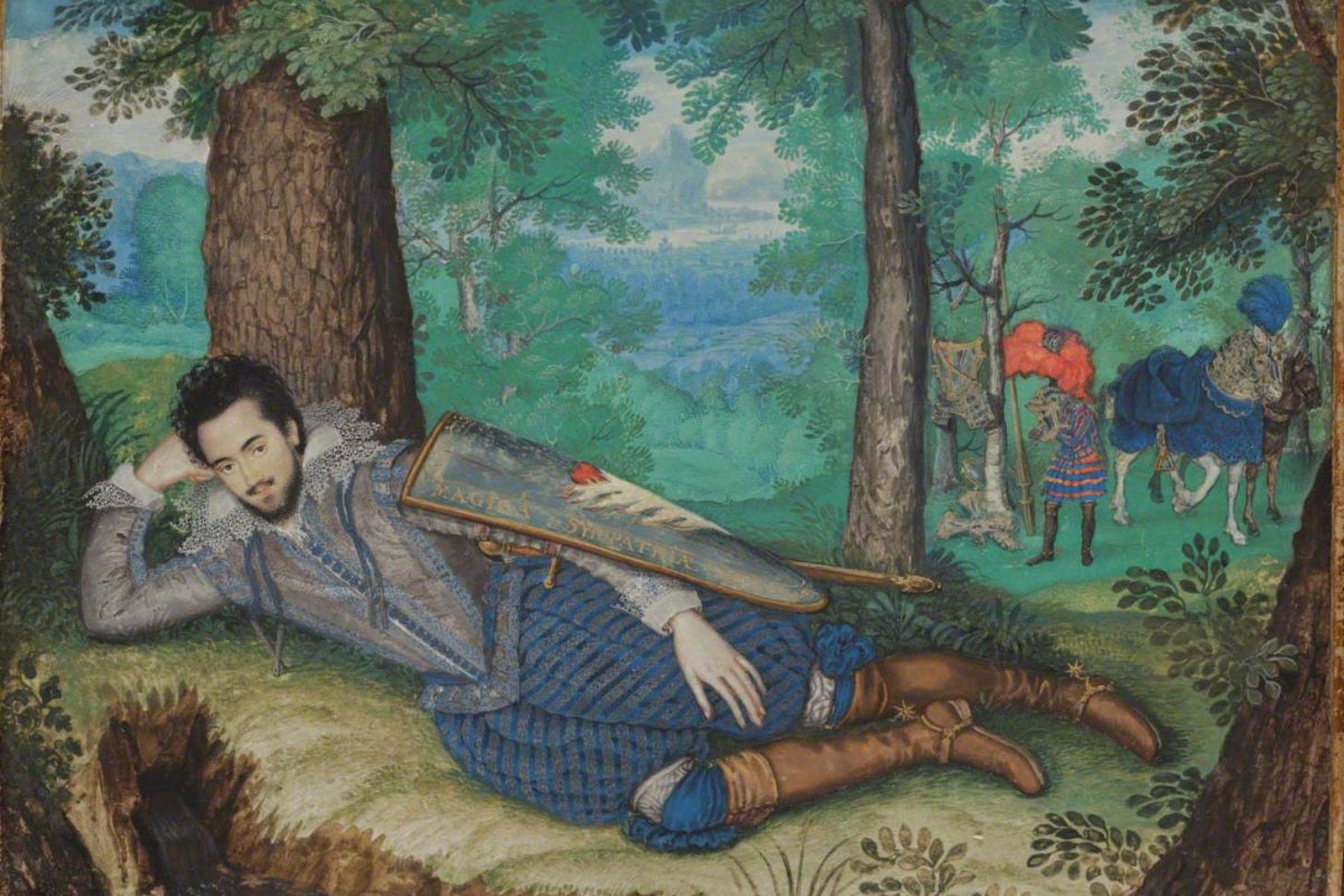
Edward Herbert, 1st Baron Herbert of Cherbury | Isaac Oliver, ca. 1613 (detail)
Why was the saddest song in England its most popular?
Key Terms for this Lesson
Pavan · Ayre · Lachrimae
The Lutenist | 1580–1598
John Dowland (d. 1626) was the finest lute player in Elizabethan England, and he never stopped saying so. The lute itself had come to Europe from the Islamic world: its name is the Arabic al-ʿūd, “the wood” (cf. Humanities I, Sec. 11.5). In 1580 the young Dowland went to Paris in the service of the English ambassador, and there he became a Catholic. He took a degree in music at Oxford in 1588. In 1594 the queen’s lutenist John Johnson died, and Dowland applied for his place. He did not get it. From Nuremberg in 1595 he wrote to the queen’s councillor Sir Robert Cecil (d. 1612), to declare his loyalty and to explain why he believed he had been passed over:
“I began to sounde the Cause, & gest that my Relygion was my hinderance.” He had heard that the queen, when his name was put to her, called him “a man to serve any princ in the world,” but “an obstinat papist.” That was his account, not hers. William Byrd (d. 1623), a Catholic, kept his place in the Chapel Royal for half a century, so the court may have had other reasons. Dowland spent the next years at German courts and in Italy, hoping to study in Rome with the madrigalist Luca Marenzio (d. 1599), and from 1598 he served Christian IV (d. 1648) of Denmark at 500 daler a year, among the highest salaries at the Lutheran court.
The Tears | Lachrimae, 1596–1604
His most famous tune began without words. It was a pavan, a slow, stately dance in duple time, and Dowland called it Lachrimae, Latin for “tears.” It opens on a falling line of four notes, the musical figure of a tear, and it spread across Europe in his own lifetime: copied by hand, printed in other men’s books, and arranged for keyboard, viols, and lute by composers from London to the Netherlands. A printer published a version in 1596 that Dowland called “false and unperfect.” In 1600 the tune appeared with words, as “Flow, my tears,” in his Second Booke of Songs or Ayres. An ayre is an English song for a single voice with lute, often printed so that four singers around one table could read their parts from the same open book. His First Booke (1597) would be reprinted four or five times in his lifetime. The first stanza sets the mood of all five:
Flow, my tears, fall from your springs! / Exiled for ever, let me mourn; / Where night’s black bird her sad infamy sings, / There let me live forlorn. Flow, My Tears (John Dowland)
Night’s black bird is the nightingale, the bird of lament. In 1604 Dowland made the tune the foundation of a whole book, Lachrimae, or Seaven Teares, for five viols and lute, dedicated to Anne of Denmark, James I’s queen: seven pavans on the one falling figure, among them “Old Tears,” “Sighing Tears,” and “True Tears.” One of its other pieces is titled Semper Dowland semper dolens, “Always Dowland, always grieving.” He signed himself “Jo: dolandi de Lachrimae” — the tears had become his name.
Sorrow & the Psalms | Sacred & Secular
Melancholy was the fashion of the 1590s. In the old Galenic medicine, it was one of the four humors, and it was thought to mark the scholar, the poet, and the lover: the thoughtful man dressed in black, like Hamlet in his “inky cloak.” To sing of sorrow was not to confess a disorder but to show refinement. And English congregations already knew how to sing sorrow. The Sternhold–Hopkins Psalter, the whole Book of Psalms in English meter, was printed with its tunes, and these were meant to be performed — sung by the whole congregation, Sunday after Sunday. It was often bound with the Geneva Bible and commonly with the Book of Common Prayer (cf. Sec. 3.2). The Sternhold–Hopkins Psalter was reprinted more than 300 times between 1603 and 1640, though leaders in the church, poets, and King James I criticized it for being obsolete and devoid of elegance and spirit. Dowland himself harmonized psalm tunes for Thomas East’s Whole Booke of Psalmes in 1592.
Why was the saddest song in England its most popular? Because to Elizabethans, sorrow beautifully sung was not despair but consolation and craft, and melancholy was the mark of a cultivated mind. Because its four falling notes were simple enough for anyone to play and rich enough for every composer to borrow, so the tune traveled by print and by hand across Europe. And because a people who sang the psalms of lament every Sunday knew how to hear grief as music. Dowland made sadness his signature, and the century kept asking him to sign.
Sec 3 • Elizabeth & the New Heavens
3.1 History & Politics • England’s Golden Age & the Sultan
3.2 Religion • The Book of Common Prayer & the King James Bible
3.3 Art & Architecture • Holbein’s The Ambassadors
3.4 Philosophy • Copernicus & the De-Centered Cosmos
3.5 Literature & Drama • Hamlet’s Modern Mind
3.6 Music • Dowland’s “Flow, My Tears”
Course Page: Humanities I & II
Next Section: Baroque & the New Science