

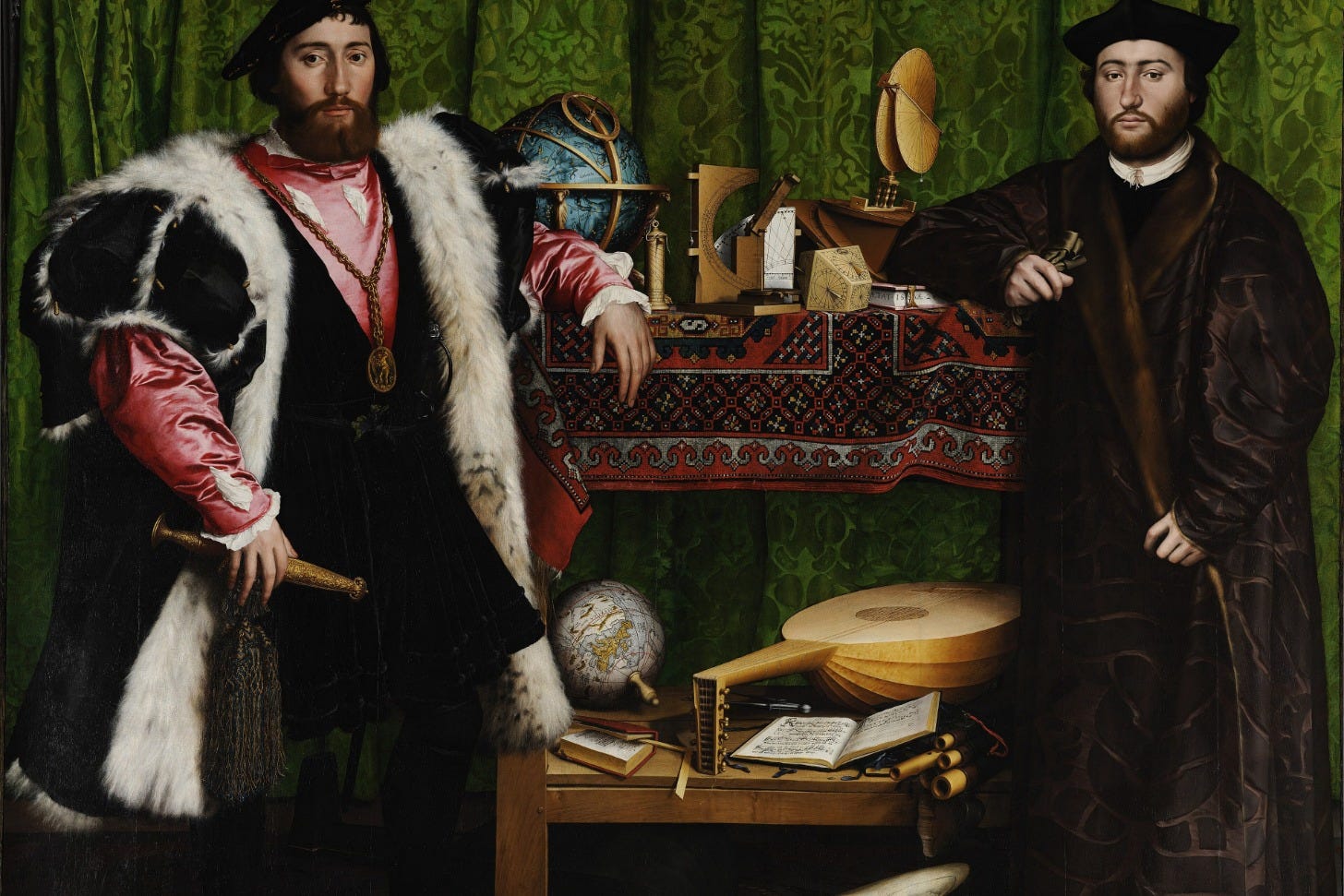
The Ambassadors | Hans Holbein the Younger, 1533 (detail)
Why did Holbein hide a skull in a portrait of two ambassadors?
Key Terms for this Lesson
Quadrivium · Anamorphosis · Vanitas
Two Frenchmen in London | 1533
Hans Holbein the Younger (d. 1543) was a German painter from Augsburg who made his name in Basel. There he painted Erasmus (cf. Humanities I, Sec. 15.2) and cut the woodblocks of his Dance of Death (cf. Humanities I, Sec. 14.5). When Basel’s churches were stripped of their images in 1529, as Zürich’s had been (cf. Sec. 2.4), the commissions dried up — and in 1532 Holbein settled in London for good. Within a few years he was painting for Henry VIII himself: the woodcut title page of the Coverdale Bible (1535), with Henry enthroned holding the sword and the book, and a drawing of Henry as Solomon receiving the Queen of Sheba. He became the Tudor court’s image-maker (cf. Sec. 3.2).
In the spring of 1533 he painted two Frenchmen. On the left stands Jean de Dinteville (d. 1555), the French king’s ambassador in London. On the right is Georges de Selve (d. 1541), bishop-elect of Lavaur, who had come to visit him. Holbein put their ages into the picture: “AET. SVÆ 29” on Dinteville’s dagger, “ÆTATIS SVÆ 25” on the book under Selve’s elbow. In his 29th year, in his 25th. It was a tense season to be a Catholic diplomat in London. On April 7, 1533, the Act in Restraint of Appeals ended appeals from English courts to Rome, and Henry’s break with the pope was becoming law (cf. Sec. 3.2). The Ambassadors is oil on oak, 207 by 209.5 centimeters, large enough to paint the two men life-size, and it is now in the National Gallery, London, which bought it in 1890.
The Shelves | Heaven & Earth
Between the men stands a two-tier table, and it holds the learning of the age. On the upper shelf, covered with a Turkish carpet, are the instruments of the heavens: a celestial globe, sundials, a quadrant, a torquetum for measuring the stars. On the lower shelf are the things of the earth: a terrestrial globe, a merchants’ arithmetic book by Peter Apian (d. 1552) open at “division,” a lute, a case of flutes, and a hymnbook. Together they are the quadrivium, the four mathematical arts of the medieval university: arithmetic, geometry, music, and astronomy (cf. Humanities I, Sec. 12.4). Two educated men, surrounded by everything they could measure.
Look closer, and the order breaks. The lute has a broken string. The hymnbook is Johann Walter’s Wittenberg hymnal of 1524, open to two of Luther’s hymns: on the left page “Komm, heiliger Geist, Herre Gott,” his version of the ancient prayer Veni Sancte Spiritus, and on the right “Mensch, willt du leben seliglich,” his hymn on the Ten Commandments (cf. Sec. 2.3). A Catholic bishop, beside a Lutheran hymnbook, beside a broken string. Many read the broken string as the discord dividing Christendom, and Selve was known to want the churches reconciled. The floor beneath them copies the stone pavement before the high altar of Westminster Abbey, where English monarchs are crowned. And at the top left corner, half hidden behind the green curtain, hangs a silver crucifix.
The Skull | Anamorphosis
Across the floor, between the men’s feet, lies a long gray smear. From the front it looks like nothing at all. Stand far to the side of the painting, close to the wall, and look along its surface, and the smear draws itself together into a human skull. The technique is anamorphosis, from the Greek ana, “again,” and morphē, “form”: an image distorted so that it can be seen in true proportion only from one angle. It is linear perspective pushed to its limit (cf. Humanities I, Sec. 15.3). The painter who could measure every globe on the table could also measure a skull into hiding. Dinteville wears a small skull as the badge on his cap — a second one, in plain sight. The skull belongs to the old tradition later called vanitas: images that set the goods of this world beside a sign of death, named for the opening of Ecclesiastes:
Vanity of vanities, saith the Preacher, vanity of vanities; all is vanity. What profit hath a man of all his labour which he taketh under the sun? One generation passeth away, and another generation cometh: but the earth abideth for ever. Ecclesiastes 1:2–4 (King James Version)
Why did Holbein hide a skull in a portrait of two ambassadors? Because the one thing on that table no instrument could measure was death, and he would not let his patrons forget it. From where we see the two men in full, we cannot see the skull. From where we see the skull, the men are a blur. The viewer has to choose an angle. The curtain hides one answer at its edge, and Holbein left it there. Holbein died in London ten years later, in 1543, the year Copernicus published the book that would move the Earth itself (cf. Sec. 3.4).
Sec 3 • Elizabeth & the New Heavens
3.1 History & Politics • England’s Golden Age & the Sultan
3.2 Religion • The Book of Common Prayer & the King James Bible
3.3 Art & Architecture • Holbein’s The Ambassadors
3.4 Philosophy • Copernicus & the De-Centered Cosmos
3.5 Literature & Drama • Hamlet’s Modern Mind
3.6 Music • Dowland’s “Flow, My Tears”
Course Page: Humanities I & II