

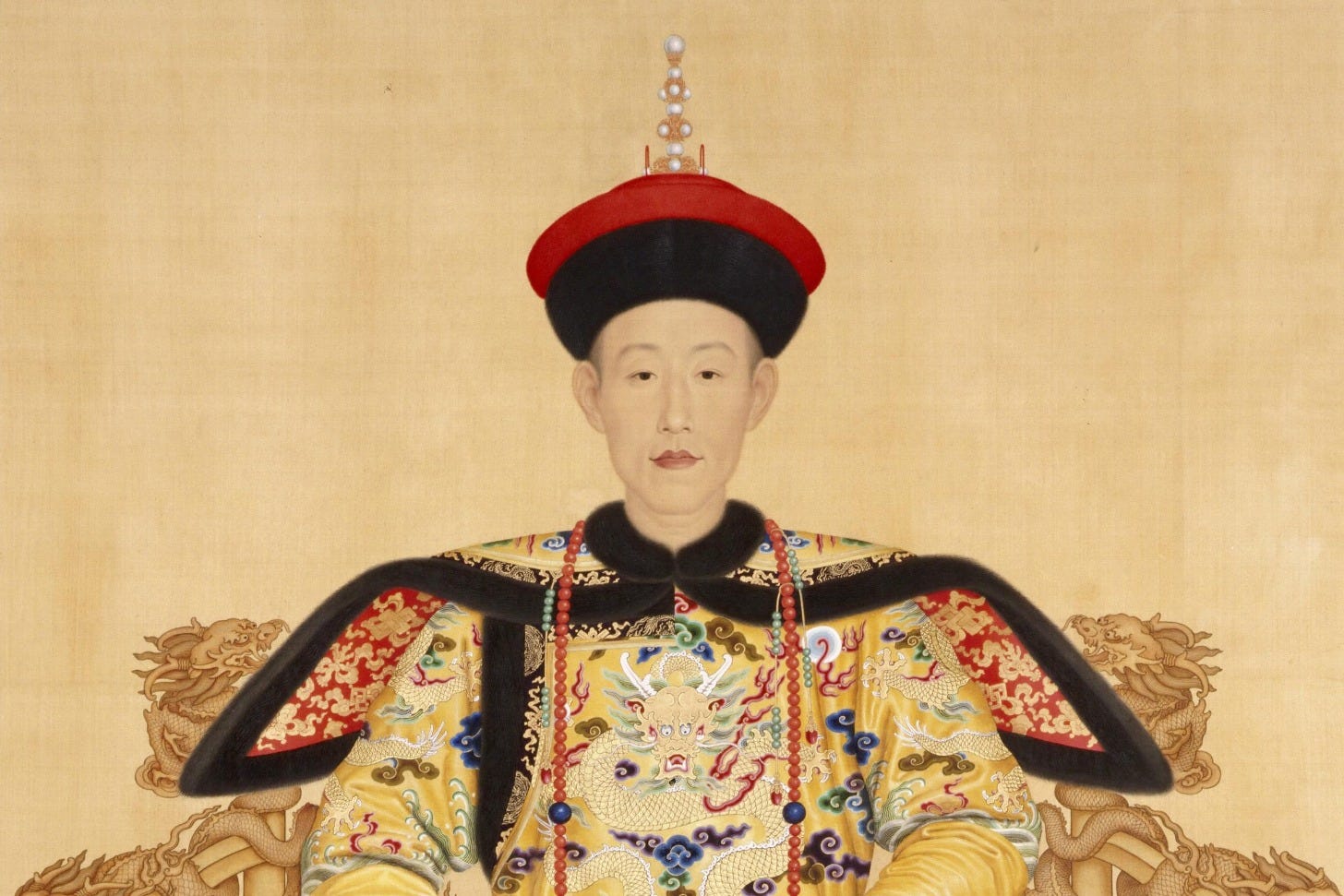
The Qianlong Emperor in Court Robes | Giuseppe Castiglione, 1736 (detail)
Why did China’s emperors watch the sky?
Key Terms for this Lesson
Dynasty · Oracle Bones · Mandate of Heaven
The River Dynasties | ca. 1600–1046 BCE
As it is easy to see when viewing a map, all of the strongest civilizations center around rivers (cf. Sec. 2.1, 3.1). China has the Yellow River (Huang He) and the Yangtze, both of which reach thousands of miles inland. The associated river valleys provided fertile land for crops: millet in the dry north and rice in the wet south. The broad northern plain could be ruled from one place.
A dynasty is a line of rulers from one family, and when one dynasty transitions into the next in ancient Chinese history, it’s usually because the new dynasty overthrew the old one.
The Shang (ca. 1600–1046 BCE) is the earliest Chinese dynasty confirmed by its own written records. They specialized in bronze craftsmanship that was utilized for an expansive military. The earliest form of Chinese writing can be dated to this time, and it is based on pictures. It survives on oracle bones — turtle shells and ox shoulder blades used for divination. A diviner carved a question into the bone, heated it until it cracked, and read the answer in the cracks. Will it rain? Will the king win? More than a hundred thousand of these pieces have been found, and some of them record eclipses of the moon.
The Mandate of Heaven | ca. 1046–256 BCE
• ca. 1600 BCE | The Shang rise on the Yellow River
• ca. 1046 BCE | The Zhou overthrow the Shang at Muye
• ca. 475 BCE | The Warring States period begins
• 221 BCE | Qin Shi Huang unifies China
• 202 BCE | The Han dynasty begins
In 1059 BCE, the five planets visible to the naked eye gathered in one small patch of the night sky, a close gathering that would not come again for many centuries. The house of Zhou, a western vassal of the Shang, seems to have read it as a sign. About thirteen years later, King Wu (d. ca. 1043 BCE) defeated the last Shang king at the Battle of Muye. To explain their right to rule, the Zhou announced a new doctrine.
Heaven (Ch. Tian) in ancient Chinese culture is not a separate realm above the world. Heaven in Chinese culture is woven together with Earth (Ch. Di) in a cosmic equilibrium. Heaven and Earth reflect two halves of the natural world, each complementing the other.
天地 Tiandi | Heaven & Earth
天命 Tianming | Mandate of Heaven
Accordingly, the Mandate of Heaven (天命) emerged as a traditional Chinese political doctrine indicating the right for a leader to rule. The Mandate suggests that a good leader governs with Heaven’s approval, which is proven by the prosperity and stability under that ruler’s domain. If unrest or calamities persist, it can be interpreted as a sign that the ruler has lost the mandate. The Zhou said exactly that of the last Shang king, and over centuries many dynasties in China justified their ascension the same way. Unlike Egypt’s pharaoh (cf. Sec. 3.1), the Chinese king was no god. He was the Son of Heaven, and he ruled only as long as Heaven approved. A Zhou king put the doctrine into a hymn for the ancestral temple:
Let me be reverent! Let me be reverent! (The way of) Heaven is evident, And its appointment is not easily preserved. Let me not say that it is high aloft above me. It ascends and descends about our doings; It daily inspects us wherever we are. Book of Songs (”Jing Zhi,” trans. James Legge, 1879)
Heaven, in the hymn, is not “high aloft.” It daily inspects. The ruler was a caretaker of cosmic harmony, obligated to observe signs in the natural world (e.g., eclipses, unusual weather, and famines) and interpret them as feedback on his rule. A line from a lost chapter of the Book of Documents, preserved by Mencius (d. ca. 289 BCE), made the people Heaven’s eyes: “Heaven sees as my people see; Heaven hears as my people hear.” In this worldview, moral conduct and political authority become inseparable.
The Zhou dynasty (ca. 1046–256 BCE) lasted longer than any other Chinese dynasty, though its kings soon parceled the land out to feudal lords. Confucius (d. 479 BCE) lived and taught in this unstable time (Sec. 5.5), and its last period is called the Warring States period (ca. 475–221 BCE).
The First Emperor & the Han | 221 BCE–220 CE
The Qin dynasty (221–206 BCE) was led by Qin Shi Huang (d. 210 BCE), who took the title “First Emperor.” He established a single writing system, weights, and measurements, which further unified the ancient Chinese people. One particularly ruthless part of his reign is called the Burning of the Books (213 BCE), in which the emperor ordered the destruction of philosophical books that were threatening to the absolute power he demanded.
Following the death of Qin Shi Huang, China fell into eight years of chaos before the Han dynasty (202 BCE–220 CE) took charge for about 400 years. Its founder, Gaozu (d. 195 BCE), was born a peasant, and the Mandate needed no noble birth. He retained the Qin system of provinces but returned a lot of power to the regions.
The sky-watching outlasted every dynasty. The court astronomers’ office came to be called the Qintianjian, the “Bureau for Revering Heaven,” and an eclipse it failed to predict could read as Heaven’s verdict. In the 1600s, European Jesuits won places at the court in Beijing with better eclipse predictions, and the Flemish Jesuit Ferdinand Verbiest (d. 1688) ran the imperial observatory for the Kangxi Emperor. More than 2,700 years after the Zhou read the planets, the Son of Heaven was still watching the sky.
Sec 5 • Ancient China
5.1 History & Politics • The Mandate of Heaven
5.2 Sacred Life • Daoism & the Ancestors
5.3 Literature & Drama • The Daodejing
5.4 Music • Bronze Bells & Confucius
5.5 Philosophy • Confucianism
5.6 Art & Architecture • The Army & the Wall
Course Page: Humanities I & II