

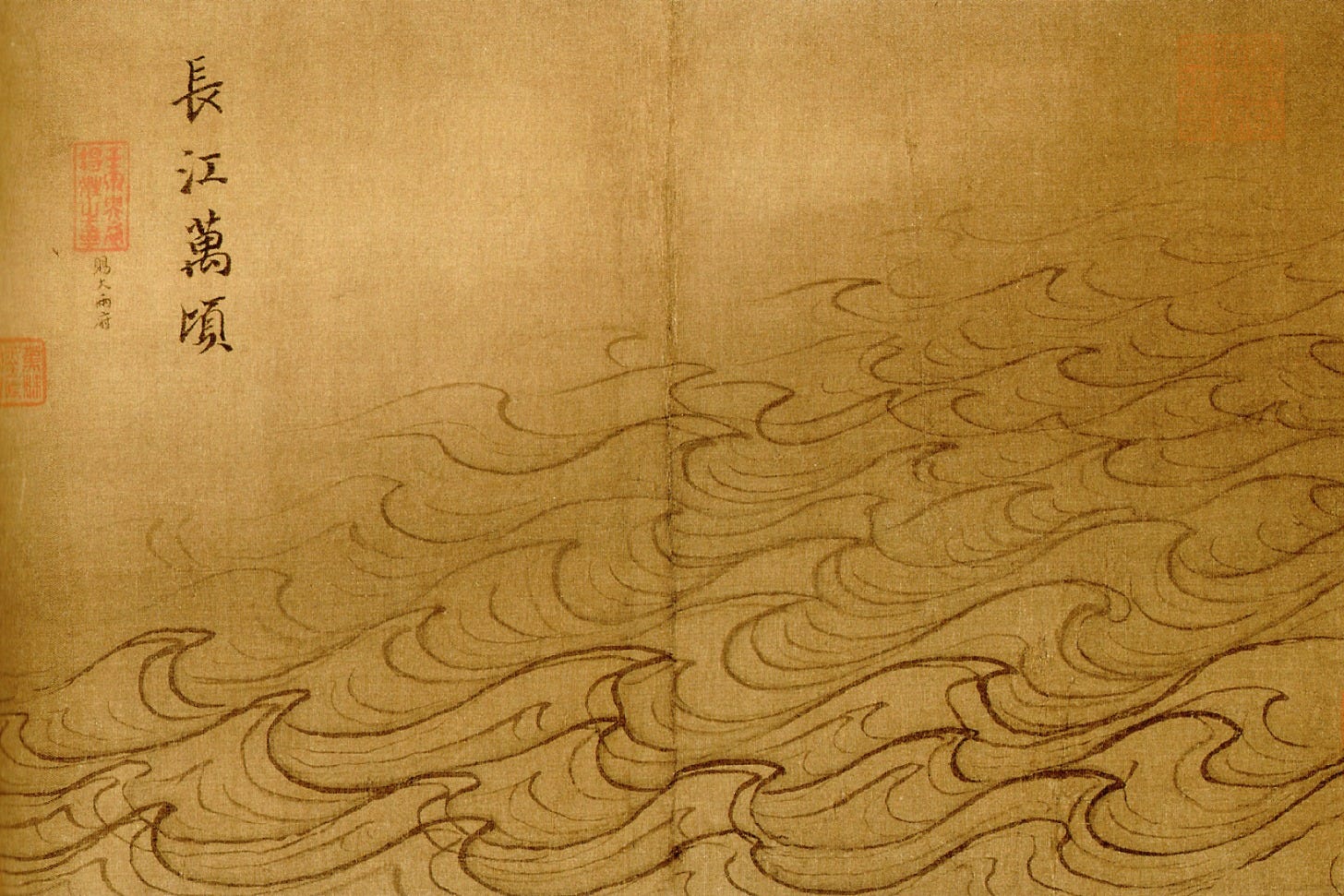
Ten Thousand Ripples on the Yangzi | Ma Yuan, early 1200s
Why would a sage want to be like water?
Key Terms for this Lesson
Ancestor Veneration · The Dao · Wuwei
The Ancestors | Shang to Zhou
The questions carved on the Shang oracle bones (cf. Sec. 5.1) were not addressed to the sky alone. They went to the royal ancestors, and to a high god called Di, who sent the rain, wind, and thunder. The Shang king served as head of the ancestral rites and often read the cracks himself. Royalty were buried with articles of value, presumably for use in the afterlife, much as Egypt provisioned its tombs (cf. Sec. 3.4).
The custom outlived the Shang by three thousand years. Chief among China’s ideals is ancestor veneration (jìng zǔ, 敬祖). Families across China and the diaspora honor their forebears through offerings, incense, and memorial rites, a direct expression of Xiao (孝, filial piety) that treats each generation as standing on the shoulders of those who came before. Xiao is the reverence a person owes their family, and above all their parents, and it extends to grandparents and to one’s ancestors. One must never bring dishonor to one’s family.
Into that household world came two teachers. Together with the Buddha, whose teaching arrived later (cf. Sec. 4.6), Laozi and Confucius make up what the Chinese call the Three Teachings (sanjiao). Confucius belongs to Sec. 5.5. This lesson follows Laozi and the way of life called Daoism. A note on spelling: this course renders Chinese in pinyin — so you will read Dao not Tao, Laozi not Lao Tzu.
The Dao | The Way & the Water
The Daodejing teaches that there is a way about the universe called the Dao (道). The word can imply “way,” “path,” or even the Greek concept of logos (cf. Sec. 6.5). In contrast to Confucian exactitude, Daoist thought describes the underlying nature of the universe more like art: abstract, elusive, and by its very nature impossible to put into exact language (Sec. 5.3).
What sets the Dao apart is that it is a process, not a product. You can name a bowl of soup (”Hey, that’s clam chowder!”), while love is something you feel and can never quite pin down. The Dao is like love (a process), and unlike soup (a thing): constantly shaping reality, different at each encounter. For my money, the closest popular analog to the Dao today may be the Force of the Star Wars films, “an energy field created by all living things.” In India, the Dao has similarities with Brahman insofar as it is the ultimate reality beneath everyday appearances (cf. Sec. 4.3).
Running water is one of the favorite images of Daoist art. Laozi’s own favorite illustration of the Dao was water, too:
The highest excellence is like (that of) water. The excellence of water appears in its benefiting all things, and in its occupying, without striving (to the contrary), the low place which all men dislike. Hence (its way) is near to (that of) the Tâo. Daodejing (Ch. 8, trans. James Legge, 1891)
Water serves everything and fights nothing. It runs downhill to the low place no one wants. And yet, as Chapter 78 adds, “There is nothing in the world more soft and weak than water, and yet for attacking things that are firm and strong there is nothing that can take precedence of it…”
Yin, Yang, & Wuwei
The two forces whose interplay is the Dao’s movement are yin and yang.
Yin is the receptive aspect: night, softness, stillness, coolness, the earth.
Yang is the active aspect: day, hardness, motion, warmth, the sky.
They are interconnected, mutually necessary, and never found without each other. Critically, just so there’s no misunderstanding, yin and yang are NOT good and evil. Westerners often jump to that conclusion, and it is completely wrong. Both are essential and necessary. For Daoists, all things have both yin and yang elements, and the point is to bring balance to the two equal and opposite forces. The famous yin-yang symbol is a picture of balance, each half already carrying a seed of the other.
In Daoist teaching, the way to live in that balance is called Wuwei. Literally “non-action,” Wuwei is not laziness or passivity. It describes action so closely aligned with the flow of life that it feels effortless. Think of it this way: does a tree take a look at the forest and make a plan to grow? No. A tree grows naturally and effortlessly. If there’s a rock in the way, the roots go over or under it. The tree doesn’t have intentions that go against nature. Daoists warn against swimming “against the current.”
A popular, though apocryphal, anecdote illustrates the principle. During the Space Race, American engineers are said to have spent large sums inventing a pressurized “space pen” for zero gravity. The Soviet cosmonauts simply brought pencils. Real or contrived, the story makes a compelling point. Working organically, without a lot of unnecessary contrivances, often yields simpler, more elegant results. Athletes describe the same state as being “in the zone.”
That is why the sage wants to be like water. Water never plans its way around a stone. It takes the low road, keeps moving, and in time the stone gives way.
Sec 5 • Ancient China
5.1 History & Politics • The Mandate of Heaven
5.2 Sacred Life • Daoism & the Ancestors
5.3 Literature & Drama • The Daodejing
5.4 Music • Bronze Bells & Confucius
5.5 Philosophy • Confucianism
5.6 Art & Architecture • The Army & the Wall
Course Page: Humanities I & II