

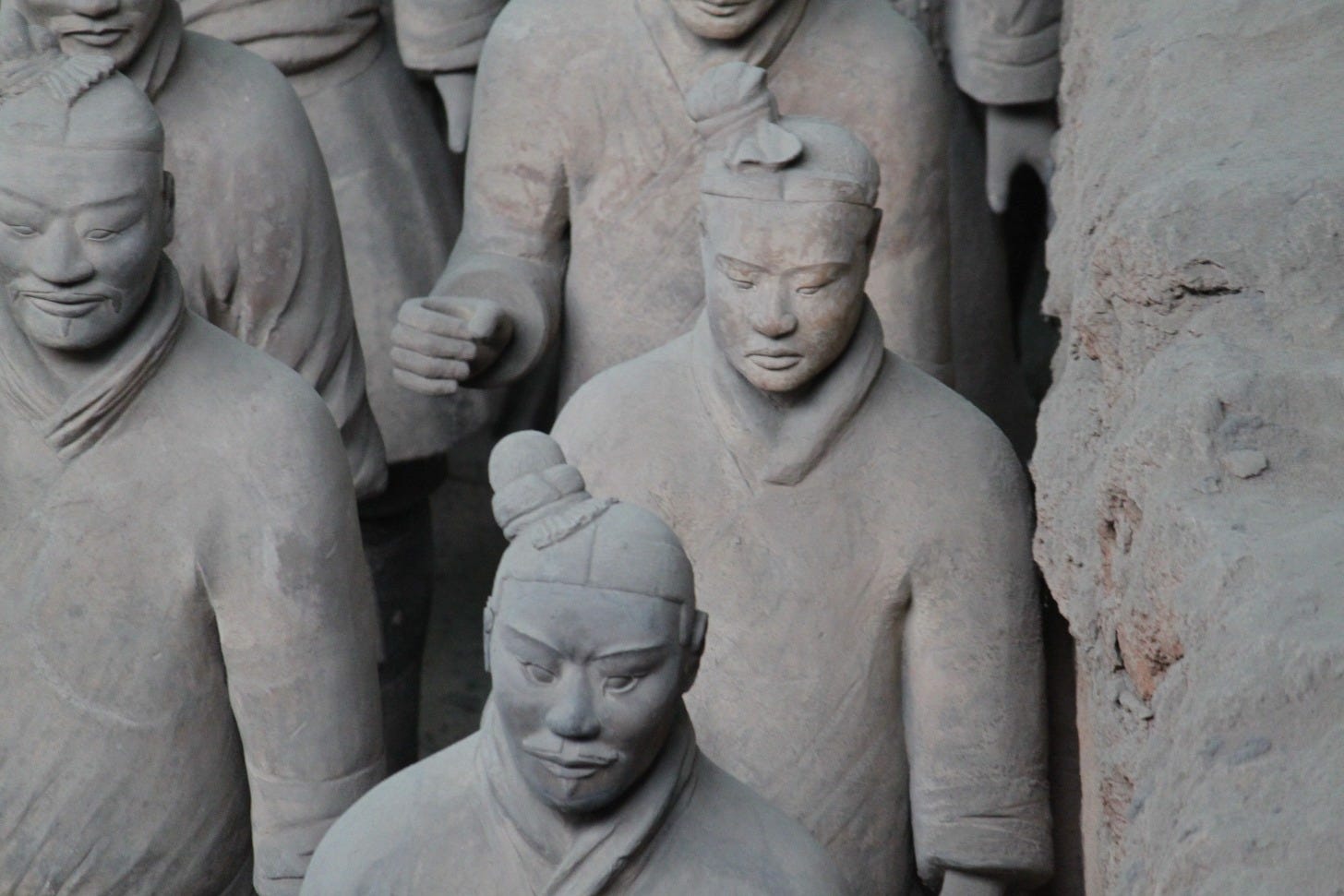
The Terracotta Army | Pit 1, Lintong, Xi’an, ca. 210 BCE
Photo Credit: Gary Todd via Wikimedia Commons, CC0
Why build an army of clay?
Key Terms for this Lesson
Funerary Art · The Terracotta Army · The Great Wall
The First Emperor | 221–210 BCE
Qin Shi Huang (d. 210 BCE) organized the diverse kingdoms into an empire and was quite brutal in getting these kingdoms to obey (cf. Sec. 5.1). He moved the wealthy and powerful families from around China to his capital so he could keep an eye on them, and passed a law that no private citizen could own weapons. The confiscated bronze was melted down and cast into the Twelve Metal Colossi, giant statues to adorn his palace.
His reforms reached art as well. His chancellor, Li Si (d. 208 BCE), gave the empire one standard script, the small seal, and the emperor had his deeds carved in it on stone steles set up on mountains across the empire. Calligraphy, the art of the brush, became one of China’s highest arts, and its emphasis was on beauty of line. After the Qin, a brushstroke made in the capital could be read at the farthest frontier.
He had been building his tomb since he was a boy. Work on it began in 246 BCE, when he became king of Qin at 13, and the historian Sima Qian (d. ca. 86 BCE) says it eventually took 700,000 conscripted workers. Like the Egyptians (cf. Sec. 3.4), Qin Shi Huang believed his empire would last forever, and he called himself the First Emperor so that the second, the third, and the ten-thousandth could follow.
The Terracotta Army
On March 29, 1974, a farmer named Yang Zhifa and his brothers were digging a well near Xi’an when they struck pieces of clay figures. They had found the Terracotta Army. Craftsmen labored to create an army to defend the emperor in the afterlife, buried in pits about a mile east of his tomb mound, facing east toward the lands he had conquered. Archaeologists estimate more than 8,000 soldiers, 130 chariots with 520 horses, and 150 cavalry horses, most of them still in the ground.
It is funerary art: art made to be buried with the dead and never seen again by the living. The soldiers are life-sized, and they grow taller with rank, so the generals stand tallest. Their bodies were built from standard molds, like parts on an assembly line, but each face was finished by hand, and no two figures are exactly alike. The sculptors signed their names in the figures’ armpits. More than 40,000 real bronze weapons have been recovered from the pits, mostly arrowheads. They were also painted in bright reds, greens, blues, and purples. Today they are gray because the paint flakes away within minutes of meeting the dry air of Xi’an.
The army was only one part of a whole empire built underground. Other pits hold clay officials, acrobats, strongmen, and musicians. The emperor’s own tomb lies under its great mound, still unopened. Like the pyramid (cf. Sec. 3.4) and the stupa (cf. Sec. 4.6), it was made to outlast its builder. An emperor who melted down every sword in China buried an army of 8,000 to guard his sleep.
The Great Wall | 7th c. BCE–1644 CE
The Great Wall was constructed by Qin Shi Huang to defend China against invaders from the northern steppe. Some walls already existed from previous dynasties (the oldest date to the 600s BCE), but in a massive construction project, he ordered they be connected. Both peasants and prisoners labored on its construction. A generation later, the scholar Jia Yi (d. 169 BCE) described it this way: the emperor “sent Meng Tian north to build the Long Wall and guard the frontier hedge,” and “the northern horsemen did not dare come south to graze their horses” (my translation).
What tourists walk on today is mostly the work of the Ming dynasty (1368–1644), built in brick and stone more than 1,500 years later. Counting every wall of every dynasty, a Chinese survey in 2012 measured the Great Wall at more than 13,000 miles. Despite what many say, it is not visible from the Moon, and from orbit it is barely visible, if at all. It is basically the same color as the surrounding land, and while it’s incredibly long, it is rarely more than 30 feet wide. China’s first astronaut, Yang Liwei, looked for it in 2003 and could not find it.
The wall kept the horsemen out, but the Qin dynasty fell four years after its founder’s death, and Jia Yi asked why:
One commoner rose in revolt, and the seven ancestral temples fell. Its ruler died at other men’s hands and became the laughingstock of the world. Why? Because it did not practice humaneness and righteousness, and the power to seize differs from the power to hold. The Faults of Qin (Jia Yi, my translation)
For the Confucian scholars of the Han, that was the lesson of the Qin, and the reason a dynasty had to keep the Mandate of Heaven by virtue rather than by walls (cf. Sec. 5.1, 5.5).
Sec 5 • Ancient China
5.1 History & Politics • The Mandate of Heaven
5.2 Sacred Life • Daoism & the Ancestors
5.3 Literature & Drama • The Daodejing
5.4 Music • Bronze Bells & Confucius
5.5 Philosophy • Confucianism
5.6 Art & Architecture • The Army & the Wall
Course Page: Humanities I & II
Next Section: Early Greece