

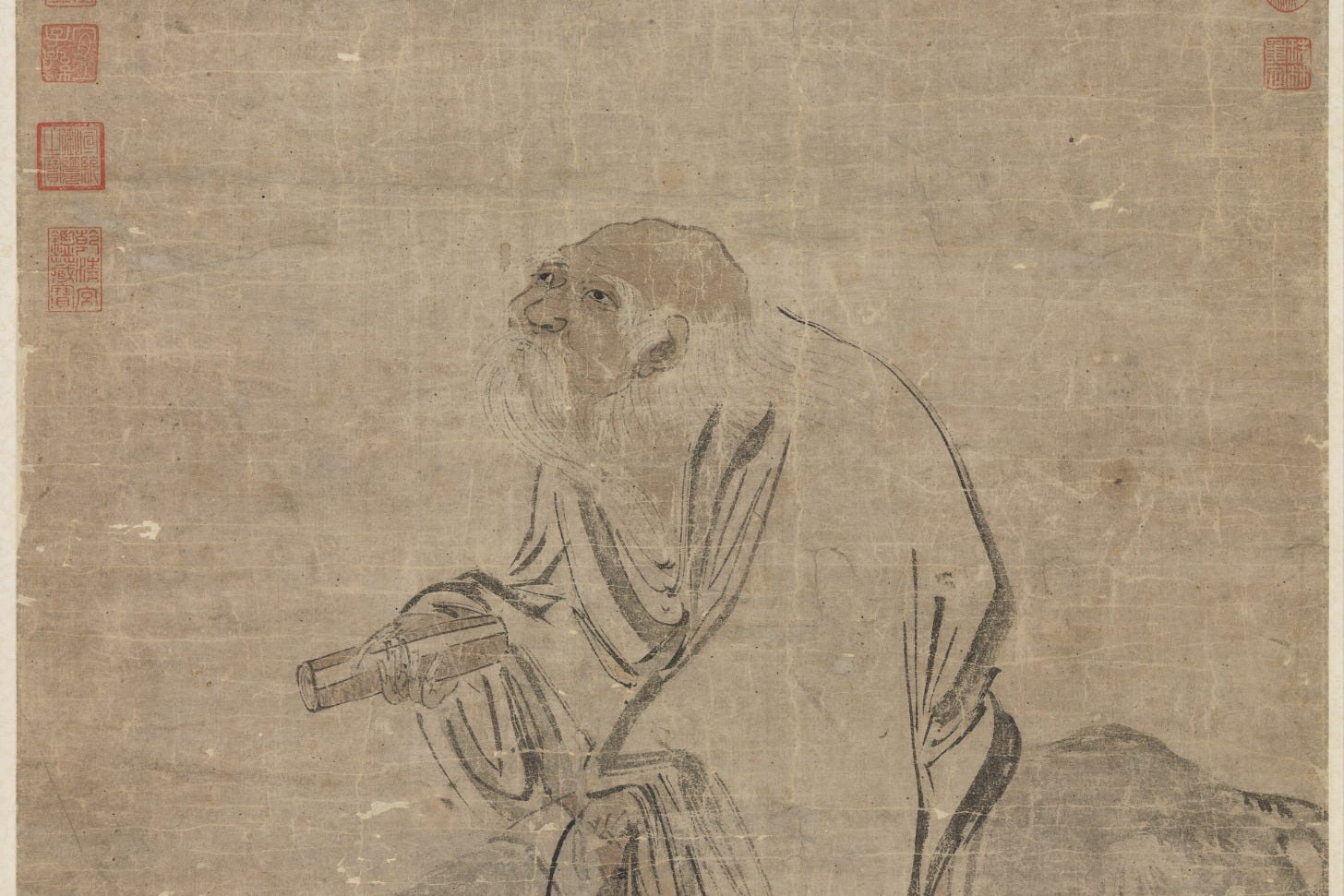
Laozi Riding an Ox | Zhang Lu, ca. 1500 (detail)
Why is the way that can be talked about not the Way?
Key Terms for this Lesson
Laozi · The Daodejing · Paradox
Laozi | The Old Master
The Daodejing (the Tao Te Ching), the foundational text of Daoist thought, is traditionally attributed to the ancient sage Laozi (Ch. the “Old Master”). The oldest account of his life comes from the Han historian Sima Qian (d. ca. 86 BCE). Laozi, he says, kept the archives at the Zhou court (cf. Sec. 5.1). Seeing the dynasty decline, he went west toward the frontier. At the pass, the warden begged him to write down his teaching before he left the world behind. Laozi wrote a book in two parts (as Legge retells it), “containing more than 5000 characters, gave the manuscript to the warden, and went his way,” and “nor is it known where he died.” Daoist tradition later added that he made the journey on a water buffalo.
The dates are harder than the legend. Tradition places Laozi in the 500s BCE, an older contemporary of Confucius (Sec. 5.5). The oldest copy we have, a partial one, is a set of bamboo slips found in a tomb at Guodian in 1993, written ca. 300 BCE. It was probably gathered over generations by multiple sages. It comes in two parts: the Dao Jing (the Book of the Way, chapters 1–37) and the De Jing (the Book of Power, chapters 38–81). It is, incredibly, among the most translated books of all time, often said to be second only to the Bible.
The Opening
The Daodejing begins:
道可道 非常道
“Dào kě dào, fēi cháng dào”
So what does this text mean? The Daodejing is an esoteric text, which is to say it does not lend itself to a clear and obvious reading. Sure, we can take each of these ideograms and, one by one, transliterate them. I can gesture toward 道 and call it “Dao,” but that’s just the phonetic sounds associated with this ideogram. None of these ideograms have a straightforward translation into English. The best we can do is to offer a variety of ways to understand each ideogram and then place those meanings together. For instance, 道 (Dao) can imply “way,” “path,” or “speak.” While 可 (kě) can mean “can,” “enable,” or “permit,” and 非 (fei) commonly negates something, like “not” or “opposed.” The Chinese 常 (cháng) can signify “constant,” “eternal,” or “absolute.”
道 appears three times in the line: twice as a noun, “the Way,” and once, in the middle, as a verb, “to speak of” (or, in James Legge‘s reading, “to tread”). Scholars have rendered this opening verse in different ways:
• Legge (1891) | “The Tâo that can be trodden is not the enduring and unchanging Tâo.”
• My own translation | “The way that can be explained is not the Eternal Way.”
While simple translation eludes us, it’s fair to point out that that’s part of the point. The Dao defies clear explanation. Rather than offering a rigid set of doctrines, the Daodejing encourages its readers to dwell in wonder, approaching wisdom as an experience. The Dao isn’t something you label and pick apart. It’s something you feel. So let’s embrace the mystery and find out what we can say about it as scholars.
Paradox | The Use of What Is Empty
What we can say, the Daodejing says in paradox: a statement that seems to contradict itself and still turns out to be true. Its eighty-one short chapters are poems built from paradoxes. The soft overcomes the hard (cf. Sec. 5.2). The one who does not strive has no one to strive against. In Chapter 11, the useful part of a thing turns out to be the part that isn’t there:
The thirty spokes unite in the one nave; but it is on the empty space (for the axle), that the use of the wheel depends. Clay is fashioned into vessels; but it is on their empty hollowness, that their use depends. Daodejing (Ch. 11, trans. James Legge, 1891)
A wheel, a bowl, a room: each is useful because of an empty space no one made. That is how the Daodejing points at the Dao. In Chapter 14, it looks for the Dao and does not see it, listens and does not hear it, reaches and does not grasp it. In Chapter 25, it puts the Dao at the top of an order: “Man takes his law from the Earth; the Earth takes its law from Heaven; Heaven takes its law from the Tâo. The law of the Tâo is its being what it is.” What this verse from the Daodejing is telling us is that the Dao is its own beginning and end and follows its own purpose. Even Heaven answers to the Dao!
So the opening line is not a riddle for its own sake. A word fixes a thing in place, and the Dao never holds still (cf. Sec. 5.2). The moment you have named it, it has already moved on. Laozi had to write something for the warden. He wrote 5,000 characters to say that 5,000 characters would never be enough.
The book traveled anyway. Stanislas Julien published a French translation in Paris in 1842, and Legge’s English version appeared in 1891. Since then it has been translated hundreds of times.
Sec 5 • Ancient China
5.1 History & Politics • The Mandate of Heaven
5.2 Sacred Life • Daoism & the Ancestors
5.3 Literature & Drama • The Daodejing
5.4 Music • Bronze Bells & Confucius
5.5 Philosophy • Confucianism
5.6 Art & Architecture • The Army & the Wall
Course Page: Humanities I & II