

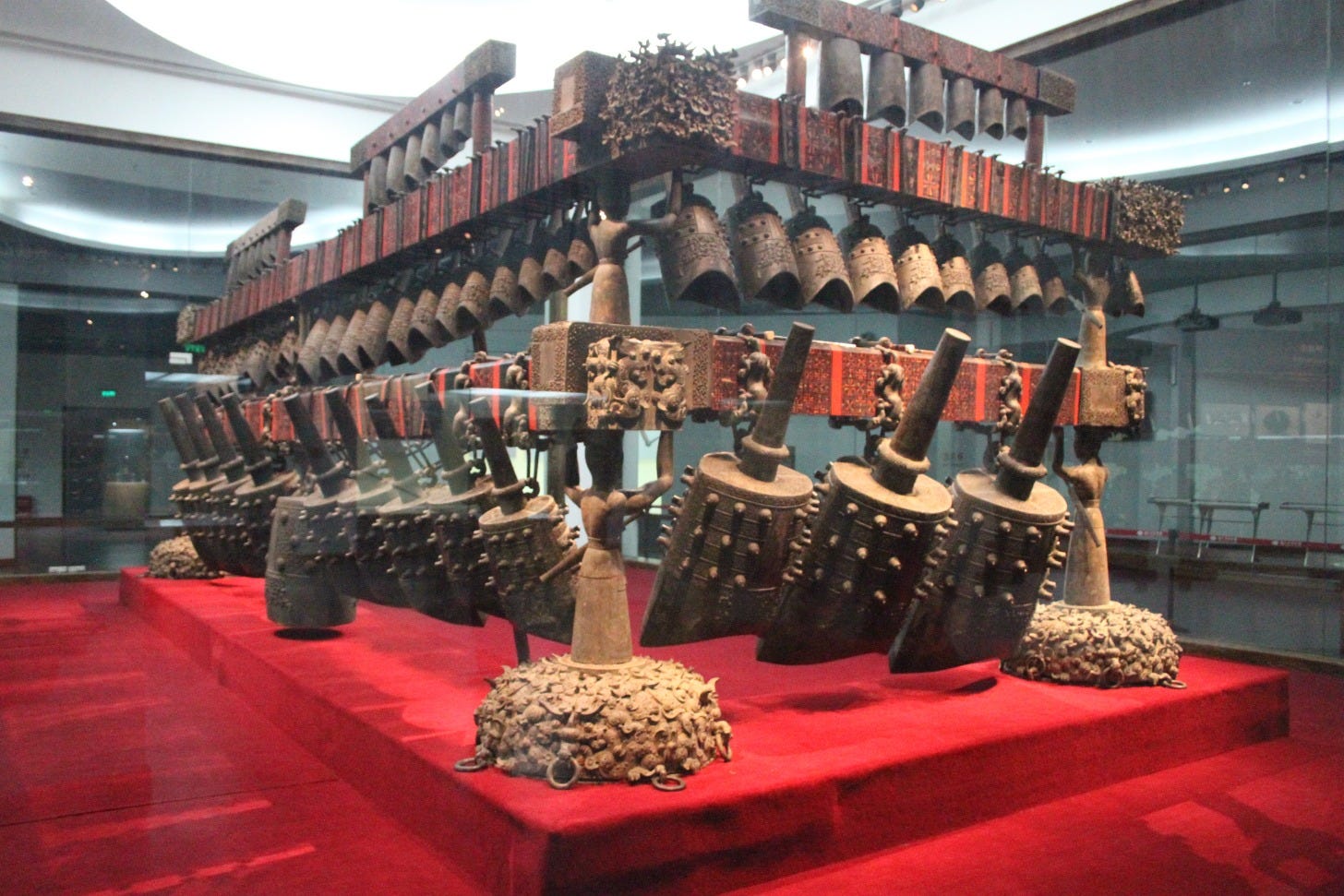
The Bells of Marquis Yi of Zeng | Suizhou, Hubei, ca. 433 BCE
Photo Credit: Gary Todd via Wikimedia Commons, CC0
How can music put a kingdom in order?
Key Terms for this Lesson
Bianzhong · Li · The Record of Music
The Bells of Marquis Yi | ca. 433 BCE
In 1977, army engineers leveling a hill for a factory in central China broke into a tomb built of great wooden timbers. It belonged to Marquis Yi, ruler of the small state of Zeng, who was buried around 433 BCE with the instruments of a full court orchestra. There were stone chimes, zithers, pan flutes, and mouth organs. And there was a set of bells unlike anything found before.
The Shang had specialized in bronze craftsmanship (cf. Sec. 5.1), and the Zhou turned that craft into music. A bianzhong is a set of tuned bronze bells hung in order on a rack, played by striking them from outside with mallets. Marquis Yi’s set has 64 bells in three tiers on an L-shaped rack of lacquered wood, the longest side about 24 feet. The largest bell stands about 5 feet tall and weighs 449 pounds. The smallest is 8 inches. Bronze figures of men hold up the beams.
Then comes the surprise. Each bell rings two different notes, a third apart, depending on whether it is struck at the center or near the edge. The secret is the bell’s shape. It is not round but almond-shaped in cross-section, so the two tones do not blur together. The set spans five octaves, and in its middle range it can play every half step of a modern piano scale. Inscriptions on the bells name their notes and record how the pitch standards of Zeng matched those of the Zhou court and the great southern kingdom of Chu. A 65th bell, a gift from the king of Chu, is inscribed with the date of the funeral. Like the lyres of Ur (cf. Sec. 2.4), these instruments went into the ground with the ruler who owned them.
Rites & Music | Li & Yue
Bells like these were not played for entertainment. They were rung for rites: sacrifices in the ancestral temple (cf. Sec. 5.2), banquets for guests of state, and the ceremonies of the court. In Zhou China, rites and music were a single system, called liyue (禮樂), “rites and music.” Li (禮), or propriety, is found in proper social conduct, from great rites and ceremonies down to everyday courtesy. It includes rituals, customs, etiquette, and everyday manners. It governs how one speaks, listens, disagrees, celebrates, mourns, and shows respect.
Music was li made audible, and it followed rank. According to the Rites of Zhou, a king could hang his bells on all four sides of the hall, a lord on three, a minister on two, and an officer on one. The number of dancers in a temple courtyard followed the same ladder, and the king alone was entitled to eight rows of eight. So when the head of the powerful Ji family in Confucius‘s home state staged eight rows of dancers in his own courtyard, Confucius (d. 479 BCE) took it as a sign of a world coming apart: “If he can bear to do this, what may he not bear to do?” (Analects 3.1). A noble who took the king’s music had already taken the king’s place.
Confucius & the Record of Music
Confucius loved music. Once, in the state of Qi, he heard the ancient Shao music, “and for three months did not know the taste of flesh” (Analects 7.13). He taught that a person is roused by poetry, established by li, and finished by music (8.8). But he also warned against mistaking the bronze for the thing itself: “Are bells and drums all that is meant by music?” (17.11). Li without ren (humaneness) degenerates into hypocrisy, and ritual observance devoid of compassion becomes an empty show (Sec. 5.5). “If a man be without the virtues proper to humanity,” he asked, “what has he to do with music?” (3.3).
Later Confucian scholars wrote the theory down. The Record of Music (Yueji), a chapter of the Book of Rites, holds that a kingdom can be heard:
Hence, the airs of an age of good order indicate composure and enjoyment. The airs of an age of disorder indicate dissatisfaction and anger, and its government is perversely bad. The airs of a state going to ruin are expressive of sorrow and (troubled) thought. There is an interaction between the words and airs (of the people) and the character of their government. Record of Music (trans. James Legge, 1885)
The Record even assigns each of the five notes of the Chinese scale a station: the ruler, the ministers, the people, affairs, and things. If none of the five is out of tune, there will be no lack of harmony in the state. That is how music can put a kingdom in order. It trains each listener to keep his own note and to sound with the rest. Across the world, Plato (d. 348 BCE) reached the same conclusion: “when modes of music change, the fundamental laws of the State always change with them” (Republic IV, trans. Benjamin Jowett) (cf. Sec. 6.4).
Confucius spent years out of office (Sec. 5.5). But a border official who met him on the road told his disappointed students that it did not matter: “Heaven is going to use your master as a bell with its wooden tongue” (Analects 3.24). That was the bell an official rang in the streets to call the people together for a royal announcement.
Sec 5 • Ancient China
5.1 History & Politics • The Mandate of Heaven
5.2 Sacred Life • Daoism & the Ancestors
5.3 Literature & Drama • The Daodejing
5.4 Music • Bronze Bells & Confucius
5.5 Philosophy • Confucianism
5.6 Art & Architecture • The Army & the Wall
Course Page: Humanities I & II