

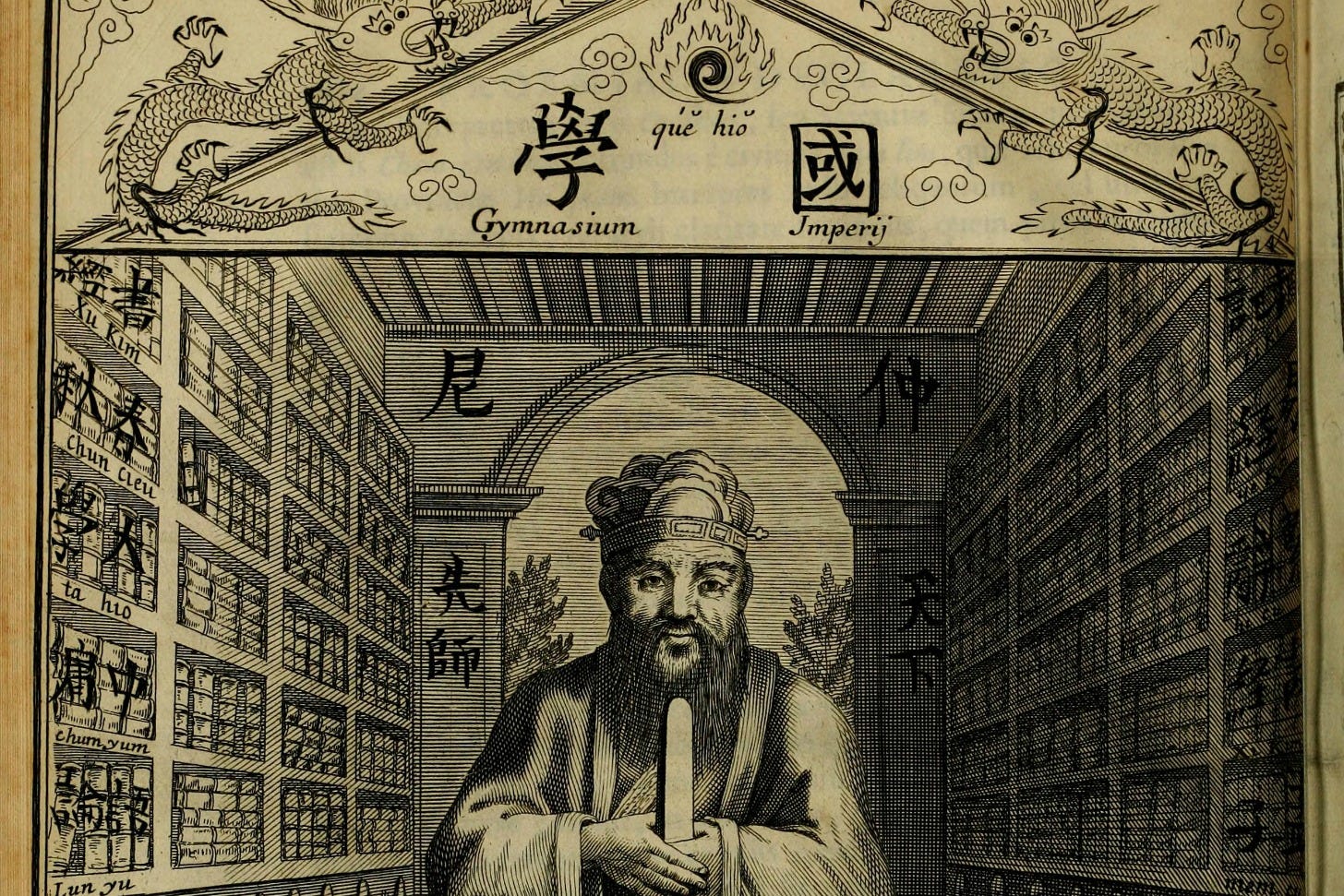
Confucius, Philosopher of the Chinese | Paris, 1687 (detail)
What happens when people forget who they are to one another?
Key Terms for this Lesson
Rectification of the Names · The Five Relationships · Ren
Confucius | The Rectification of the Names
Confucius (d. 479 BCE) lived in the turbulent centuries of the late Zhou, when the dynasty’s old order was fraying and rival states continually challenged one another across China (cf. Sec. 5.1). Into that disorder Confucius brought a single, steadying aim: to restore social harmony. Where the Daoist looked past our society to the rhythms of nature (cf. Sec. 5.2), Confucius focused straight at our society and asked why it had come apart.
His answer was that we had forgotten who we are to one another.
Confucius was born near Qufu in the small state of Lu, held office there (by tradition rising to Minister of Crime), and taught any student willing to learn. His fee could be as little as “his bundle of dried flesh” (Analects 7.7). For years he wandered from court to court, seeking a ruler who would govern by his way. Spoiler: none did. But his students gathered his sayings into the Analects, and in the late 1500s Jesuit missionaries Latinized his title, Kong Fuzi (”Master Kong”), as Confucius. He remains the most influential teacher in Chinese history.
He was not alone in asking how to mend the age. The late Zhou became an era of wandering teachers, remembered as the Hundred Schools of Thought. The Legalists answered with law and punishment: make the penalties harsh enough, and order will follow. The Mohists answered with impartial care for everyone alike. The Daoists answered by stepping back from politics altogether. Confucius’s answer began somewhere more intimate: with the names we have for one another.
In what he called the Rectification of the Names, he argued that society holds together only when each person understands and honors the particular bonds they stand within. Today, we might call this “knowing your role.” Notice the similarity to the Hindu notion of dharma (cf. Sec. 4.3).
There is government, when the prince is prince, and the minister is minister; when the father is father, and the son is son. Analects (12.11, trans. James Legge, 1893)
The Five Relationships
The Five Relationships (wulun), first listed together by the Confucian philosopher Mencius (d. ca. 289 BCE), are the Confucian path back to a stable society. Each is a bond of reciprocal duty. Each side owes the other something, and each is distinct and cannot be confused with another.
• Ruler | Subject | protection and provision, answered with loyalty
• Parent | Child | nurture and discipline, answered with respect
• Husband | Wife | provision and protection, answered with devotion
• Elder Sibling | Younger Sibling | guidance, answered with respect
• Friend | Friend | the one bond between equals
Confucius felt the Rectification of the Names was necessary because he saw all of these relationships flipped on their heads. Do you know any parents who treat their small children more like friends instead of showing them boundaries and rules? What about when a company goes under because the owner didn’t take responsibility and instead treated his employees like friends? For Confucius, such social confusion leads to a lack of proper leadership and a loss of public trust.
If the Five Relationships are the structure,
the Five Virtues are the character that fills them.
Ren (仁), often translated empathy or benevolence, lies at the core of Confucian ethics. Ren is the inner virtue. Li (禮), or propriety, is its outward expression (cf. Sec. 5.4). If Ren is the feeling within, Li is the form it takes externally in the world. Beside them stand Yi, justice, Zhi, wisdom, and Xin, trustworthiness. Beneath them all lies Xiao, filial piety (cf. Sec. 5.2), the first virtue learned. The person these virtues build has a name. In the old aristocratic order, a junzi was a “lord’s son.” In Confucius’s teaching, a junzi is something you become: the common person made noble by their excellent character.
Confucius & the State | 136 BCE–1313 CE
If Daoism gave the throne its cosmology, Confucianism gave it a bureaucracy. The Han had rebuilt the classics after the Qin burned them, piecing the texts together from fragments and from memory (cf. Sec. 5.1). Under the Han, Emperor Wu (d. 87 BCE) adopted Confucianism as the guiding philosophy of the imperial government, and in 136 BCE the Five Classics were made the core of official learning. From the 600s CE, mastery of these texts became the path into government through civil-service examinations, a system that lasted some 1,300 years.
Learning without thought is labour lost; thought without learning is perilous. Analects (2.15, trans. James Legge, 1893)
These are the kinds of teachings Chinese civil servants had to study. Beginning in the Song dynasty (960–1279), a movement we call Neo-Confucianism revitalized classical Confucian teaching by absorbing what it found useful in Daoism and Buddhism. Its foremost figure was Zhu Xi (d. 1200). In 1313, the Four Books, the Analects among them, replaced the Five Classics at the center of the curriculum.
The examinations became the main path to government office, which made mastery of the approved texts the surest road to power. The same tradition that could counsel a ruler toward gentleness could also close every other door to advancement. A cold reminder that no tradition in this course is only its best self.
When the Jesuits reached China, they read the Analects closely. In 1687, a team of them published the first substantial Latin translation of the Confucian classics in Paris, under the title Confucius, Philosopher of the Chinese, and Europe could read Master Kong for itself.
Sec 5 • Ancient China
5.1 History & Politics • The Mandate of Heaven
5.2 Sacred Life • Daoism & the Ancestors
5.3 Literature & Drama • The Daodejing
5.4 Music • Bronze Bells & Confucius
5.5 Philosophy • Confucianism
5.6 Art & Architecture • The Army & the Wall
Course Page: Humanities I & II