

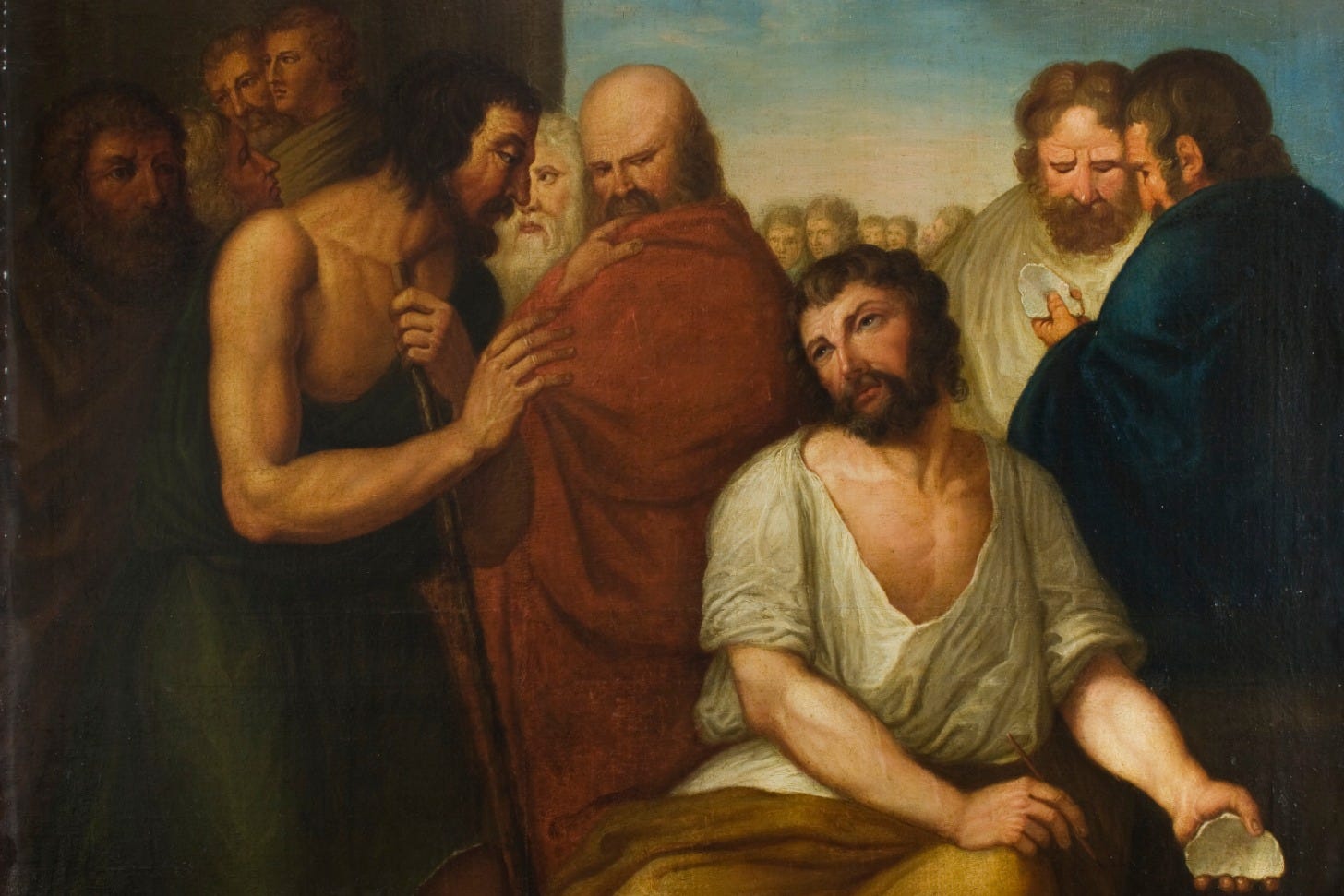
Ostracism over Aristides | Franciszek Smuglewicz, before 1807 (detail)
How to rule without a king.
Key Terms for this Lesson
Polis · Tyrant · Democracy
The Polis | ca. 1100–750 BCE
Every civilization in this course so far has set a king at its center: a priest-king in Sumer, a god-king in Egypt, a Son of Heaven in China (cf. Sec. 2.2, 3.1, 5.1). Greece is the exception, and its geography is the first reason why.
When the palaces of Mycenaean Greece fall in the Bronze Age collapse (cf. Sec. 1.6), the Greek world enters the Iron Age (ca. 1100 BCE), and writing disappears for some 300 years. Early Greece is divided into three periods: the Heroic Age (1100–750 BCE), the Age of Colonization (750–600 BCE), and the Archaic Period (600–480 BCE).
The terrain of Greece is comprised of a series of mountain ranges and high hills, which divide the region into areas with limited travel options. Because of this, urban centers developed in isolation from one another, forging a strong sense of identity and loyalty to one’s state. The result is the polis (pl. poleis), the Greek city-state: a town and its farmland, governed by its own citizens. Our word politics comes from it, by way of politēs, a citizen of the polis. There were more than a thousand of them. In Plato’s Phaedo, Socrates pictures the Greeks living around their sea “like ants or frogs about a marsh.”
Each polis competed with the others in pursuit of the ideal society. Some, like Athens, Sparta, and Corinth, grew strong enough to control their neighbors. But no single throne ruled them all.
Colonies & Tyrants | ca. 750–510 BCE
• ca. 594 BCE | Solon reforms the laws of Athens
• 546 BCE | Pisistratus rules Athens as tyrant
• 510 BCE | Athens expels the tyrant Hippias
• 508 BCE | Cleisthenes founds the democracy
• 490 BCE | Athens defeats Persia at Marathon
In the Age of Colonization, early Greek society changed with the advent of a wealthy aristocracy. An abundance of wealth, coupled with overpopulation in valleys bound by mountains, led to colonization. The Greek city-states spread to Italy, Sicily, Egypt, Asia Minor, and the shores of the Black Sea, from Syracuse (ca. 733 BCE) to Massalia (today Marseille, ca. 600 BCE).
Wealth also sharpened the quarrel between the few and the many. In Athens, a farmer could borrow against his own body, and if he could not pay, he could be sold into slavery. Around 594 BCE, the Athenians gave the lawgiver Solon (d. ca. 560 BCE) the power to settle the crisis. He cancelled the debts and freed the Athenians enslaved for them (the seisachtheia, “shaking off of burdens”). Then he refused the tyranny his friends urged on him.
Later, in the 600s and 500s BCE, tyrants emerged. A tyrant (Gr. tyrannos) was a ruler who seized power outside the old, inherited order, often with the people’s support. The word did not yet carry the cruelty it carries today. Tyrants were more often than not artistic patrons, funding the innovative approaches to art that came out of the Archaic Period of Greek history. In Athens, Pisistratus (d. 527 BCE) built temples and enlarged the city’s festival for its goddess (cf. Sec. 6.3). His son Hippias ruled harshly, and in 510 BCE the Athenians drove him out.
Rule by the People | 508–480 BCE
In 508 BCE, Cleisthenes (fl. 508 BCE) reorganized Athens into ten tribes, each mixing families from the coast, the city, and the inland hills, so that no clan could rule its own corner. The result was democracy (Gr. demos + kratos — rule by the people). Every adult male citizen could speak and vote in the Assembly (ekklesia), which met on a hillside called the Pnyx. A Council of 500, fifty from each tribe, set its agenda. Women, enslaved people, and resident foreigners could not vote. Athenian democracy was direct, not representative: the citizens themselves voted on war, taxes, and law.
To keep a tyrant from rising again, Athens practiced ostracism. Each citizen scratched a name on an ostrakon (a pottery shard), and if at least 6,000 votes were cast, the man named most often left Athens for ten years. He kept his property. Plutarch (d. ca. 120 CE) tells of an illiterate farmer who handed his shard to a stranger and asked him to write Aristides on it. Asked what Aristides had done to him, the farmer said nothing at all. He was tired of hearing him called “the Just.” The stranger was Aristides (d. ca. 468 BCE), and he wrote his own name. In 482 BCE, the Athenians voted him out.
Democracy was tested at once. In 490 BCE, the Persian king Darius (d. 486 BCE) sent an army against Athens, guided by the exiled Hippias, and the Athenians defeated it at Marathon. Ten years later, Darius’s son Xerxes (d. 465 BCE) came himself, and the Greeks turned him back at Salamis (480 BCE). Aristides, recalled from exile, fought there for the city that had sent him away. Herodotus (d. ca. 425 BCE), the “Father of History,” explained why the freed city kept winning:
…it is evident, not by one instance only but in every way, that Equality is an excellent thing, since the Athenians while they were ruled by despots were not better in war than any of those who dwelt about them, whereas after they had got rid of despots they became far the first. This proves that when they were kept down they were wilfully slack, because they were working for a master, whereas when they had been set free each one was eager to achieve something for himself. The Histories (5.78, trans. G. C. Macaulay)
Herodotus’s word for that equality is isēgoria, an equal right to speak. Within a generation, Athens would turn that confidence into an empire (cf. Sec. 7.1).
Sec 6 • Early Greece
6.1 History & Politics • The Polis & Democracy
6.2 Literature & Drama • The Iliad & Odyssey
6.3 Sacred Life • The Olympians & Athena
6.4 Music • The Doctrine of Ethos
6.5 Philosophy • The Presocratics
6.6 Art & Architecture • Geometry to the Kritios Boy
Course Page: Humanities I & II