

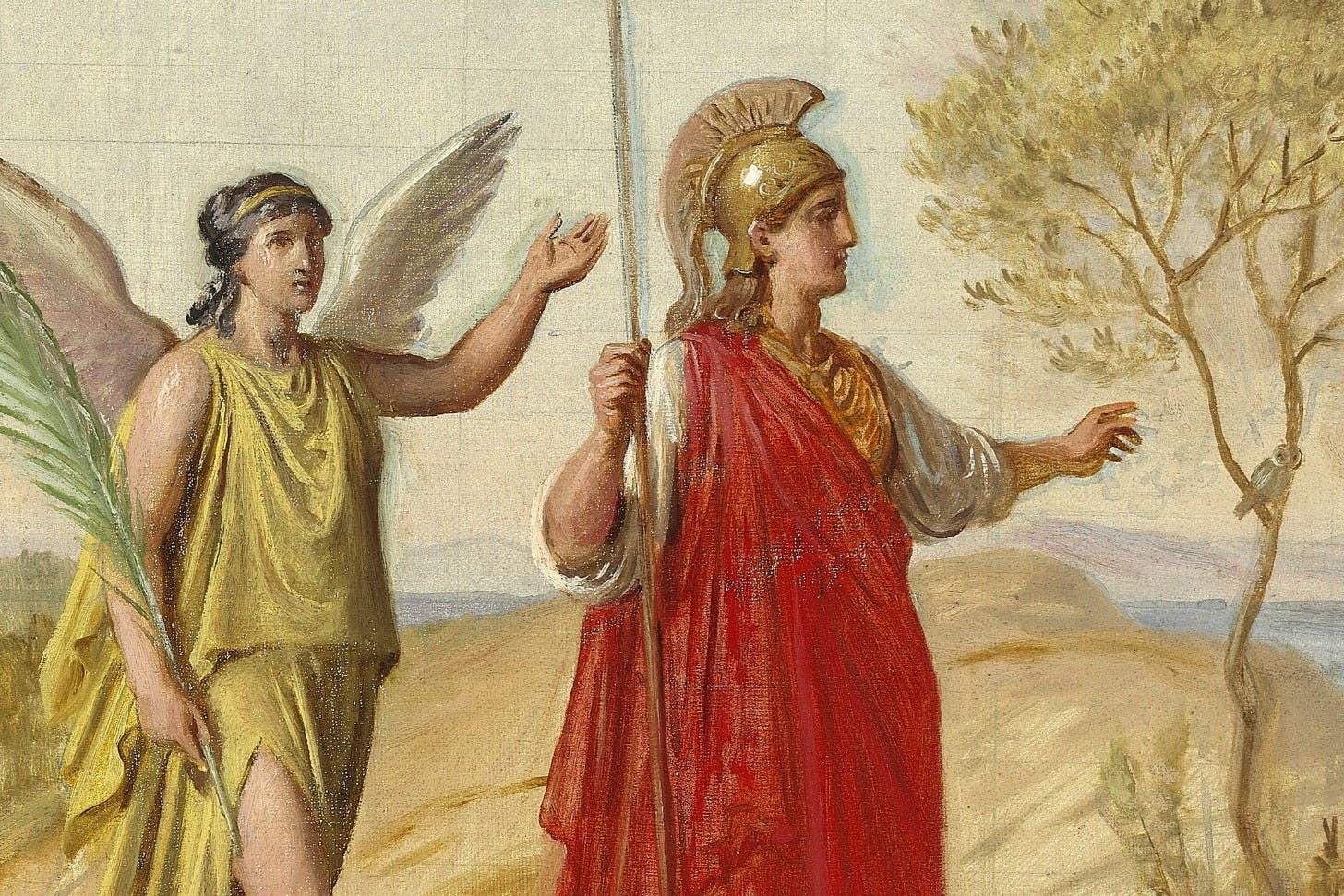
Athena and Nike in the Contest for Attica | Constantin Hansen, 1851–52 (detail)
Why did Athens choose Athena over Poseidon?
Key Terms for this Lesson
Polytheism · The Olympians · Patron Deity
Sacred Life in Greece | No Word for Religion
Before Ancient Rome, societies like the ancient Greeks had no concept of “religion” as we understand it. Yet the Greeks had items and behaviors that many today would label “religious.” The ancient Greeks wore special colors into battle, set aside special foods for ceremonies, and held sacred contests like the Olympic Games at Olympia, the sanctuary of Zeus. There were sacred foods, sacred songs, and sacred dances uniting the Greeks, just as American football unites us today. For the Greeks, these practices were simply woven into the fabric of everyday living. Simply put, the Greeks had no special institutions set aside from daily life to promote “religious” objectives. There was no “church” as opposed to the “state” in ancient Greece, and no single sacred book.
The sacred life that developed in Greece differs from Judaism and Christianity because it was polytheistic, which means there were many gods, and the narratives about those gods were contradictory. These contradictions in large part were caused by the geographic isolation of the city-states (cf. Sec. 6.1). Poets and artists were free to pick and choose details to suit their purposes. If a poet from Sparta wanted to accentuate Athena’s warlike qualities, and a poet from Athens her wisdom, they did so without much thought to what the other was doing.
Most of these narratives were passed down orally for many years before they were recorded. They were stories parents told their children, teachers told their students, and poets sang at festivals. Homer’s epics (cf. Sec. 6.2) and Hesiod‘s Theogony (ca. 700 BCE) reinforced them because these stories served a great purpose: they taught young Greeks moral lessons.
The Olympians | Zeus & the Twelve
The Greeks inherited their chief god from a far older people. The prehistoric Indo-Europeans worshiped a “Sky-Father” called Dyeus. In Greece, the Sky-Father became Zeus, whom Homer calls “father of gods and men.” In Rome, Zeus the Father became Jupiter. Back east, in India, he remained Dyaus Pitr in the Rig Veda (cf. Sec. 4.2).
Hesiod’s Theogony tells how the gods came to be. First came Chaos, then Earth and Sky, then the Titans. The Titan Cronus was overthrown by his son Zeus, who (in Homer’s telling) divided the world with his brothers by lot: the sky for Zeus, the sea for Poseidon, and the underworld for Hades. Like Babylon’s Marduk in the Enuma Elish (cf. Sec. 2.5), Zeus won his throne.
There are dozens of gods and goddesses in the Greek pantheon, but the twelve Olympians were the most important, named for Mount Olympus, their home. These are the twelve the artists of the Parthenon carved in its frieze:
• Zeus | king of the gods, sky, weather, and law
• Hera | queen of the gods, marriage
• Poseidon | seas, floods, and earthquakes
• Demeter | agriculture and harvest
• Athena | wisdom, strategy, and crafts
• Apollo | music, healing, and prophecy
• Artemis | the hunt and wild animals
• Ares | war
• Aphrodite | love and beauty
• Hephaestus | fire, metalworking, and crafts
• Hermes | messengers, travelers, and trade
• Dionysus | theater and festivity (cf. Sec. 7.3)
Hades is not included because he does not reside on Olympus. The great variety of gods speaks to the various needs of early Greek communities.
Athena & Athens | The Olive & the Sea
City-states generally had a select god or goddess they favored more than others, a patron deity. The city of Athens was linked to Athena, and Corinth to Poseidon. However, no Athenian traveled to Corinth to “convert” the Corinthians to worship Athena. When an Athenian traveled to Corinth, he honored Poseidon, their patron god.
The Athenians told how Athena and Poseidon once competed for their city. Poseidon struck the rock of the Acropolis with his trident, and a spring of salt water rose from it. Athena planted an olive tree. The olive won, and Athena became the goddess of Athens because she gifted them with the olive tree, which gave them food, oil, and wood, valuable resources for a growing community. A sea spring was a marvel. An olive tree was a living. Herodotus (cf. Sec. 6.1) described both witnesses on the Acropolis, and recorded what happened to the tree when the Persians burned the city in 480 BCE:
…there is in this Acropolis a temple of Erechtheus, who is said to have been born of the Earth, and in this there is an olive-tree and a sea, which (according to the story told by the Athenians) Poseidon and Athene, when they contended for the land, set as witnesses of themselves. Now it happened to this olive-tree to be set on fire with the rest of the temple by the Barbarians; and on the next day after the conflagration those of the Athenians who were commanded by the king to offer sacrifice, saw when they had gone up to the temple that a shoot had run up from the stock of the tree about a cubit in length. The Histories (8.55, trans. G. C. Macaulay)
What Athens did for its goddess fills its calendar and its coins. The Athenians honored her as Athena Polias (of the city) and Athena Parthenos (the maiden), the name the Parthenon still carries. Every summer, the city held the Panathenaia (”all-Athenian” festival), and a procession brought a newly woven robe (peplos) to her ancient olive-wood statue. Every fourth year, the Great Panathenaia made it grander still. Victors in its games won jars of oil pressed from her sacred olives. Athens stamped Athena’s owl on its silver coins, and Greeks called them simply “owls.” The contest itself would one day fill the west pediment of the Parthenon (cf. Sec. 7.2).
Sec 6 • Early Greece
6.1 History & Politics • The Polis & Democracy
6.2 Literature & Drama • The Iliad & Odyssey
6.3 Sacred Life • The Olympians & Athena
6.4 Music • The Doctrine of Ethos
6.5 Philosophy • The Presocratics
6.6 Art & Architecture • Geometry to the Kritios Boy
Course Page: Humanities I & II