

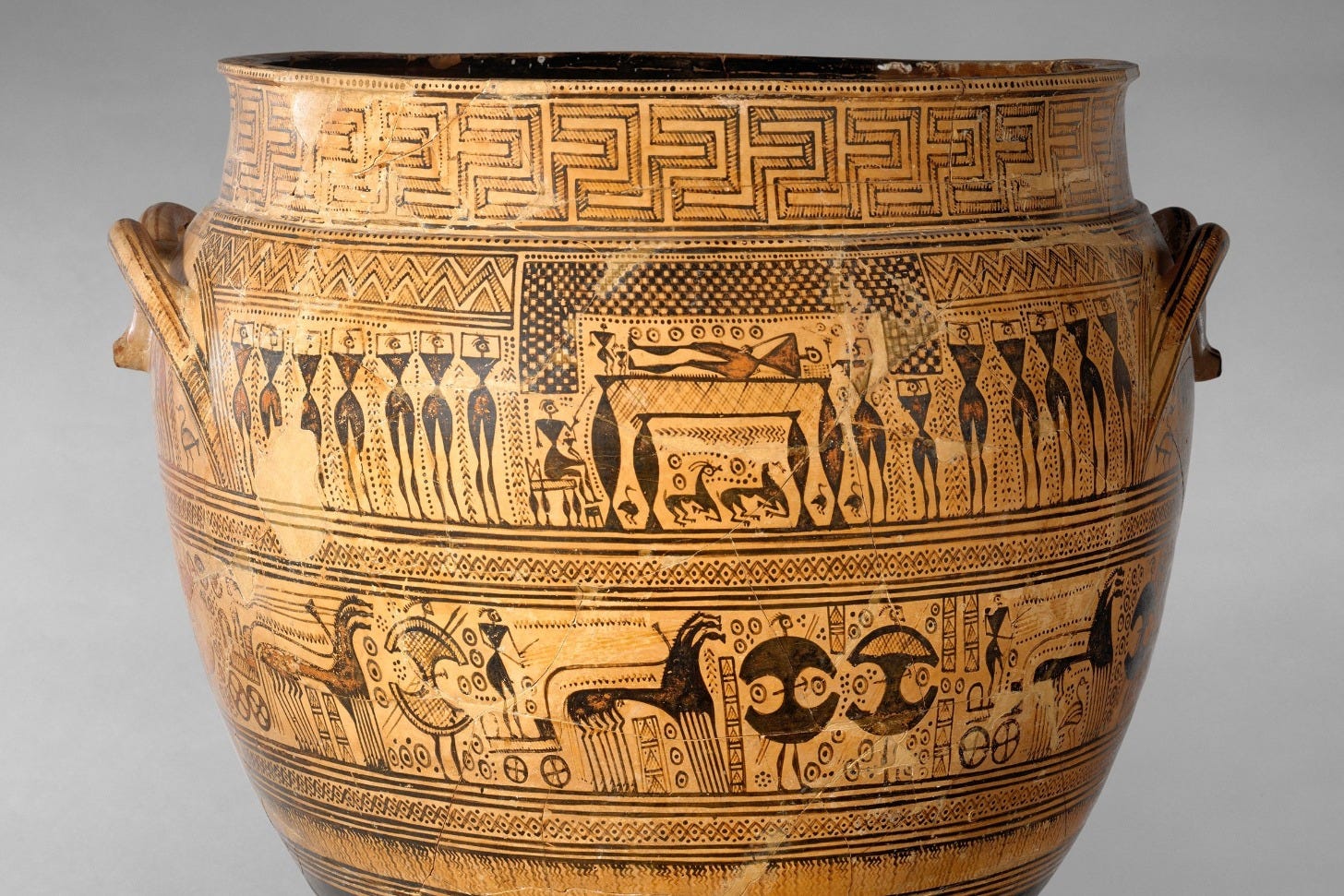
Geometric Grave Marker | Hirschfeld Workshop, Athens, ca. 750–735 BCE (detail)
Photo Credit: The Metropolitan Museum of Art via Wikimedia Commons, CC0
Why did Greek statues stop standing stiff?
Key Terms for this Lesson
Kouros · Kore · Contrapposto
Geometric Art | ca. 1000–700 BCE
Evidence for the arts in the Heroic Age is mainly limited to pottery, because very little other evidence has survived. For some 300 years, Greek potters covered their vessels in bands of geometric design: circles, zigzags, and the meander, a maze-like key pattern still painted on Greek restaurants today. The human form did not emerge on Greek pottery until the 700s BCE, and when it did, it came as silhouettes built from triangles and sticks.
One of the largest artistic pieces we have from this time is the funerary vase. The Dipylon Amphora (ca. 755–750 BCE), over five feet tall, was set over a tomb as a grave marker. Some such vases had holes in their bases, so that offerings poured by relatives could seep down to the dead below. Their painted friezes show what the vase was for. The dead lie on a bier while mourners raise their hands to their heads, and chariots parade in honor below, as on the grave marker above. Like Egypt’s tombs (cf. Sec. 3.4), these vases make the absent present. But they do it with pattern, not likeness.
Colonies & Eastern Motifs | ca. 700–530 BCE
In the Age of Colonization, Greek art began to take on characteristics seen in the art of other cultures. Egypt, Assyria, Lydia, and the Phoenicians surround the Greeks, and many became trading partners (cf. Sec. 6.1). It is only natural that their artistic tendencies would mix. Greek art took on a variety of motifs we typically associate with eastern influences: sphinxes, winged figures, and floral designs. Historians call this the Orientalizing period.
Regional differences can also be seen, in particular between the city-states of Corinth and Athens. Corinthian vases, covered in eastern animals and monsters, were so commercially successful that trade made Corinth an economic powerhouse in the 600s BCE. Meanwhile, Athenian pottery featured scenes that depicted stories of the gods and daily life. The popularity of Athenian pottery set the scene for a trade rivalry that would last for centuries.
Pottery during this time is divided into two groups: black-figure and red-figure. Black-figure pottery occurs when the red clay pot is painted with black figures, their details scratched in. Red-figure pottery, invented in Athens around 530 BCE, is made by painting around the figures, leaving the red clay to show through. It’s similar to viewing the negative of a film. The vase on 6.4’s header is red-figure.
Kore, Kouros, & the Kritios Boy | ca. 650–480 BCE
Greek sculpture also began under Egypt’s influence. Egyptian statues had stood stiffly for centuries, left foot forward, arms at their sides. The Greek equivalent of this look was the kore (maiden) and the kouros (youth), first sculpted in the late 600s BCE. The kore is a clothed female figure, often painted, and the kouros an unclothed male figure. Both wear the faint “Archaic smile.” Some, kouroi especially, stood over graves, like the Geometric vases before them. One kore still carries her epitaph:
Marker of Phrasikleia. I shall be called maiden forever, having received this name from the gods instead of marriage. Epitaph of Phrasikleia (Attica, ca. 540 BCE, my translation)
Phrasikleia died before her wedding, and her statue gave her the name forever. A kouros from the same countryside marks a young soldier: “Stay and mourn beside the marker of dead Kroisos, whom furious Ares destroyed one day as he fought in the front ranks” (ca. 530 BCE, my translation).
The Archaic Period then features the evolution of freestanding sculpture. The stiff kore and kouros became more realistic and natural looking. Greek art took on a new realism as the study of human anatomy developed. Statues became representations of life and vigor, not just figures. The Archaic Age is also notable for the appearance of high and low relief sculpture, carved into a stone background rather than standing free. High relief stands out from the stone, while low relief appears mostly flat.
A key piece that represents this shift is the Kritios Boy (ca. 480 BCE), the first sculpture of a human that steps away from the rigid, Egyptian-inspired kouros design. His weight rests on one leg while the other relaxes, so his hips tilt and his shoulders answer them. Later Italians would call this pose contrapposto (counterpose). His head turns slightly, no longer staring straight ahead as hundreds of statues had before him. The Egyptians carved for eternity, and so their statues never move. The Greeks carved a living moment. The Kritios Boy was found buried in the debris of the Persian sack of the Acropolis (cf. Sec. 6.1, 6.3). He is the piece to know, because he marks the transition from Archaic to Classical art (cf. Sec. 7.2).
Sec 6 • Early Greece
6.1 History & Politics • The Polis & Democracy
6.2 Literature & Drama • The Iliad & Odyssey
6.3 Sacred Life • The Olympians & Athena
6.4 Music • The Doctrine of Ethos
6.5 Philosophy • The Presocratics
6.6 Art & Architecture • Geometry to the Kritios Boy
Course Page: Humanities I & II
Next Section: Classical Greece