

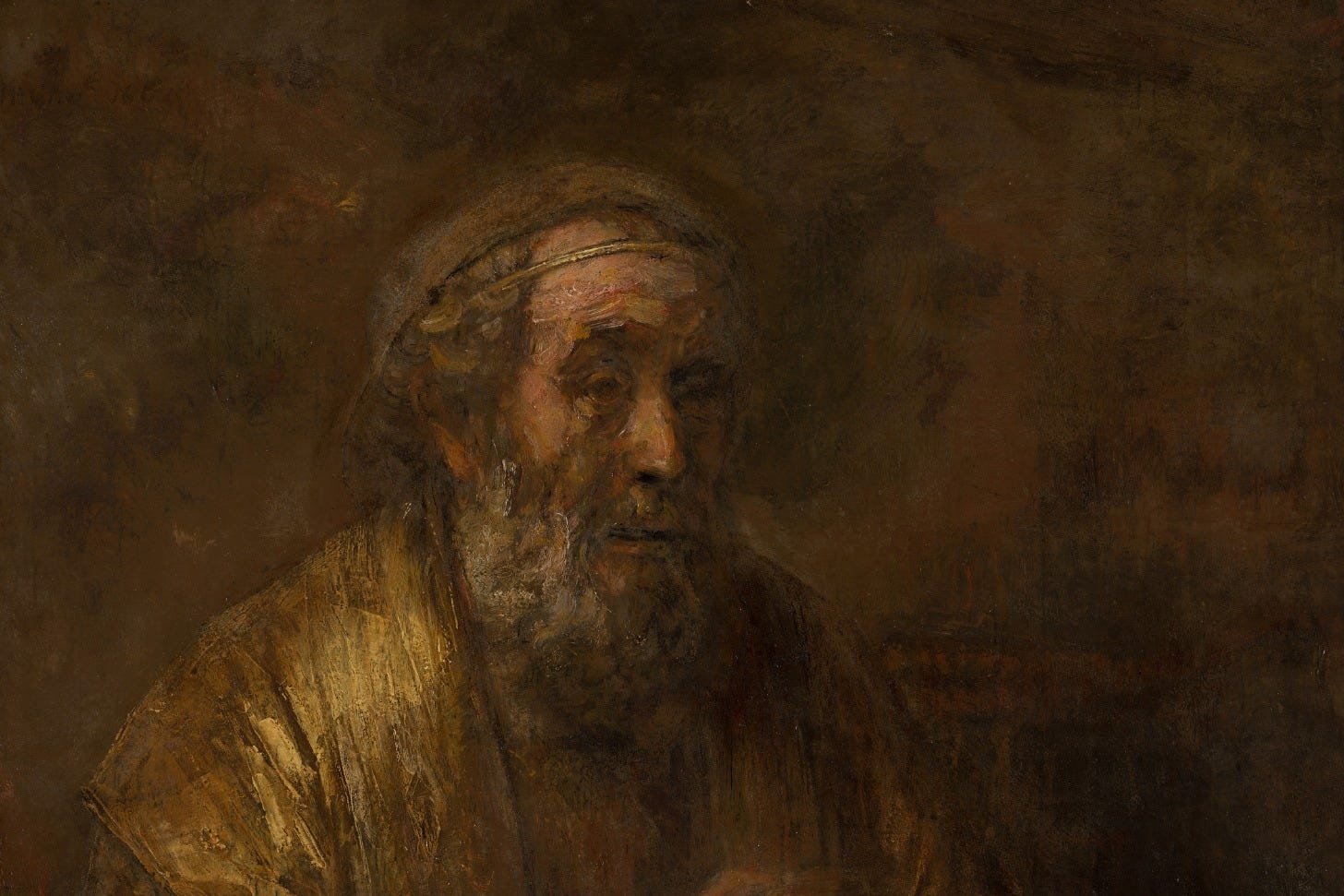
Homer | Rembrandt van Rijn, 1663 (detail)
Why does the greatest Greek warrior refuse to fight?
Key Terms for this Lesson
Epic · Epithet · Aretē
Homer & the Oral Epic | ca. 750–700 BCE
The most important author to emerge from the long oral tradition of the Heroic Age is Homer. He is the first author of Western literature, and he is a complete mystery to us. We do not know when or where he lived, or even if he was a single person or a collection of individuals who shaped the poems over time. Almost every major city in Greece claimed to be his birthplace. Tradition remembered him as blind.
Homer’s two masterpieces, the Iliad and the Odyssey, are each an epic: a long narrative poem about heroes and gods, composed to be performed aloud. Each runs to 24 books (the Iliad about 15,700 lines). Both grew out of centuries of oral tradition, sung by bards before the Greeks borrowed their alphabet from the Phoenicians (ca. 800 BCE) and wrote the poems down. Like Gilgamesh and the Mahabharata (cf. Sec. 2.5, 4.5), they were memory before they were books.
Homer uses many epithets, which are descriptive adjectives applied to each main character. An epithet is a short tag repeated whenever a name appears: Achilles is “swift-footed,” Odysseus is “cunning,” and Dawn is “rosy-fingered.” In the 1930s, the American scholar Milman Parry (d. 1935) recorded singers in Yugoslavia performing epics thousands of lines long from memory, and showed how such ready-made phrases let a bard compose as he sang. Homer also uses incredibly elaborate similes, some of which run on for many lines. Homer’s epics illustrate heroic Greek values like honesty, bravery, and intelligent problem-solving while also exploring the ethical consequences of moral choices and actions.
The Iliad | The Rage of Achilles
The major theme of the Iliad is human responsibility, and its first word is mēnis (rage): “Sing, O goddess, the anger of Achilles son of Peleus, that brought countless ills upon the Achaeans.”
The poem recounts a few weeks in the tenth year of the Trojan War. Helen, the wife of the Greek king Menelaus, has gone to Troy with Paris, a prince of the Greeks’ rivals. Agamemnon, Menelaus’ brother, rallies the Greeks to wage war on Troy. When Agamemnon is forced to give back a captive, the daughter of a priest of Apollo, he takes the prize of honor belonging to Achilles, the Greeks’ greatest fighter, instead.
Achilles is so enraged that he refuses to fight anymore and sits in his tent fuming. The whole of the Iliad surrounds this conflict. For a Greek warrior, a prize was timē (honor made visible), and Agamemnon has taken Achilles’ in front of the whole army. Achilles’ mother, the sea goddess Thetis, asks Zeus to favor the Trojans until the Greeks learn what they have lost.
Achilles returns to battle only when his friend Patroclus is killed by the Trojan prince Hector. Driven by rage, Achilles kills Hector and drags his body away, refusing him burial. Then Hector’s father, King Priam, crosses the lines at night with a single herald and kneels before the man who killed his son:
Fear, O Achilles, the wrath of heaven; think on your own father and have compassion upon me, who am the more pitiable, for I have steeled myself as no man yet has ever steeled himself before me, and have raised to my lips the hand of him who slew my son. Iliad (Book 24, trans. Samuel Butler)
Achilles weeps, for his own father and for Patroclus, and gives Hector back. The poem ends with Hector’s funeral. Achilles did what he wanted, even when everyone begged him to change his mind, and that independence had both good and bad consequences. The Iliad shows the value of living with honor instead of pride, and of accepting the consequences of one’s actions.
The Odyssey | The Return Home
The theme of the Odyssey is the return of the epic hero: “Tell me, O Muse, of that ingenious hero who travelled far and wide after he had sacked the famous town of Troy.” Ten years after the war, Odysseus has still not returned to Ithaca. His wife, Penelope, has many suitors, and his son, Telemachus, is at a loss for what to do about them.
Odysseus is highly intelligent, but his arrogance offends the gods. He blinds the Cyclops Polyphemus, son of Poseidon, and the sea god pursues him with storms. Athena intervenes and lands him among the friendly Phaeacians, whose king and queen insist he tell his adventures. The queen’s name is Arete.
For the Greeks, aretē is nothing short of the full realization of one’s potential. In a word, it’s excellence. But it’s so much more than that. It’s doing what you were born to do. Achilles’ aretē is strength in battle. Odysseus’s is a mind of many turns (Gr. polytropos).
Odysseus returns home in disguise, where his son recognizes him, and the two of them plot against the suitors. After a feat of strength and skill involving shooting an arrow through twelve axes, he reclaims his house, his loyal wife, and his elderly father. The moral lessons of this story include the value of wisdom, a caution against disrespecting the gods, and gratitude for the blessings of the gods. By Plato’s day, Homer’s admirers called him “the educator of Hellas” (cf. Sec. 7.6).
Sec 6 • Early Greece
6.1 History & Politics • The Polis & Democracy
6.2 Literature & Drama • The Iliad & Odyssey
6.3 Sacred Life • The Olympians & Athena
6.4 Music • The Doctrine of Ethos
6.5 Philosophy • The Presocratics
6.6 Art & Architecture • Geometry to the Kritios Boy
Course Page: Humanities I & II