

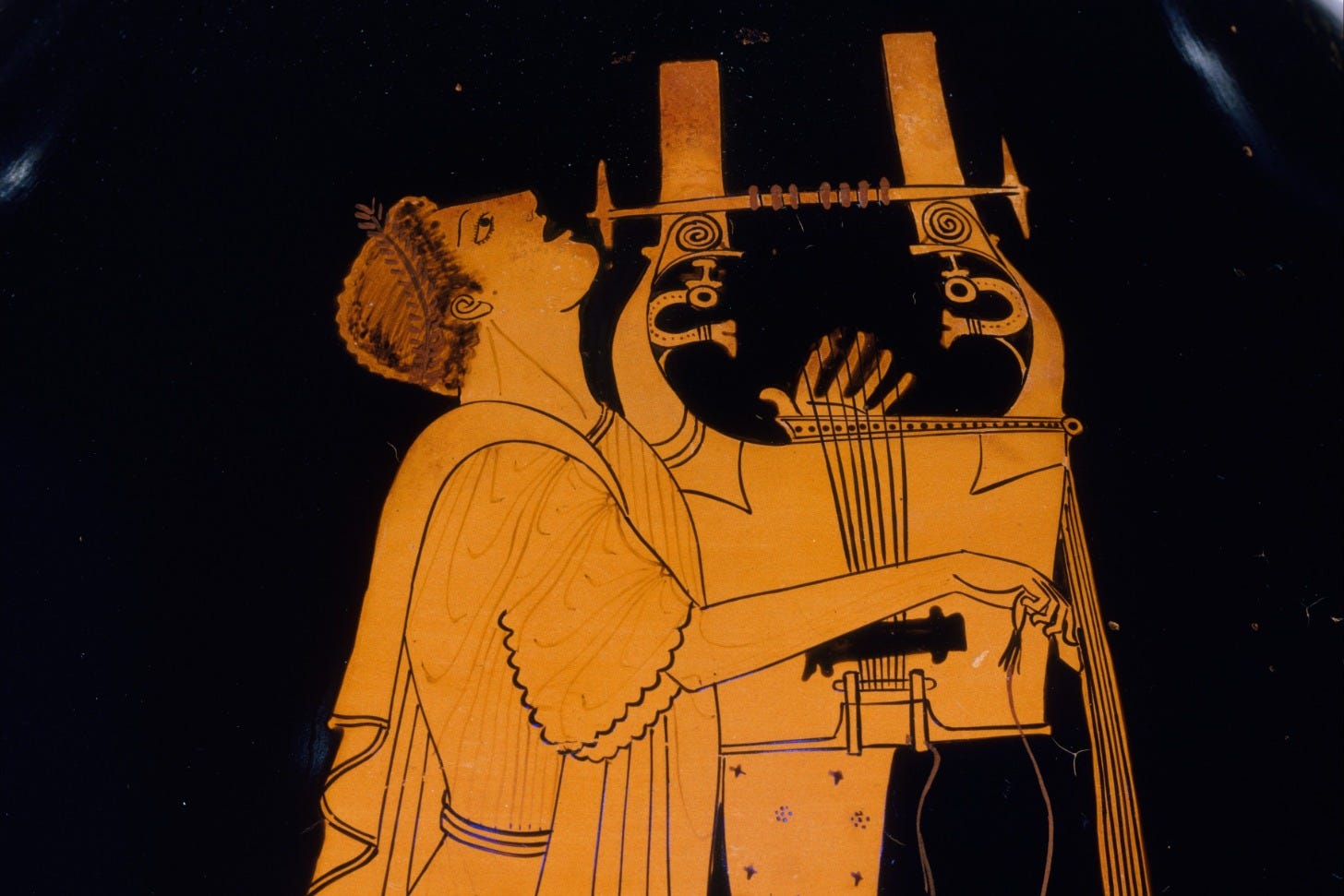
Youth Singing with a Kithara | Berlin Painter, ca. 490 BCE (detail)
Photo Credit: The Metropolitan Museum of Art via Wikimedia Commons, CC0
Why did the Greeks believe a song could shape character?
Key Terms for this Lesson
Mousikē · Mode · Ethos
Music in Early Greece | Lyre & Pipe
Historians know music was important to early Greek culture because of the depictions of musicians on pottery and in poetry. Vases show a variety of people, not just professional musicians, playing instruments. When Agamemnon’s envoys reach the tent of the refusing Achilles (cf. Sec. 6.2), they find him “playing on a lyre, fair, of cunning workmanship… and singing the feats of heroes” (Iliad 9, trans. Samuel Butler). Even off the battlefield, the greatest warrior is a singer. However, very little survives to tell us what it sounded like. Barely sixty scraps of written Greek music remain, nearly all of them centuries later than Homer.
Music for the early Greeks was divine. In the Homeric Hymns, the infant god Hermes makes the first lyre from a tortoise shell and gives it to Apollo, god of music. Athena was said to have invented the aulos, a double reed pipe with a piercing sound. The professional singer played the larger kithara, the instrument on our vase above, a cousin of the lyres buried with the kings of Ur (cf. Sec. 2.4).
The Greek word for music, mousikē, meant “the art of the Muses,” and it covered far more than notes. Closely associated with music, of course, is dance and storytelling. Song, poetry, and dance were one art, taught together. The story the music tells mattered as much as the notes that were played. Homer’s epics were sung, not read (cf. Sec. 6.2).
The Archaic Age also introduced a new form of poetry, lyric verse, named for the lyre it was sung to. Heroic verse had told how the gods were involved in the lives of mortals. In lyric verse, the poet conveys personal feelings instead. The most important lyric poet to know is Sappho (d. ca. 570 BCE), the first woman in Greek literature to leave a record of her own voice.
Pythagoras | Number & Harmony
For the Greeks, music was more than something pretty playing in the background. Later tradition credits Pythagoras (d. ca. 495 BCE) with a discovery about a plucked string. Halve its length, and it sounds the same note an octave higher (a ratio of 2:1). Two-thirds of the string sounds a fifth (3:2), and three-quarters a fourth (4:3). A later legend has him hearing the different notes of a blacksmith’s hammers and weighing the hammers to find these ratios. The story is legend, but the ratios are real. Math could be used to explain universal truths about music, and the Pythagoreans went further: if pleasing sounds were made of simple numbers, perhaps the whole cosmos was too (cf. Sec. 6.5).
The Greeks called this fitting-together of parts harmonia. A well-tuned lyre and a well-ordered soul were described in the same words. Aristotle (d. 322 BCE) reports that “some wise men held the soul itself to be harmony” (Politics 8.5, trans. William Ellis). If a soul could be tuned like a string, it could also be put out of tune.
Plato & Aristotle | The Doctrine of Ethos
Music has the power to influence human behavior. This was written about by both Plato (d. 348 BCE) and Aristotle, and it is called the Doctrine of Ethos. Greek ēthos means “character,” and it is close kin to ethos, “habit.” Our modern concept of character comes from the ancient Greek word kharasso, meaning “to engrave.” Ancient Greeks like Aristotle thought of one’s character as the deep mark or impression one makes on one’s own soul. This depth of character accrues over a lifetime of choices. For Aristotle, no one is born virtuous or vicious. Character emerges through habit, not impulse. And whatever a person hears again and again becomes a habit of the heart.
Their writings explain there are many different modes of music, which are essentially scales that make you feel a certain way. The Dorian mode was powerful and steady, used to inspire courage. The Phrygian mode was exciting and emotional. Aristotle set out the doctrine plainly:
…different harmonies differ from each other so much by nature, that those who hear them are differently affected, and are not in the same disposition of mind when one is performed as when another is; the one, for instance, occasions grief and contracts the soul, as the mixed Lydian: others soften the mind, and as it were dissolve the heart: others fix it in a firm and settled state, such is the power of the Doric music only; while the Phrygian fills the soul with enthusiasm… Politics (8.5, trans. William Ellis)
Athens schooled its boys accordingly. In Plato’s Protagoras, the teachers of the lyre set the lyric poets to music and “make their harmonies and rhythms quite familiar to the children’s souls, in order that they may learn to be more gentle, and harmonious, and rhythmical” (trans. Benjamin Jowett). Aristotle drew the same conclusion about schooling: “if it can do this, most certainly it is what youth ought to be instructed in.” Plato went further, and would have let only two modes, the Dorian and the Phrygian, into his ideal city (cf. Sec. 7.4). Half a world away, China’s Record of Music had reached the same conclusion (cf. Sec. 5.4). For the Greeks, a song was never only entertainment. It was practice for the soul.
Sec 6 • Early Greece
6.1 History & Politics • The Polis & Democracy
6.2 Literature & Drama • The Iliad & Odyssey
6.3 Sacred Life • The Olympians & Athena
6.4 Music • The Doctrine of Ethos
6.5 Philosophy • The Presocratics
6.6 Art & Architecture • Geometry to the Kritios Boy
Course Page: Humanities I & II