

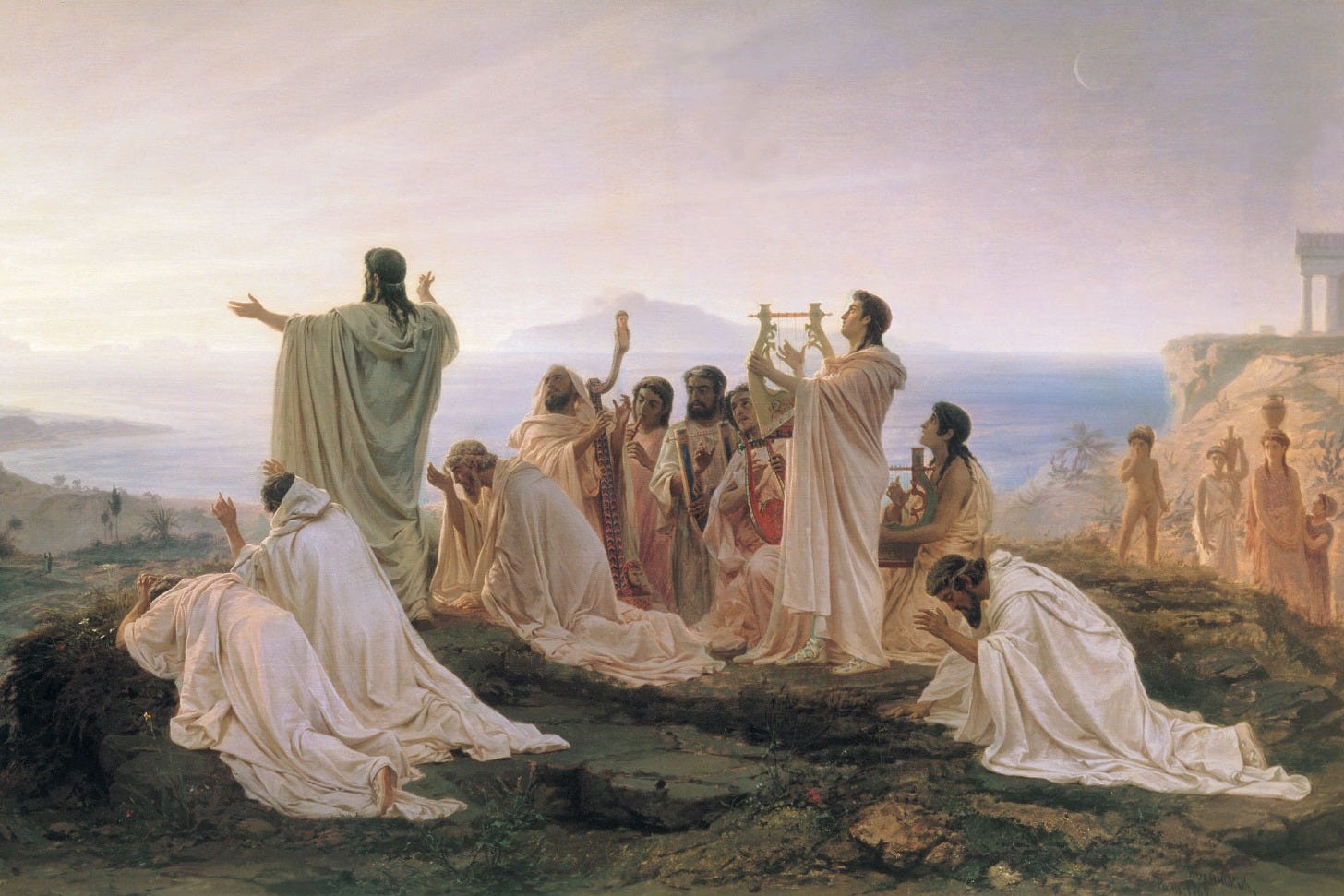
Hymn of the Pythagoreans to the Rising Sun | Fyodor Bronnikov, 1869 (detail)
Why can’t you step in the same river twice?
Key Terms for this Lesson
Arché · Logos · Flux
The First Philosophers | Water, Air, & Number
Before the advent of philosophy, the Greeks explained the world through ad hoc stories, simple “just so” narratives that addressed critical questions about life and the natural world. Iron Age Greeks enjoyed ad hoc stories like Hesiod’s Theogony and Homer’s Iliad and Odyssey (cf. Sec. 6.2, 6.3). By the 500s BCE, some Greek thinkers began to set aside their traditional narratives and sought instead rational explanations for natural phenomena. What makes the sun rise? What pulls the tide in? What are we made of?
Systematic philosophical inquiry begins in the West with Thales (d. ca. 546 BCE), who lived in the Greek city of Miletus (today on the Turkish coast). Like many before him, Thales was deeply interested in discovering the fundamental, deep structure of reality. But he sought something new: a description of reality that would be just as true in Greece as in Africa, Europe, or Asia. Much of ancient Greek thought was centered on the search for the arché (origin, first principle) of existence. What is the foundation of reality? Thales’ vote was water, the origin from which everything arises and into which everything eventually returns. Yet he was no scoffer. Aristotle reports him saying that “all things are full of gods.”
A later Milesian, Anaximenes (d. ca. 528 BCE), proposed that all matter is a form of air (not water), transformed into different substances through condensation and rarefaction. For Thales, water made sense because all living things require water. But Anaximenes points out that all living things also require air. These thinkers were using reason, rather than cultural tradition, to describe the world. Pythagoras (d. ca. 495 BCE) went further still: for him, the arché was not physical stuff at all, but number (cf. Sec. 6.4).
Being & Becoming | Parmenides & Heraclitus
The Greek philosopher Parmenides (fl. ca. 475 BCE) came from Elea, a Greek town south of Naples, Italy, and he questioned the very nature of being itself. It was Parmenides’ claim that the fundamental nature of reality is unity, eternal and true. He argues that what we perceive as change and variety in the world is illusory. Being is singular and unchanging.
Meanwhile, the philosopher Heraclitus (d. ca. 475 BCE) came from Ephesus, a Greek town in the Persian Empire (today, Türkiye), and he argued the opposite. For Heraclitus, the phenomena of our world (e.g., trees, people, cities) are in a constant state of change, or flux. Trees sprout, grow, and die in a predictable way, but where they drop seeds, when they blossom, and how they eventually fall happen in unpredictable ways. His surviving fragments put it this way:
It is wise to hearken, not to me, but to my Word, and to confess that all things are one… You cannot step twice into the same rivers; for fresh waters are ever flowing in upon you. Fragments of Heraclitus (1, 41–42, trans. John Burnet)
You can’t step in the same river twice, primarily for two reasons. First, when you return to the river, it has changed. The waters have receded, the stones have moved, and even the sunlight may reflect off its surface differently. But you must also consider that when you return to the river, you have also changed! You’re now older, wiser, and perceive things differently than you did when you were last at the river’s edge.
The Logos | Order Beneath Change
Yet Heraclitus did not think the world was chaos. The Greeks recognized that the world has a recognizable order to it: the moon waxes and wanes, the tide goes in and out, children grow up, grow old, and die. They called this order the logos. Logos has no direct English equivalent. It has connotations of order, reason, and even word, which is how Burnet translates it above. Biology, for example, means the study (logos) of life (bios). For Heraclitus, the logos is the divine ordering principle of the cosmos, reason itself, giving structure to our language, our thoughts, and the world. So, for Heraclitus, there are two levels of reality. Above all is the logos. But in our lived experience, we witness a world in flux, where rivers, governments, and planets are constantly in motion. For Heraclitus, both visions of reality are true.
The Presocratics lived around the same time and came to different conclusions. But they agreed that the old Greek stories were insufficient explanations of nature, and they tried to find a reason within nature for things that happened. In the same centuries, India’s sages sought the Middle Way and China’s the Dao (cf. Sec. 4.4, 5.2). The logos would long outlive Ephesus. The Stoics made it the center of their ethics (cf. Sec. 8.6), and the Gospel of John would open with the same Greek word: “In the beginning was the Word” (John 1:1).
Heraclitus also left a line that brings the river home to the self: “Man’s character is his fate” (fr. 121). Character, the Greeks agreed, is made of what we do again and again (cf. Sec. 6.4).
Sec 6 • Early Greece
6.1 History & Politics • The Polis & Democracy
6.2 Literature & Drama • The Iliad & Odyssey
6.3 Sacred Life • The Olympians & Athena
6.4 Music • The Doctrine of Ethos
6.5 Philosophy • The Presocratics
6.6 Art & Architecture • Geometry to the Kritios Boy
Course Page: Humanities I & II