

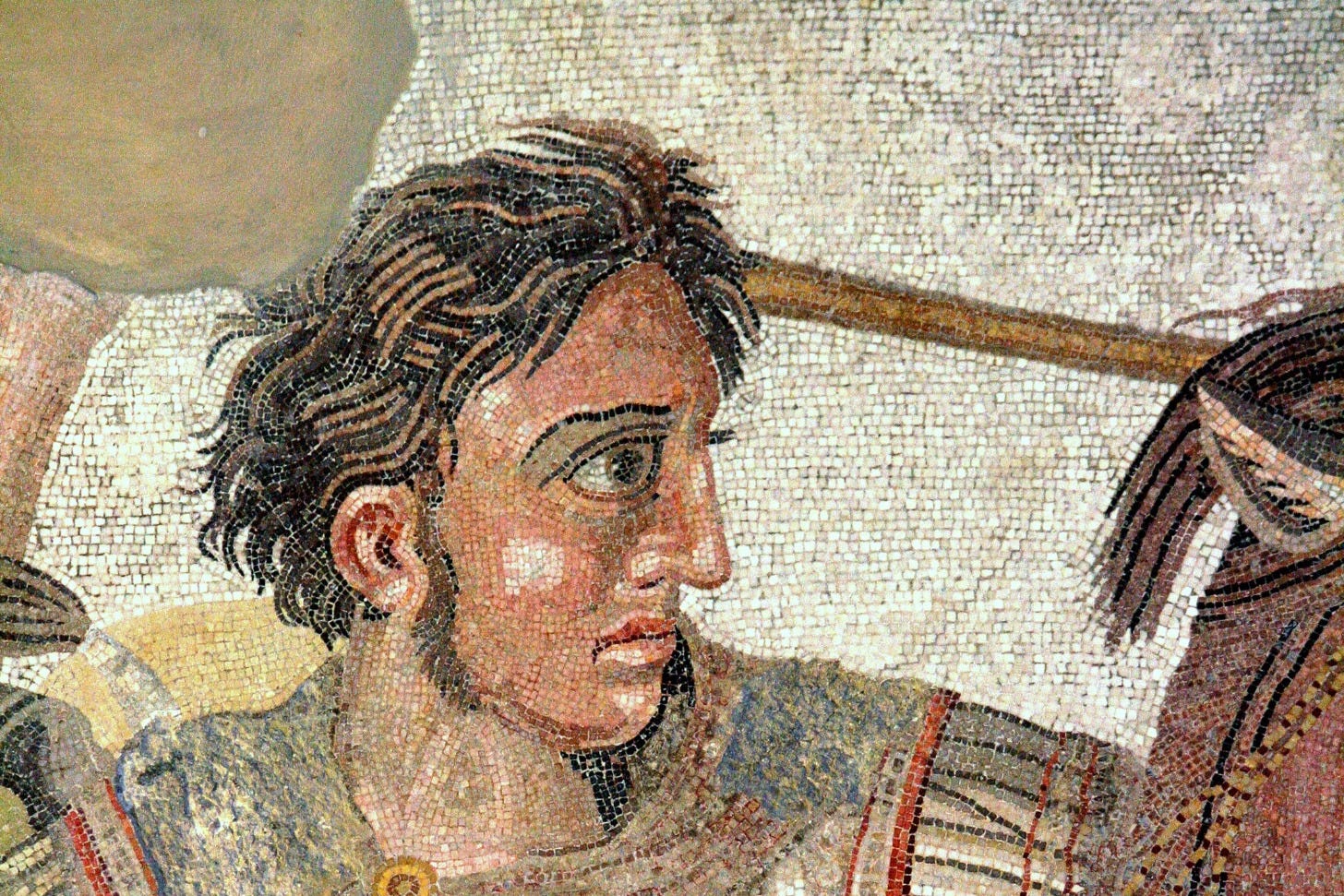
The Alexander Mosaic | House of the Faun, Pompeii, ca. 100 BCE (detail)
Why did the Greeks who beat Persia together go to war with each other?
Key Terms for this Lesson
Delian League · Peloponnesian War · Hellenistic Period
Athens & the Delian League | 479–431 BCE
The Classical Age, or Period, of Greek history includes the Golden Age of Greece. It runs from the end of the Persian Wars (479 BCE) to the death of Alexander the Great (323 BCE). The last half of the fifth century BCE is the Golden Age of Greece, which got its name because of the richness in artistic and intellectual achievement that occurred during this time (cf. Sec. 7.2–7.6).
The most important city-state of this time period is Athens. Athenian soldiers and sailors played a huge part in the defeat of Persia (cf. Sec. 6.1), and because of this, Athens was the place to be in the first half of the Classical Period. In 478 BCE, Athens and the Greek cities of the Aegean islands and the Ionian coast swore an alliance against Persia. Its treasury sat on the sacred island of Delos, so historians call it the Delian League. Athens supplied the ships, and most members the silver.
Slowly, the alliance became an empire. When the island of Naxos tried to leave (ca. 470 BCE), the Athenian fleet forced it back. In 454 BCE, the treasury moved from Delos to Athens. The leader most associated with the achievements of the Athenian Golden Age is Pericles (d. 429 BCE). He led Athens during its most economically prosperous, artistically creative, and constructive time, and he paid for the new temples on the Acropolis partly with the league’s silver (cf. Sec. 7.2). Pericles himself was candid about what Athens had become: “For what you hold is, to speak somewhat plainly, a tyranny; to take it perhaps was wrong, but to let it go is unsafe” (Thucydides 2.63, trans. Richard Crawley). The city that had driven out its own tyrant (cf. Sec. 6.1) now ruled other Greeks like one.
The Peloponnesian War | 431–404 BCE
• 431 BCE | The Peloponnesian War begins
• 415 BCE | Athens sails against Syracuse in Sicily
• 405 BCE | Sparta destroys the Athenian fleet at Aegospotami
• 404 BCE | Athens surrenders to Sparta
The Peloponnesian War set Athens and its empire against Sparta and its allies, the Peloponnesian League, and it lasted 27 years. The Athenian general Thucydides (d. ca. 400 BCE), who fought in the war and wrote its history (cf. Sec. 1.2), gave his answer:
The real cause I consider to be the one which was formally most kept out of sight. The growth of the power of Athens, and the alarm which this inspired in Lacedaemon, made war inevitable. History of the Peloponnesian War (1.23, trans. Richard Crawley)
Lacedaemon is Sparta, and the two powers fought very different wars. Sparta ruled the land, and Athens ruled the sea. Pericles pulled the farmers of Attica inside the city’s Long Walls and let the Spartans burn the fields while the fleet fed Athens. In 430 BCE, a plague broke out in the crowded city, and Pericles died of it the next year.
Even Socrates (d. 399 BCE) was a combat veteran of the Peloponnesian War (cf. Sec. 7.6). He fought at Potidaea (on the eve of the war), Delium, and Amphipolis, and at Potidaea he saved the life of Alcibiades (d. 404 BCE), later an Athenian general. In 415 BCE, Alcibiades talked the Assembly into a great expedition against Syracuse, then deserted to Sparta. The expedition ended in 413 BCE with the army destroyed. Sparta then built a navy with Persian gold, and in 405 BCE it destroyed the last Athenian fleet. Athens surrendered in 404 BCE, and the Spartans pulled down its Long Walls.
Philip & Alexander | 404–146 BCE
This begins the Late Classical Period (ca. 404–323 BCE), and Athens is no longer the center of Greek power. Sparta led Greece, then Thebes, and then a kingdom on the northern edge of the Greek world, Macedon, where Philip II (d. 336 BCE) ruled. Philip was a powerful and charismatic leader, and after defeating Athens and Thebes at Chaeronea (338 BCE), he united Greece, with the exception of Sparta, in the League of Corinth. He was assassinated in 336 BCE, and his son Alexander the Great (d. 323 BCE), a pupil of Aristotle, succeeded him.
In eleven years, Alexander and his army conquered the Persian Empire. He took Egypt (cf. Sec. 3.1), where he founded Alexandria in 331 BCE, then Babylon, Persia, and Bactria, and he reached the Indus (cf. Sec. 4.6). He died in Babylon (cf. Sec. 2.1) at the age of 32. The time after the death of Alexander the Great in 323 BCE and the rise of Rome is known as the Hellenistic Period, from Hellēnes, the Greeks’ name for themselves.
Alexander’s generals divided his empire, and Greek culture went with them. The Ptolemies took Egypt, and the Seleucids took Asia. This intermingling of cultures spread Greek culture from Egypt to India, while bringing their cultures back to Greece. Ashoka’s edicts name the Greek kings, and at Kandahar one was carved in Greek (cf. Sec. 4.1). Koine, the “common” Greek of these kingdoms, would one day be the language of the New Testament.
Rome finished what Alexander began. Rome defeated Macedon in 168 BCE, and in 146 BCE Rome captured Corinth, the symbol of Greek independence. The glory days of Ancient Greece were over. Even though Greece was politically conquered by Rome, Greek art and culture made a pronounced impression on Rome.
Sec 7 • Classical Greece
7.1 History & Politics • The Peloponnesian War & Alexander
7.2 Art & Architecture • The Acropolis & the Parthenon
7.3 Sacred Life • Delphi, Dionysus, & the Mysteries
7.4 Music • The Tragic Chorus & the Greek Modes
7.5 Literature & Drama • Tragedy, Comedy, & Thucydides
7.6 Philosophy • Socrates, Plato, & Aristotle
Course Page: Humanities I & II