

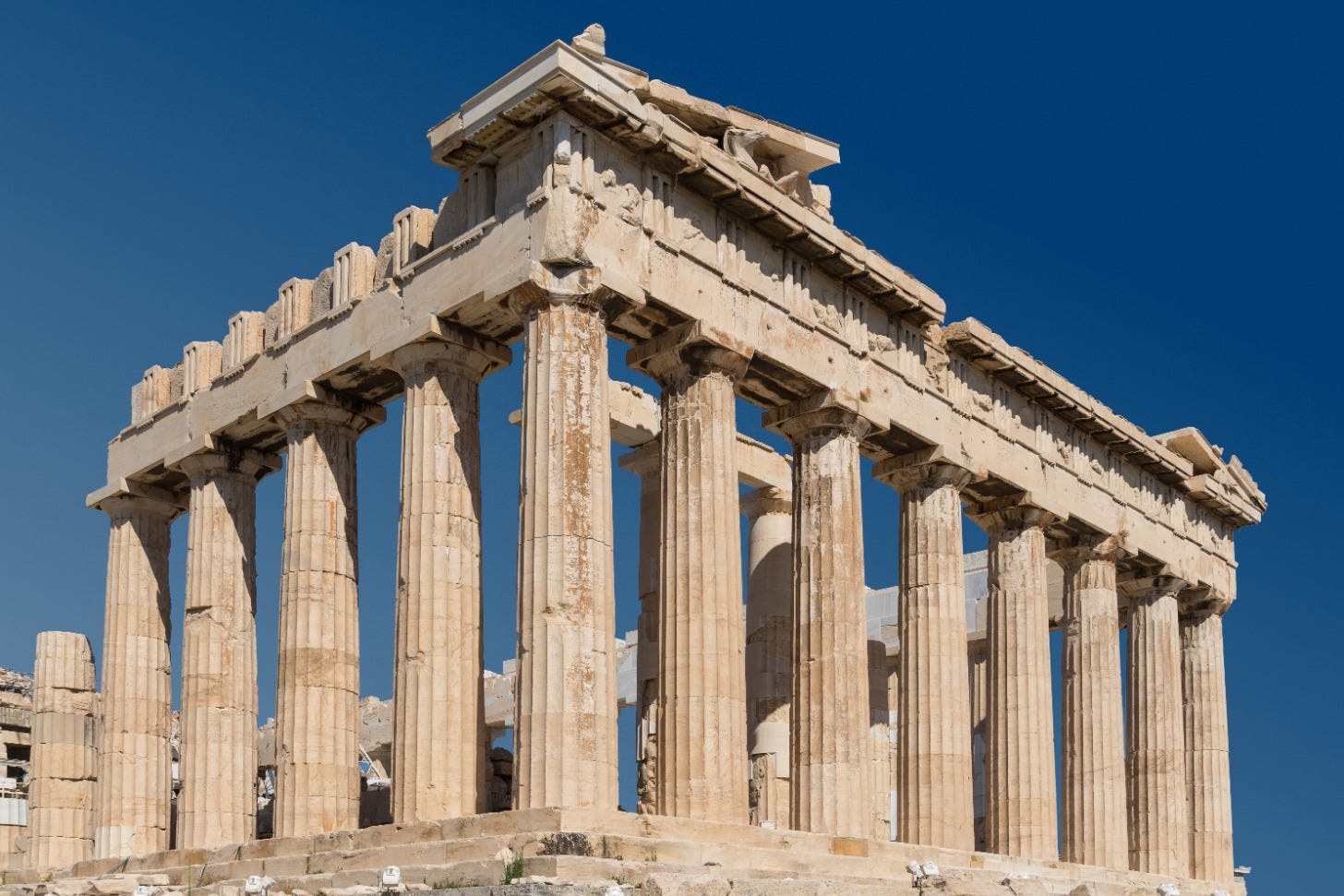
The Parthenon | Athens, 447–432 BCE
Photo Credit: Jebulon via Wikimedia Commons, CC0
Why did Athens spend its allies’ silver on a temple?
Key Terms for this Lesson
Classical Ideal · Parthenon · Caryatid
The Classical Ideal | ca. 480–400 BCE
The Classical Age of Greece is known for the Classical Ideal, which was the idea of perfection that was promoted during the time in many artistic endeavors. Qualities of the Classical Ideal are order and control. Most important to these artists and philosophers was the principle of balance. Their works showed the value of human potential and capability. In a nutshell, the Classical Ideal holds that:
• Existence can be ordered and controlled
• Human ability can triumph over chaos
• Society should be balanced, in equilibrium
• Proportion can be perfect
• Nothing should be in excess
• Human motivations can be understood
The Greeks carved the fifth line in stone at Delphi, where Apollo’s temple bore the words “Nothing in excess” (cf. Sec. 7.3).
One of the first great achievements after the Persian Wars was the Temple of Zeus at Olympia (ca. 470–456 BCE). It shows the proportion and balanced interrelationships typified by the Classical Ideal. Sculpture changed in the same decades. The Kritios Boy had already stepped away from Archaic stiffness (cf. Sec. 6.6), and Myron’s Discus Thrower (in the Greek Discobolus, ca. 450 BCE), known today from Roman copies, is an excellent example of realism in Greek sculpture: the idealized portrayal of an athlete, showing the ideals of proportion, symmetry, and balance.
The Parthenon | 447–432 BCE
The Acropolis (the “high city”) of Athens had been a citadel for centuries, and in 480 BCE the Persians burned the temples on it. For some thirty years, the Athenians left the ruins as they were. Then came Pericles’ building program, paid for in part with the silver of the Delian League (cf. Sec. 7.1). Pericles’ new buildings had no military purpose, and not every Athenian approved. Plutarch (d. ca. 120 CE) reports that his enemies cried out in the Assembly that “with her own enforced contributions for the war, we are gilding and bedizening our city.” Pericles answered that the allies furnished “not a horse… not a ship, not a hoplite, but money simply,” and that Athens owed them no account so long as it kept the Persians away. The building would bring the city “everlasting glory,” and it would put the whole city to work. Quarrymen, carters, masons, and painters all drew their pay from it.
The Parthenon is the temple of Athena Parthenos, Athena the Maiden (cf. Sec. 6.3). Ictinus and Callicrates were its architects, and the sculptor Phidias (d. ca. 430 BCE) oversaw the work and made the statue of Athena Parthenos, nearly 40 feet tall in gold and ivory, that stood inside. Like the Temple of Zeus at Olympia, the Parthenon focuses on proportion and balance and represents ideal beauty. It is built of white marble in the Doric order, with Ionic touches such as its continuous frieze. Yet the Parthenon has almost no straight lines. Its floor rises gently toward the center, and its columns lean slightly inward and swell a little at the middle, so that, to the eye, it looks perfectly straight and solid. Plutarch, writing more than 500 years later, could still say:
For this reason are the works of Pericles all the more to be wondered at; they were created in a short time for all time. Each one of them, in its beauty, was even then and at once antique; but in the freshness of its vigour it is, even to the present day, recent and newly wrought. Life of Pericles (13.3, trans. Bernadotte Perrin)
The Frieze & the Erechtheion | 438–406 BCE
The relief that runs around the top of the Parthenon’s inner walls, called a frieze, depicts a procession, showing Athenians on their way to the Acropolis to honor Athena. Most scholars read it as the procession of the Panathenaia, which brought the goddess her new robe (cf. Sec. 6.3). It runs some 524 feet, and there is a great variety of movement, gesture, and rhythm even in this low relief. Most of what survives is divided today between the Acropolis Museum in Athens and the British Museum in London, where Lord Elgin’s agents shipped it in the early 1800s.
The second building to know is the Erechtheion (ca. 421–406 BCE), raised during the war over the very ground where Athena’s olive and Poseidon’s spring were shown. It is built in the more graceful Ionic order, and Athena’s sacred olive grew in the courtyard beside it. Visitors reached it, and the Parthenon, through a great marble gateway, the Propylaea (437–432 BCE), past the small Temple of Athena Nike, Athena of Victory. Its Porch of the Maidens rests on six Caryatids. These statues are columns in the shape of women that held up the roof of the Erechtheion’s south porch. This is incredibly delicate work and very impressively shows the greatness of Greek architecture.
The Parthenon outlived the gods it was built for. It became a church in late antiquity and a mosque under the Ottomans. In 1687, a Venetian shell struck the gunpowder the Ottoman garrison had stored inside, and the explosion tore out its center. Even in ruins, it is the building most of the world pictures when it hears the word “Greece.”
Sec 7 • Classical Greece
7.1 History & Politics • The Peloponnesian War & Alexander
7.2 Art & Architecture • The Acropolis & the Parthenon
7.3 Sacred Life • Delphi, Dionysus, & the Mysteries
7.4 Music • The Tragic Chorus & the Greek Modes
7.5 Literature & Drama • Tragedy, Comedy, & Thucydides
7.6 Philosophy • Socrates, Plato, & Aristotle
Course Page: Humanities I & II