

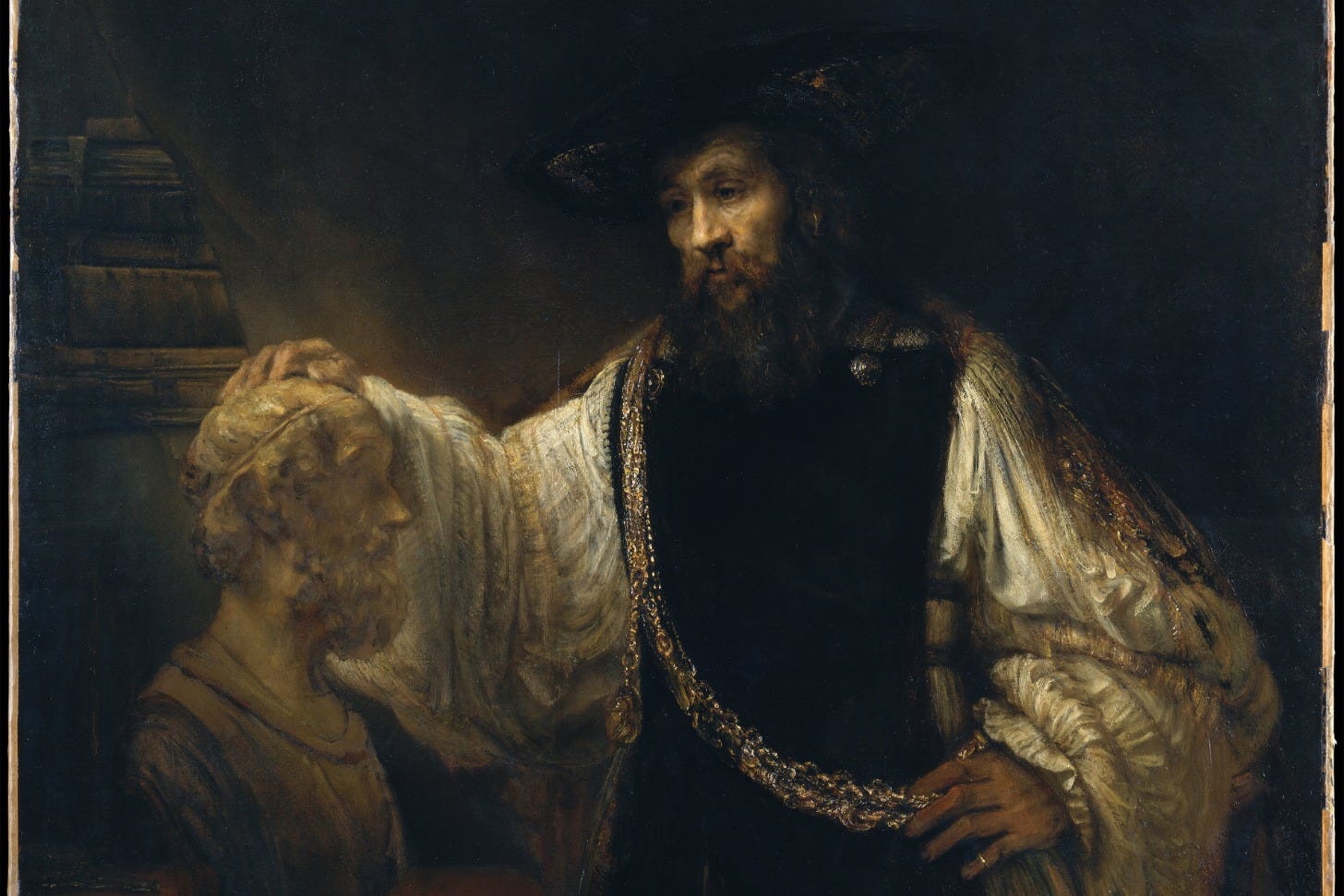
Aristotle with a Bust of Homer | Rembrandt, 1653 (detail)
Why would a man rather die than stop asking questions?
Key Terms for this Lesson
Socratic Method · Theory of Forms · Golden Mean
Socrates | Know Thyself
The first philosophers asked what the world is made of (cf. Sec. 6.5). With Socrates, philosophy turns from nature to the soul. Socrates (d. 399 BCE) was born in Athens, the son of a humble stonemason, and he was a combat veteran of the Peloponnesian War (cf. Sec. 7.1). He never wrote anything down. In the Athenian marketplace (i.e., the agora), Socrates could be found debating friends, enemies, the young, the old, the downtrodden, and the élite alike. He wanted to know about the state of one’s soul (Gr. psychē):
• What is courage?
• What does it mean to be a good person?
• What is justice?
• What is piety?
Rather than pontificating on elaborate cosmological theories, Socrates engaged in combative dialogue with people who claimed to have wisdom. He questioned the élite and powerful of his day to reveal contradictions in their thinking and strip away false beliefs. That patient questioning is the Socratic Method. When the oracle at Delphi named him the wisest of men (cf. Sec. 7.3), he eventually concluded that his wisdom lay in his awareness of his own ignorance, unlike others who falsely believed themselves wise.
Eventually, Socrates’ antagonistic relationship with the Athenian élite got him arrested. In 399 BCE, he was charged with corrupting the youth of Athens and with failing to honor the city’s gods. Socrates famously defended himself by describing the city-state of Athens as a great and noble horse, slow because of its size, and likening himself to a gadfly that stings the lethargic state, provoking it to move forward and complete her valuable work. He could have proposed exile as his penalty, but he would not promise to keep quiet there:
…daily to discourse about virtue, and of those other things about which you hear me examining myself and others, is the greatest good of man, and that the unexamined life is not worth living… Apology (38a, trans. Benjamin Jowett)
The judges sentenced him to death. Even in prison, Socrates refused his friend Crito’s offer of escape, because breaking the law would betray his principles and damage his soul. He drank the cup of hemlock calmly.
Plato | Leaving the Cave
After Socrates’ death, philosophy is forever changed. His young student Plato (d. 348 BCE) founded the Academy around 387 BCE, a school that becomes the model for Western education and the source of our word academic. Everything we know of Socrates’ teaching on the immortal soul comes to us as Plato tells it, in dialogues like the Phaedo.
In Plato’s Allegory of the Cave, prisoners chained in a dark cave see only shadows on the wall and imagine these shadows as the only reality. One prisoner is freed and slowly and painfully makes his way out to the sunlit world. When he returns to free the others, he is met with laughter and disbelief, and Plato adds that if they could, “they would put him to death” (Republic VII, 517a, trans. Jowett). Every reader in Athens knew whom he meant.
Working from his Allegory of the Cave, Plato posits two sides to reality, which we call the Theory of Forms. The World of Becoming is our changeable, material world, where things grow and come to an end. The World of Being is a perfect reality above it, unchanging, ideal, and eternal, apprehensible only by reason. The beauty and justice we see here are but poor copies of their ideal forms. Plato even judged Homer by this standard (cf. Sec. 6.2): he granted that Homer “is the greatest of poets,” but would admit to his ideal city only “hymns to the gods and praises of famous men” (Republic X, 607a).
Aristotle | Virtue & the Golden Mean
Just as Plato was a student of Socrates, Aristotle (d. 322 BCE) was a student of Plato. He studied at the Academy for some twenty years, tutored the young Alexander (cf. Sec. 7.1), and in 335 BCE founded his own school, the Lyceum. Instead of teaching that there is an ideal world of Forms, Aristotle focused his philosophical study on the world here on earth. His Nicomachean Ethics opens: “Every art and every inquiry, and similarly every action and pursuit, is thought to aim at some good” (trans. W. D. Ross).
For Aristotle, the highest good is eudaimonia, flourishing: to live up to one’s best purpose, one’s best self. It comes through virtue, acquired by habit over a lifetime (cf. Sec. 6.4). Between a vice of too little and a vice of too much lies the moderate virtue of just right. This is the Golden Mean. Courage is the mean between the surplus of recklessness and the deficiency of cowardice. The Buddha’s lute string, neither too tight nor too loose, makes a similar point (cf. Sec. 4.4). Where Aristotle emphasizes character formation through habituated excellence, Confucius emphasizes character formation through relational responsibility (cf. Sec. 5.5). Both treat ethics as a lifelong practice.
Aristotle’s contributions were so vast that, sixteen centuries later, the poet Dante would call him “the Master… of those who know” (Inferno 4.131, trans. Henry Wadsworth Longfellow).
Sec 7 • Classical Greece
7.1 History & Politics • The Peloponnesian War & Alexander
7.2 Art & Architecture • The Acropolis & the Parthenon
7.3 Sacred Life • Delphi, Dionysus, & the Mysteries
7.4 Music • The Tragic Chorus & the Greek Modes
7.5 Literature & Drama • Tragedy, Comedy, & Thucydides
7.6 Philosophy • Socrates, Plato, & Aristotle
Course Page: Humanities I & II
Next Section: The Romans