

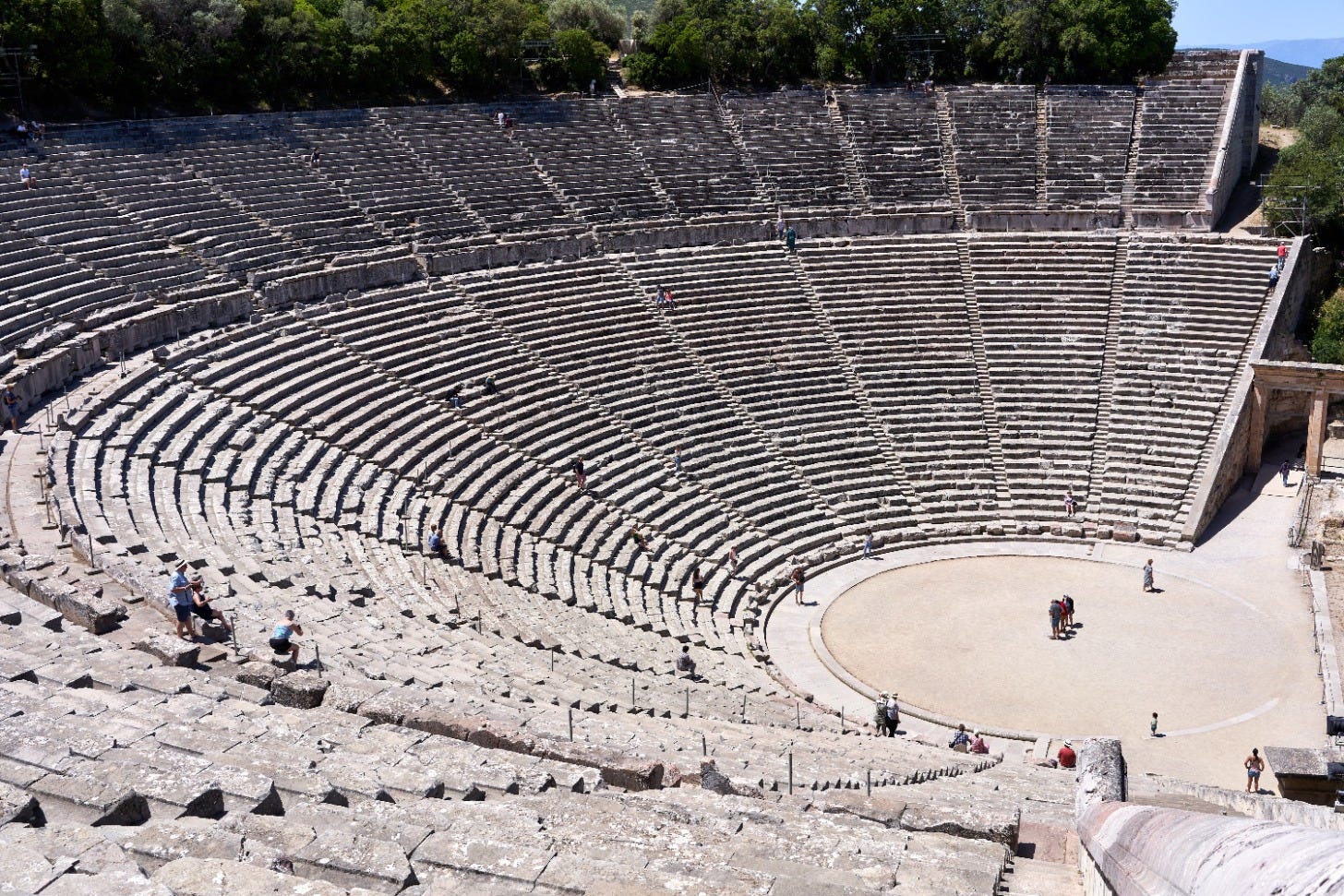
The Theater of Epidaurus | Argolis, Greece, 4th century BCE
Photo Credit: George E. Koronaios via Wikimedia Commons, CC0
Why did Greek tragedy need a chorus?
Key Terms for this Lesson
Chorus · Aulos · Delphic Hymns
The Tragic Chorus | Song & Dance
Greek tragedy began as song. Long before Thespis stepped forward to speak a part, choruses had sung and danced hymns to Dionysus (cf. Sec. 7.3). The Greek choros meant both a band of singing dancers and the floor they danced on, and it gives us chorus and choreography. In the theater, the chorus performed in the orchestra (the “dancing place”), the great circle of beaten earth in front of the stage. A tragedy’s chorus numbered twelve, and later fifteen, citizens of Athens. A wealthy citizen, the choregos, paid for their training and their costumes as a public service, and they rehearsed for months.
These plays also featured a Chorus, which often spoke from the point of view of a spectator, giving the audience a figurative voice in the play, in addition to asking questions that would enable the audience to follow the action. The Chorus basically provided a running commentary of the play. The actors spoke their lines, and the chorus sang theirs, in unison and in matched stanzas: a strophe (“turn”) as they danced one way across the orchestra, and an antistrophe (“counter-turn”) as they danced back.
Aristotle (d. 322 BCE) wanted the chorus at the heart of the play. “The Chorus too should be regarded as one of the actors,” he wrote; “it should be an integral part of the whole, and share in the action, in the manner not of Euripides but of Sophocles” (Poetics 18, trans. S. H. Butcher). In Sophocles (d. 406 BCE), the elders of the city argue with their king. In later poets, Aristotle complained, the choral songs became mere interludes.
The chorus was the city on stage. Its members were ordinary citizens, not professional actors, and they played the people a hero’s choices fall upon: the elders of Thebes, the women of a town, sailors, captives. Aeschylus (d. 456 BCE) made the chorus of his Eumenides the Furies themselves (cf. Sec. 7.5). Where the hero acts alone, the chorus remembers, warns, prays, and mourns, as the city would.
The Aulos | Plato’s Two Modes
The chorus sang to the aulos, a pipe played with a double reed (cf. Sec. 6.4). The piper played two pipes at once, one in each hand, with a buzzing, piercing sound closer to an oboe than to the “flute” of older translations. The aulos also kept time for marching soldiers, rowers, and athletes, and sounded at every sacrifice.
Plato (d. 348 BCE) wanted less music, not more. In the Republic, his ideal city keeps only two modes, the Dorian and the Phrygian (cf. Sec. 6.4), one for courage in danger and one for peace and prayer:
These two harmonies I ask you to leave; the strain of necessity and the strain of freedom, the strain of the unfortunate and the strain of the fortunate, the strain of courage, and the strain of temperance; these, I say, leave. The Republic (III, 399c, trans. Benjamin Jowett)
Plato banished the mournful Lydian modes, the soft Ionian, the many-stringed instruments, and the aulos itself, which he judged “worse than all the stringed instruments put together.” The philosopher would have silenced the very instrument of the tragic chorus.
Hearing Greek Music | Papyrus & Stone
We know music was popular because it was written about by philosophers and incorporated in other art, from plays and poetry to pottery. Yet what it sounded like is harder to know. Greek music was sung in unison or in octaves, without chords. Harmonia meant a tuning, a “fitting-together” of notes (cf. Sec. 6.4), not a stack of them. Musicians wrote their melodies as letters above the syllables of the words, and only scraps of that notation survive.
The oldest scraps reach back to tragedy itself. A torn papyrus copied around 200 BCE preserves a few lines of a chorus from the Orestes (408 BCE) of Euripides (d. 406 BCE), with its melody, perhaps the poet’s own. The fullest survivals are the Delphic Hymns, two hymns to Apollo carved, with their notation, on the wall of the Athenian Treasury at Delphi in 128 BCE (cf. Sec. 7.3). A century or two later, a man named Seikilos carved a short song on a grave marker near Tralles (today in Turkey), the oldest complete melody known (the Seikilos epitaph). Its words are a small Greek philosophy of their own: “As long as you live, shine. Let nothing grieve you at all. Life lasts only a little while, and time demands its end” (my translation).
Today, scholars and musicians have rebuilt the aulos and the lyre and sing these melodies again, and the chorus of the Orestes can be heard for the first time in more than two thousand years.
Sec 7 • Classical Greece
7.1 History & Politics • The Peloponnesian War & Alexander
7.2 Art & Architecture • The Acropolis & the Parthenon
7.3 Sacred Life • Delphi, Dionysus, & the Mysteries
7.4 Music • The Tragic Chorus & the Greek Modes
7.5 Literature & Drama • Tragedy, Comedy, & Thucydides
7.6 Philosophy • Socrates, Plato, & Aristotle
Course Page: Humanities I & II