

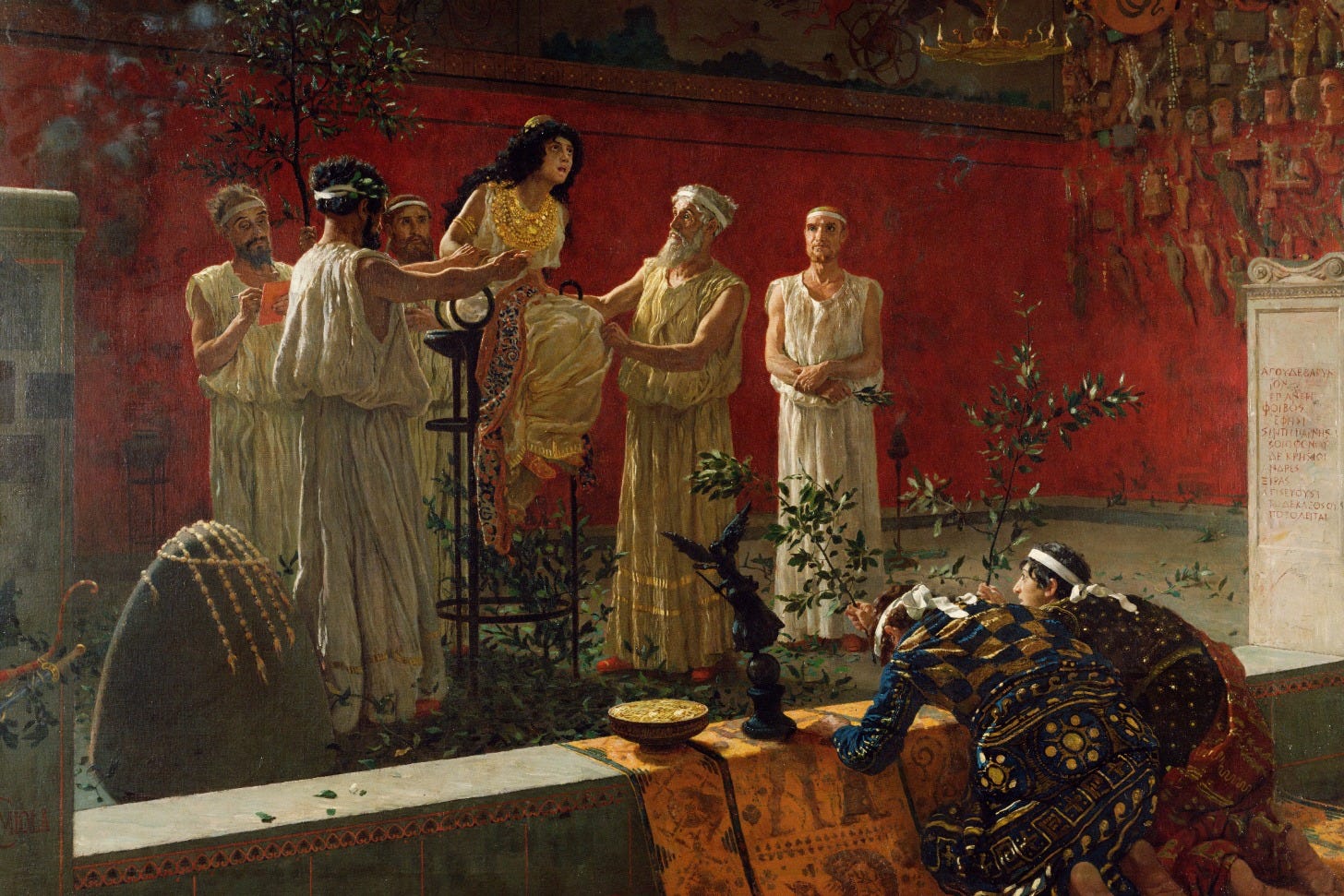
The Oracle | Camillo Miola, 1880 (detail)
Why did all of Greece consult one priestess at Delphi?
Key Terms for this Lesson
Pythia · City Dionysia · Eleusinian Mysteries
Delphi | The Navel of the World
Every Greek city had its own patron god (cf. Sec. 6.3), but a few sacred places belonged to all the Greeks at once. The greatest was Delphi, high on the slopes of Mount Parnassus and sacred to Apollo. Greek tradition held that Zeus released two eagles from opposite ends of the earth, and they met at Delphi, so a carved stone there, the omphalos, marked the navel of the world. Apollo is associated with Delphi because, in the Homeric Hymn to Apollo, he took the form of a dolphin, leapt aboard a ship of Cretans, and steered them to Delphi to be his priests.
At Delphi, Apollo answered questions through a priestess called the Pythia. She sat on a bronze tripod in the innermost room of his temple, and the Greeks believed the god spoke through her. In Socrates’ time, the powerful and prominent visited the storied Oracle at Delphi to seek guidance. Cities asked before founding a colony (cf. Sec. 6.1), making a law, or going to war. Rival cities even built their treasuries side by side along the road up to the temple, and Athens built one after Marathon. Every four years, the Pythian Games gathered them for contests in music and athletics. Below the temple, in the sanctuary of Athena Pronaia, stands the Tholos (ca. 380 BCE), an elegant round building whose design was later copied many times.
At the front of the temple, the phrase “Know Thyself” (Gr. gnōthi seauton) was displayed for all who came to receive the oracle’s wisdom. Beside it stood “Nothing in Excess” (Gr. mēden agan). Moderation was the keystone to Greek living (cf. Sec. 7.2), and “Know Thyself” has been the credo of philosophers ever since. When Socrates’ friend Chaerephon asked the oracle whether anyone was wiser than Socrates, the Pythia answered that no one was (cf. Sec. 7.6).
The oracle’s answers were famously hard to read. In 480 BCE, with the Persian king Xerxes marching on Athens, the Athenians asked Apollo what to do. The Pythia answered in verse:
Then far-seeing Jove grants this to the prayers of Athene; Safe shall the wooden wall continue for thee and thy children. The Histories (7.141)
Themistocles (d. ca. 459 BCE) read the “wooden wall” as the Athenian fleet, and the Greeks won at Salamis (cf. Sec. 6.1).
Dionysus & the Theater | The City Dionysia
Theater in Greece was essentially a religious ritual honoring the god Dionysus, god of the theater and of festivity (cf. Sec. 6.3). Every spring, Athens held the City Dionysia. The god’s ancient wooden statue was carried in procession to his sanctuary on the south slope of the Acropolis, offerings were made at his altar, and then came days of plays in the Theater of Dionysus. Choruses of fifty men and boys sang and danced hymns to the god, and the festival honored Athens too: the allies’ tribute was carried into the theater, and the sons of soldiers killed in the war were presented in armor paid for by the city.
The physical theaters in Greece were considered to be sacred ground. The priest of Dionysus had the seat of honor at the center of the front row. Tradition credits Thespis (fl. ca. 534 BCE) with being the first actor, stepping out of the chorus to speak a part (our word thespian is his name). Playwrights competed for a prize, and a panel of citizens chosen by lot judged them. The plays themselves belong to a later lesson (cf. Sec. 7.5), and so does their chorus (cf. Sec. 7.4).
The Mysteries | Demeter & Persephone
Fourteen miles west of Athens, at Eleusis, the Greeks kept their most secret rite: the Eleusinian Mysteries. Its story is told in the Homeric Hymn to Demeter. Hades, lord of the underworld, carried off Persephone, the daughter of the grain goddess Demeter. Grieving, Demeter searched the earth and let no grain grow until Zeus agreed that her daughter would return to her for part of every year. It was the Greeks’ account of the seasons, and the hymn says Demeter herself taught her rites to the people of Eleusis.
Each autumn, the initiates (Gr. mystai) walked the Sacred Way from Athens to Eleusis. The rite was open to men and women, to citizens and the enslaved, to anyone who spoke Greek and had not shed blood. Inside the great hall of initiation, the Telesterion, something was shown and done that no initiate ever revealed. Our word mystery comes from the Greek myein, “to close” the eyes or the lips. Egypt’s Isis would one day draw the same kind of devotion across the Roman world (cf. Sec. 3.2, 8.2). The secret was kept so well that, after more than a thousand years of initiations, we still do not know exactly what the initiates saw.
Sec 7 • Classical Greece
7.1 History & Politics • The Peloponnesian War & Alexander
7.2 Art & Architecture • The Acropolis & the Parthenon
7.3 Sacred Life • Delphi, Dionysus, & the Mysteries
7.4 Music • The Tragic Chorus & the Greek Modes
7.5 Literature & Drama • Tragedy, Comedy, & Thucydides
7.6 Philosophy • Socrates, Plato, & Aristotle
Course Page: Humanities I & II