

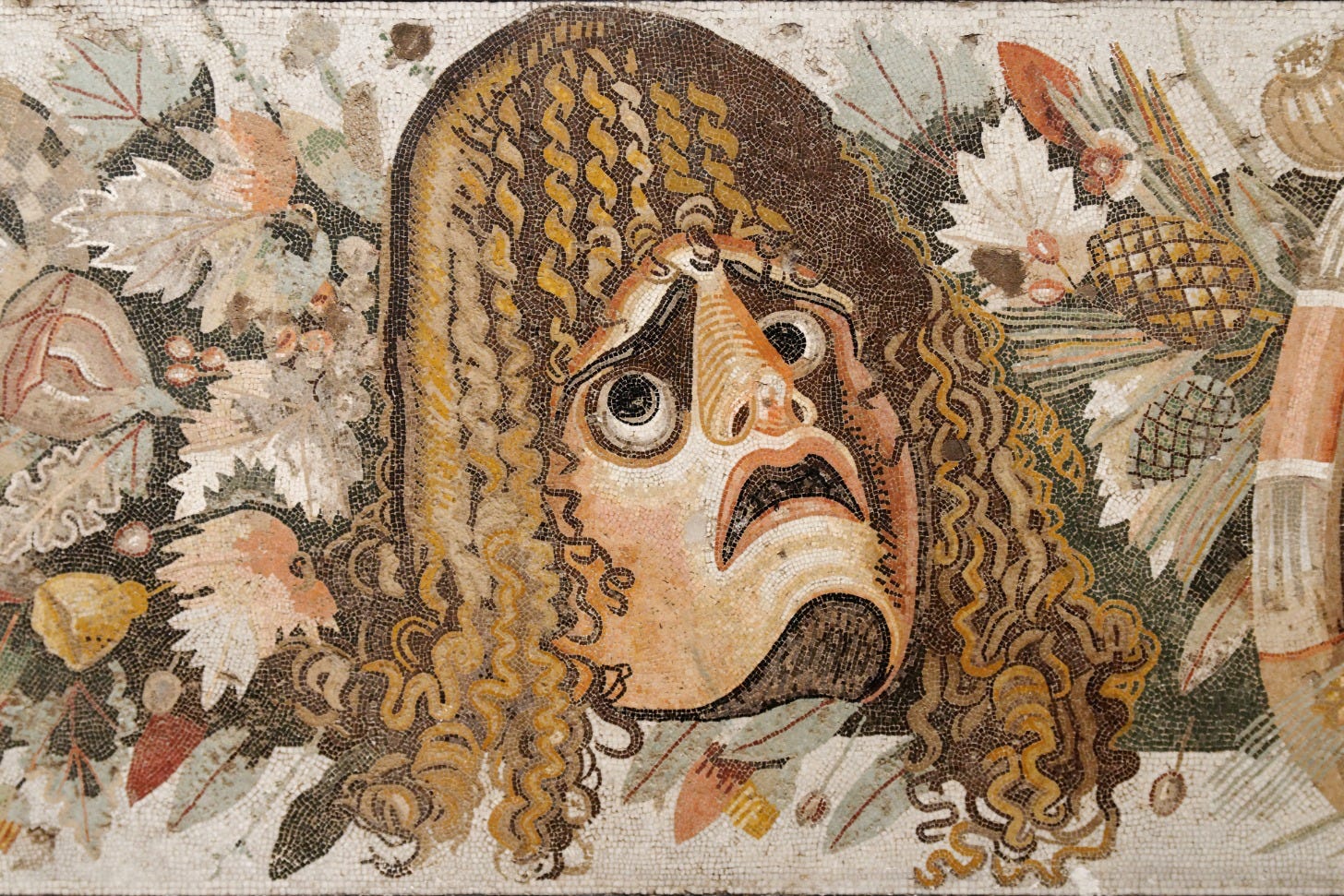
Theater Masks | Pompeii, ca. 100 BCE (detail)
How does a city face its worst fears without living them?
Key Terms for this Lesson
Tragedy · Catharsis · Hamartia
Tragedy | Aeschylus, Sophocles, & Euripides
While these plays are read today, in their day they were performed before thousands of spectators. At the City Dionysia, each of three poets offered three tragedies and a lighter satyr play (cf. Sec. 7.3), and their plots came from the old myths, many of them from Homer (cf. Sec. 6.2). There were many playwrights in Athens in the Classical Period. However, three of them matter most.
First is Aeschylus (d. 456 BCE), the first important Athenian tragic dramatist, whose plays promoted an optimistic philosophy: civilization would only get better through reason and order. He is best known for the Oresteia (458 BCE), the only complete trilogy to survive. King Agamemnon comes home from Troy and is murdered by his wife. Their son avenges him and is driven mad by the Furies. In the last play, the son finds his way to Athens and stands trial. Athena sets up a court of citizens, breaks their tie in his favor, and ends the cycle of revenge. The moral moves from “violence breeds violence” to only reason can end violence.
Sophocles (d. 406 BCE), a friend of Pericles, wrote about the tragic consequence of human error, and his plays are the most traditionally religious of the three. In Antigone, the king of Thebes forbids anyone to bury a traitor, and the traitor’s sister buries him anyway, because she believes the gods’ law outranks the king’s. She answers him:
…nor deemed I that thy decrees were of such force, that a mortal could override the unwritten and unfailing statutes of heaven. For their life is not of to-day or yesterday, but from all time, and no man knows when they were first put forth. Antigone (453–457, trans. R. C. Jebb)
The king condemns her and changes his mind too late, and his own family is destroyed with hers. The play asks what is more important, man’s law or the gods’. In Oedipus the King, the hero is destined to kill his father and marry his mother, and the whole play is his discovery that he already has.
Euripides (d. 406 BCE) wrote realistic and rational plays, with a deep concern for psychological truth and the most sympathy for the problems of women. In his Suppliant Women, the mothers of seven fallen commanders beg a king for the return of their sons’ bodies. More of Euripides’ plays survive than those of any other Greek tragedian: nineteen, against seven each for the other two.
Catharsis & Comedy | Aristotle & Aristophanes
A century later, Aristotle explained why a city would want to watch such suffering. In the Poetics, he defines tragedy as “an imitation of an action that is serious, complete, and of a certain magnitude… through pity and fear effecting the proper purgation of these emotions” (6, trans. S. H. Butcher). That purgation, or cleansing, is catharsis (Gr. katharsis). The audience feels pity and fear in the theater, where no one is harmed, and leaves the lighter for it. India’s Natyashastra had its own account of the feelings a play should raise (cf. Sec. 4.5).
The best hero, Aristotle says, is neither a saint nor a villain, but a man brought down “not by vice or depravity, but by some error or frailty” (13). His word for it is hamartia, often mistranslated as a “tragic flaw.” It means an error, a missing of the mark (Oedipus did not know who his father was).
Comedy competed too. Aristophanes (d. ca. 386 BCE), the greatest Athenian comic poet, also wrote about war, but mixed political satire and fantasy. In The Birds (414 BCE), two Athenians leave home to find a better place to live. They join forces with the birds and build a new city in midair called Cloudcuckooland.
Thucydides | History as Literature
One of the most significant texts, not plays, we have from the Classical Age of Greece is Thucydides’ History of the Peloponnesian War (cf. Sec. 7.1). Herodotus (d. ca. 425 BCE; cf. Sec. 6.1) attributed many things in history to fate and morality: Persia lost, in his telling, because of its hubris, or excessive ambition. Thucydides attempted to analyze human motives so that future generations could understand how and why the conflict occurred (cf. Sec. 1.2). He wrote out the speeches of the war as he judged the speakers ought to have spoken, and they read like scenes from a tragedy. Pericles, mourning the first year’s dead, calls Athens “the school of Hellas” (2.41). Fifteen years later, Athenian envoys tell the small island of Melos that “the strong do what they can and the weak suffer what they must” (5.89, trans. Richard Crawley). Hammurabi’s laws had promised to keep the strong from harming the weak (cf. Sec. 2.6). Thucydides recorded both speeches, the school and the threat, and left the reader to judge.
Sec 7 • Classical Greece
7.1 History & Politics • The Peloponnesian War & Alexander
7.2 Art & Architecture • The Acropolis & the Parthenon
7.3 Sacred Life • Delphi, Dionysus, & the Mysteries
7.4 Music • The Tragic Chorus & the Greek Modes
7.5 Literature & Drama • Tragedy, Comedy, & Thucydides
7.6 Philosophy • Socrates, Plato, & Aristotle
Course Page: Humanities I & II