

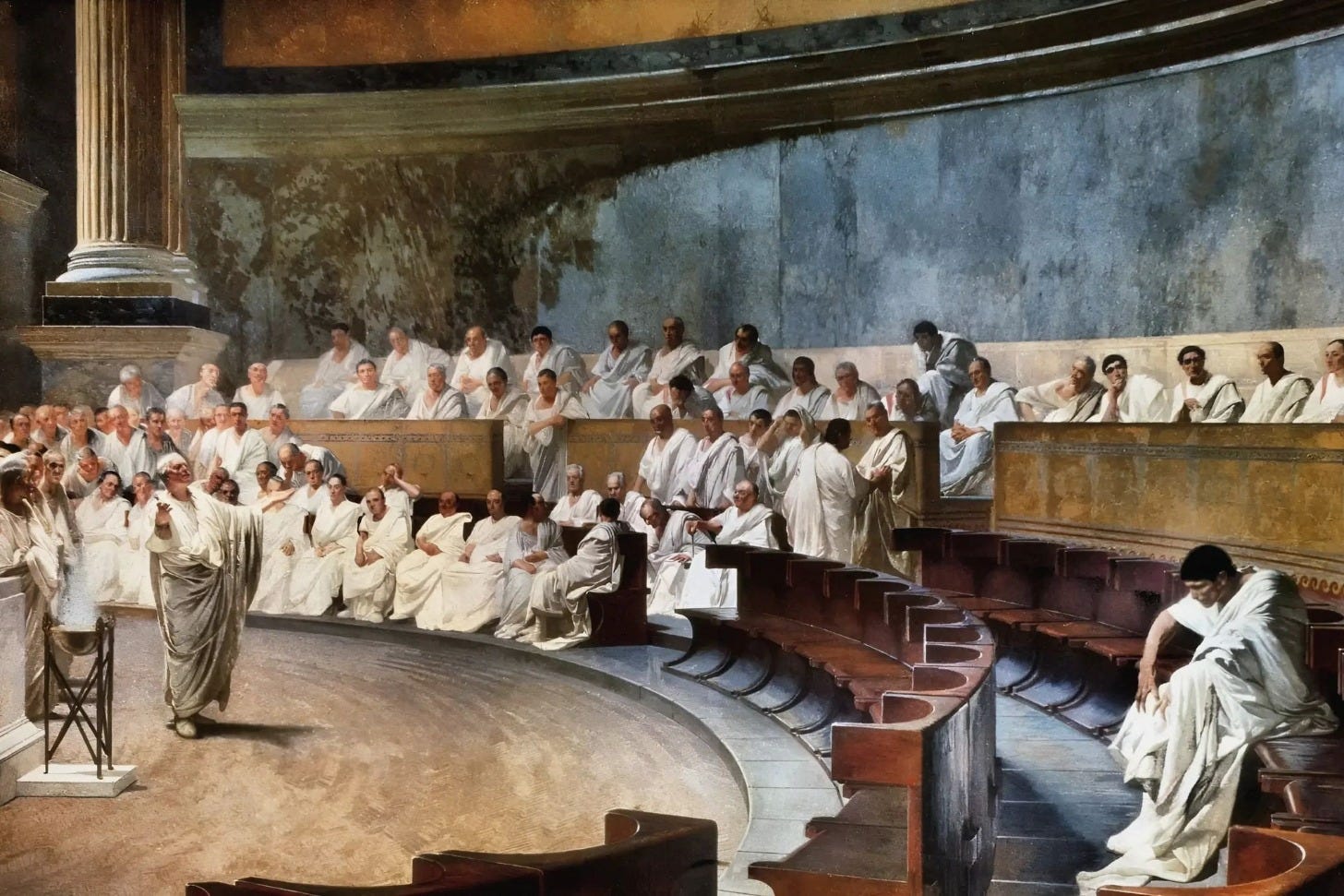
Cicero Denounces Catiline | Cesare Maccari, 1888
Why did the Romans, who swore never again to have a king, accept an emperor?
Key Terms for this Lesson
Republic · Senate · Pax Romana
Kings & the Republic | 753–264 BCE
Ancient Rome is divided into three ages: the Monarchy, the Republic, and the Empire. By Roman tradition, Rome was founded in 753 BCE by a tribe of farmers and herdsmen known as the Latins. To their north lived the Etruscans, who (tradition says) gave Rome its last kings. The Latins, now called Romans, learned from the Etruscans’ organizational structure and grew more powerful themselves. In 509 BCE (the traditional date), they drove out their last king, Tarquin the Proud.
Like Athens, which had driven out its tyrant the year before (cf. Sec. 6.1), Rome would rule itself without a king. The historian Livy (d. 17 CE) says the first consul, Brutus, “made them take an oath that they would not suffer any man to reign in Rome” (2.1, trans. Canon Roberts).
What replaced the king was a Republic, from the Latin res publica, “the public thing.” Two consuls, elected for one year, led the city and its armies. The Senate, a council of some 300 elders drawn at first from the old aristocratic families (the patricians), advised them and held the purse. Assemblies of citizens elected the magistrates and passed the laws, and they all met in the Forum, the city’s central public square. The time of the Roman Republic was noted for its struggle for political equality. The commoners (the plebeians) won their own officers, the tribunes, and a written code of law (cf. Sec. 8.6), and by the Hortensian Law (287 BCE), the plebeians’ own council could pass laws binding on every Roman. Rome was not a democracy like Athens, since its votes were weighted by wealth, but it was a constitution of shared power. It lasted nearly five hundred years.
Conquest & Civil War | 264–31 BCE
• 264 BCE | The Punic Wars with Carthage begin
• 146 BCE | Rome destroys Carthage and takes Corinth
• 49 BCE | Julius Caesar crosses the Rubicon
• 44 BCE | Caesar is assassinated on the Ides of March
• 31 BCE | Octavian wins the Battle of Actium
The Republic conquered the Mediterranean. In the 3rd and 2nd centuries BCE, Rome fought three wars against Carthage, a Phoenician colony in North Africa, beginning over the island of Sicily. These were the Punic Wars (264–146 BCE), from Punicus, the Latin word for Phoenician. In 146 BCE, Rome destroyed Carthage, and in the same year it captured Corinth (cf. Sec. 7.1).
But victory enriched a few men and armed them. Plunder and new provinces made a wealthy business class (the equestrians), while many small farmers lost their land as their sons fought abroad. Generals began to raise armies loyal to themselves rather than to the Senate. During the final century of the Republic (133–31 BCE), repeated power struggles between generals, Pompey (d. 48 BCE) and Julius Caesar (d. 44 BCE) above all, tore the Republic apart. In 49 BCE, Caesar led his army across the Rubicon (the river bounding his province), and civil war began. The Senate made him dictator for life in 44 BCE. A month later, senators who missed their power assassinated him at a meeting of the Senate on March 15, the Ides of March. Caesar’s adopted heir, Octavian, then defeated Mark Antony and Cleopatra of Egypt at Actium in 31 BCE.
Augustus & the Pax Romana | 27 BCE–476 CE
In 27 BCE, Octavian took the name Augustus (d. 14 CE) and became the first emperor of Rome, though he never called himself a king. He was the princeps, the “first citizen,” and he kept the Senate, the consuls, and the elections. In his own account of his reign, the Res Gestae (“Things Accomplished”), set up in bronze before his tomb, he said he had given the Republic back:
In my sixth and seventh consulships, when I had extinguished the flames of civil war, after receiving by universal consent the absolute control of affairs, I transferred the republic from my own control to the will of the senate and the Roman people. … After that time I took precedence of all in rank, but of power I possessed no more than those who were my colleagues in any magistracy. Res Gestae (34, trans. Frederick W. Shipley)
Augustus kept the forms of the Republic and the command of the armies, and a people worn out by a century of civil war let him. He did not want to be known as a war hero, despite the fact that his rise to power was undeniably bloody. Instead, he wanted to be remembered as the leader who brought peace and splendor to Rome, and he boasted that he had found Rome “built of brick and left it in marble” (Suetonius, Augustus 28.3, trans. J. C. Rolfe). He presided over one of the most peaceful and prosperous empires of its time. His reign began the Pax Romana, the “Roman Peace,” some two centuries (27 BCE–180 CE) of relative peace across the Mediterranean world. Roads, one coinage, and Roman law bound it together from Britain to Syria.
After the Pax Romana, the Western Empire lasted three more centuries, and it fell for a complex series of reasons. The army was too small for the size of the empire, so it often relied on mercenary troops who were not loyal to the interests of Rome. The emperors raised taxes, but because the value of their money kept falling, the attempt was worthless. In 410 CE, the Visigoths sacked Rome itself. In 476 CE, a Germanic general deposed the last emperor in the West, a boy who bore the names of Rome’s founder and its first emperor: Romulus Augustulus, “little Augustus.”
Sec 8 • The Romans
8.1 History & Politics • From Republic to Empire
8.2 Religion • Household Gods & the Imperial Cult
8.3 Literature & Drama • The Aeneid & Roman Satire
8.4 Art & Architecture • Aqueducts & Arches
8.5 Music • The Water Organ & the Arena
8.6 Philosophy • Stoicism & Roman Law
Course Page: Humanities I & II